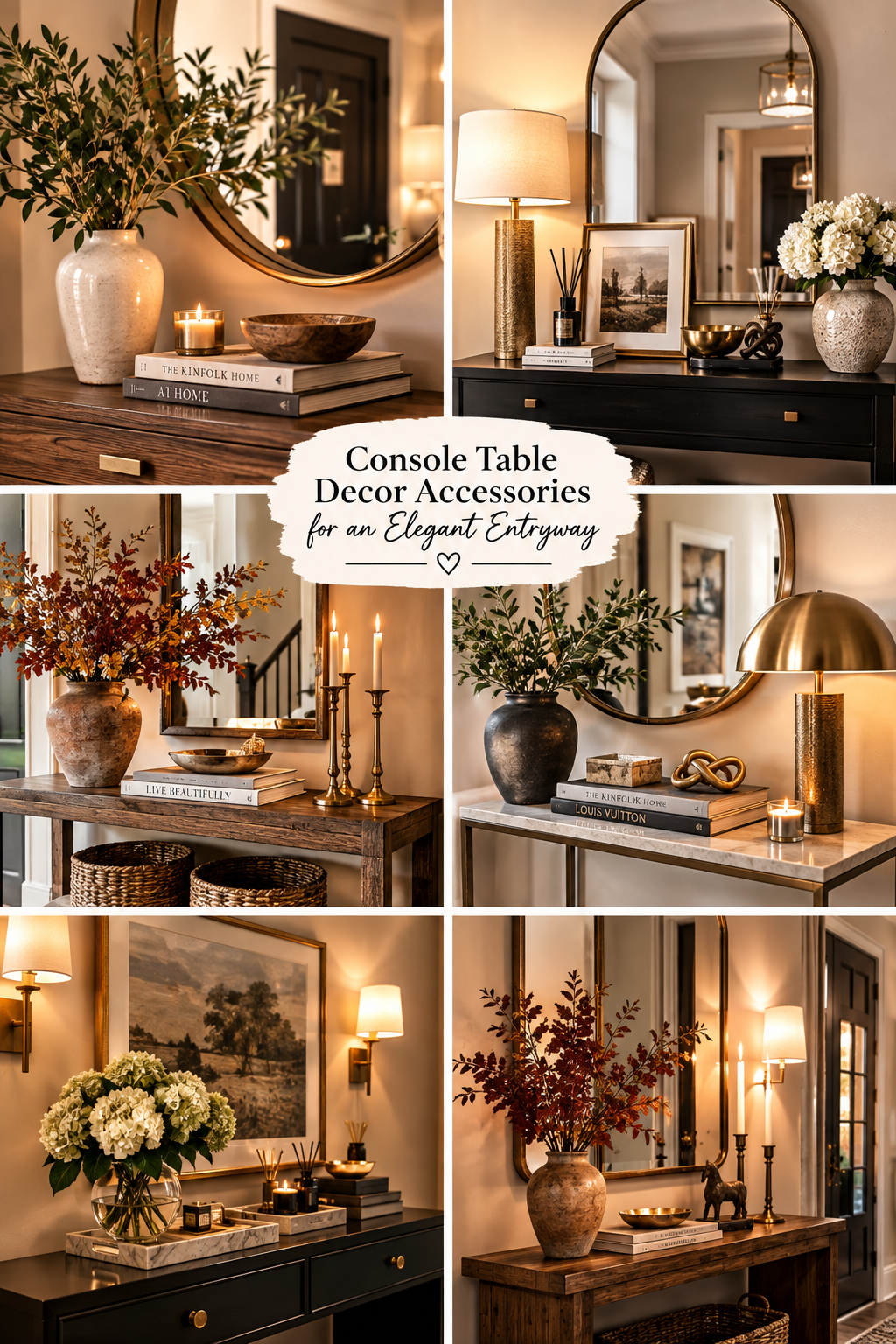
An entryway may be one of the smallest areas in a home, but it has an outsized effect on how the entire house feels. It is the first space you see when you arrive home, the first area guests experience, and often the transition point between the outside world and your private living spaces.
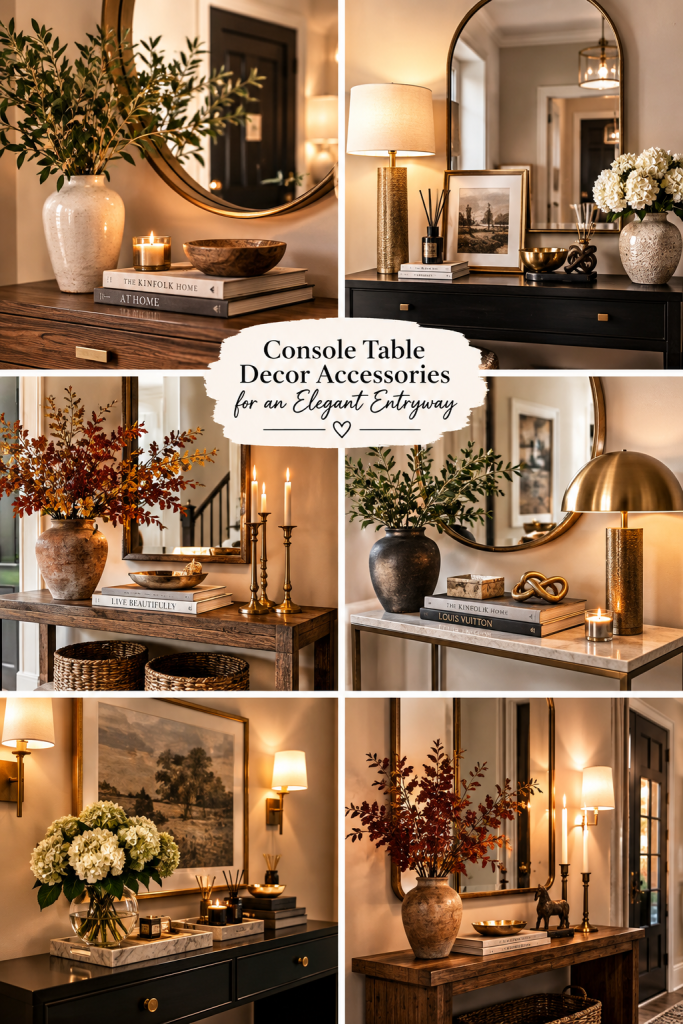
That makes an entryway worth decorating intentionally.
A console table is one of the easiest ways to give this area structure. It fills an empty wall, provides a convenient surface for everyday items, and creates a natural place to introduce the colors, materials, and personality found throughout the rest of the home.
But an elegant console table does not require dozens of decorative objects.
In fact, the opposite is usually true.
A successful arrangement depends more on selection and proportion than quantity. One beautiful mirror can have more impact than a crowded gallery wall. One sculptural lamp can make a stronger statement than several small accessories. A carefully chosen tray can make everyday keys and sunglasses feel organized rather than messy.
Current entryway styling guidance continues to emphasize this balance between decoration and function. Designers are recommending practical catch-all pieces, soft lighting, mirrors, ceramic vessels, natural textures, and personalized objects while discouraging surfaces that become overloaded with small decorative items.
This approach is particularly useful for modern homes because entryways need to look beautiful while still handling real life.
Keys need somewhere to go.
Mail needs to be controlled.
Small personal belongings inevitably arrive at the front door.
The console table should accommodate those habits rather than fight them.
A decorative tray can provide a landing zone. A bowl can collect keys. A lamp can provide warm evening illumination. A vase can bring height and organic texture. Books can add personality. A sculptural object can introduce an artistic element.
The goal is to make every accessory earn its place.
Another important consideration is scale.
A console table that is beautifully styled with appropriately sized accessories can make an entryway feel polished and intentional. The same table can feel cluttered if it is covered with objects that are all the same size or competing for attention.
The wall above the table matters just as much as the tabletop.
A mirror or artwork establishes the vertical focal point, while the objects below create a visual connection between the wall and furniture. Together, they form one composition rather than two separate decorating projects.
For smaller entryways, restraint becomes even more important. A narrow console should not be overwhelmed by oversized accessories, and the walking path should remain comfortable. A slim table paired with a mirror, one tall accessory, a functional tray, and a little greenery can be enough to make a compact foyer feel complete.
Larger entryways offer more freedom, but even a wide console does not need to be filled from end to end. Empty space helps important pieces stand out and preserves the practical purpose of the surface.
The most elegant entryways also tend to feel personal.
They are not simply collections of things that look good together. A framed photograph, vintage object, handmade ceramic piece, travel find, or favorite book can give the arrangement a sense of history and individuality.
The following ten accessories provide a flexible starting point for creating an elegant console table. You do not need every item. Select the pieces that suit your table, entryway, lifestyle, and decorating style.
1. Make a Statement With a Mirror
A mirror is one of the most effective accessories for an entryway console because it combines decoration with everyday function.
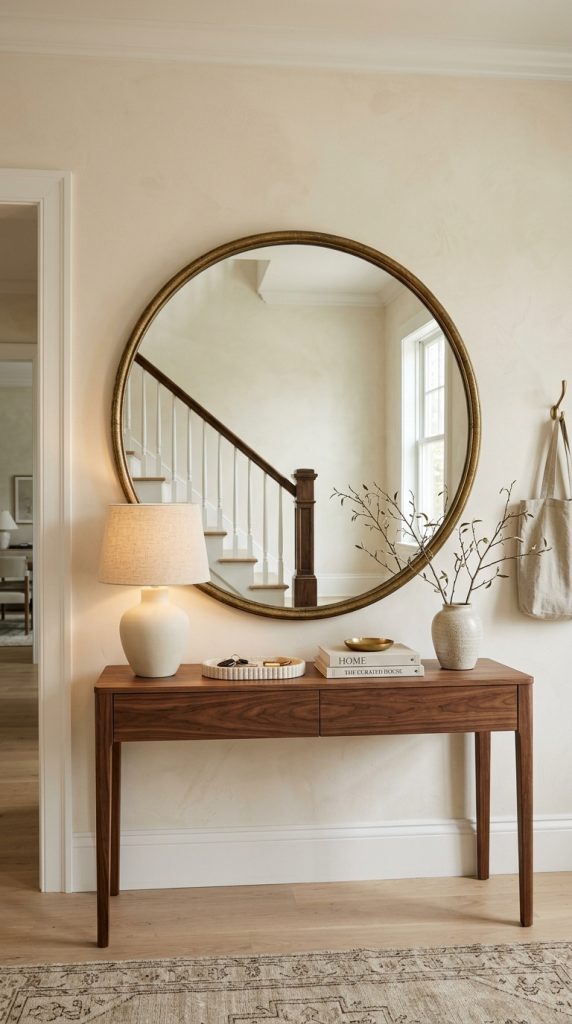
It gives the wall above the console a clear focal point while reflecting available light and creating a greater sense of openness. This can be particularly valuable in narrow hallways, apartments, or entryways without large windows.
The shape of the mirror can influence the character of the entire arrangement.
A round mirror introduces softness and works especially well with rectangular furniture. An arched mirror adds architectural interest and draws the eye upward. A rectangular mirror creates a more structured appearance and can suit contemporary or minimalist interiors.
The frame provides another opportunity to establish the design direction.
Consider warm walnut for an organic interior, aged brass for traditional elegance, matte black for contrast, natural oak for a relaxed look, or champagne-toned metal for subtle sophistication.
The mirror should relate visually to the console rather than appear disconnected from it. A useful starting point is a mirror that is somewhat narrower than the console, allowing the furniture to remain visually grounded.
Instead of surrounding a large mirror with numerous wall decorations, allow it to function as the primary focal point.
The simpler surrounding wall often makes the mirror feel more substantial.
A mirror can also be positioned strategically to reflect a window, attractive artwork, architectural feature, or light source. This adds depth without requiring additional decoration.
2. Introduce a Sculptural Table Lamp
A table lamp is both a practical lighting source and a decorative accessory, making it particularly valuable on an entryway console.
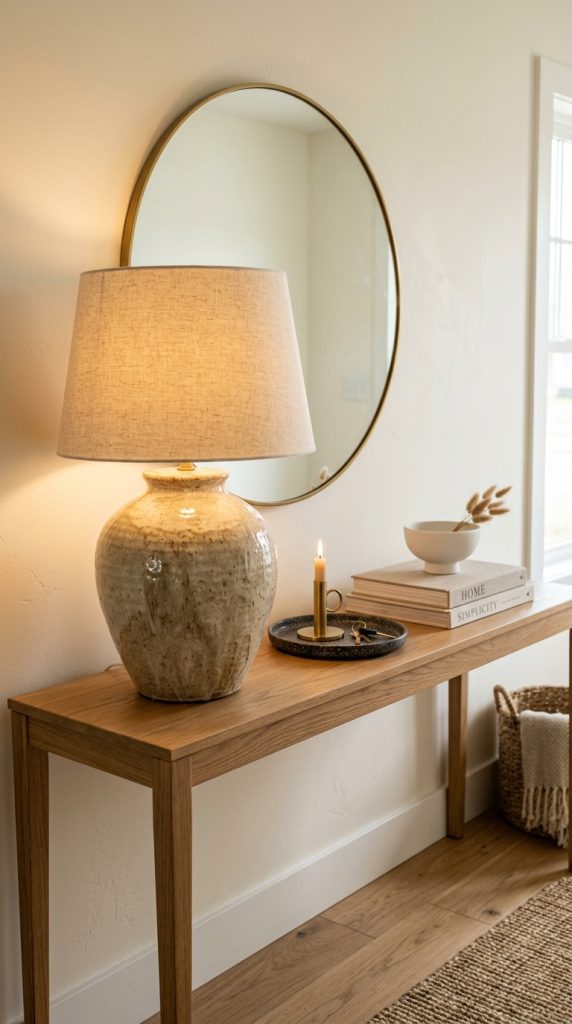
During daylight, the lamp contributes shape and material. In the evening, it creates a warm pool of light that makes the entryway feel more welcoming.
Current design advice increasingly favors decorative lamps and layered lighting instead of relying exclusively on overhead fixtures. Sculptural lamps can provide warmth while also functioning as an intentional design feature.
The lamp itself can establish the mood.
A ceramic lamp feels soft and handcrafted.
A stone or plaster-style lamp suits organic modern interiors.
A brass base introduces warmth.
A linen shade creates a relaxed, timeless appearance.
A dark sculptural lamp can provide contrast against a light console or wall.
For a narrow console, choose a lamp with a relatively compact footprint. A wider console can support a more substantial design or even a pair of lamps.
One lamp works especially well with an asymmetrical arrangement, allowing the opposite side of the table to contain a vase, books, or another lower object.
Warm-toned lighting is generally more inviting in an entryway than harsh, cool illumination. The lamp should illuminate the surrounding area without producing uncomfortable glare in the mirror.
The best lamp is one that looks intentional even when it is switched off.
3. Add a Decorative Tray for Everyday Function
A decorative tray is one of the most useful accessories you can add to an entryway console.
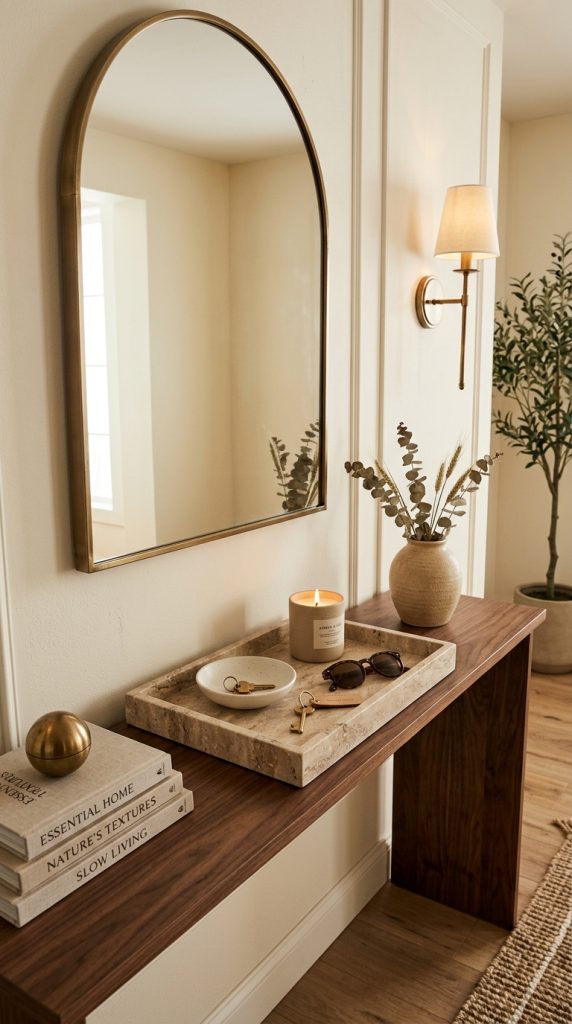
Its primary purpose is organization, but it can also strengthen the visual composition.
Keys, sunglasses, wallets, small accessories, and other daily necessities tend to spread across an unstructured surface. A tray creates a defined zone for those objects.
This means the console can remain functional without looking like a storage station.
The material of the tray can also introduce contrast.
A wooden tray works naturally with walnut or oak.
A stone tray adds sophistication.
A brass tray creates a subtle glamorous accent.
A woven tray introduces warmth and texture.
A lacquered tray can complement a more polished contemporary interior.
A shallow catch-all bowl can be placed inside the tray or used independently for keys and loose items.
The important distinction is between organized function and accumulated clutter.
The tray should not become a container for every object that enters the house. Give it a clear purpose and remove items that do not belong there.
This is one of the simplest ways to make an elegant entryway practical enough for everyday use. Designers continue to recommend trays and catch-all bowls as stylish ways to control loose belongings.
4. Bring Height With a Ceramic Vase and Branches
A tall vase provides vertical interest and gives a console table a natural focal element.
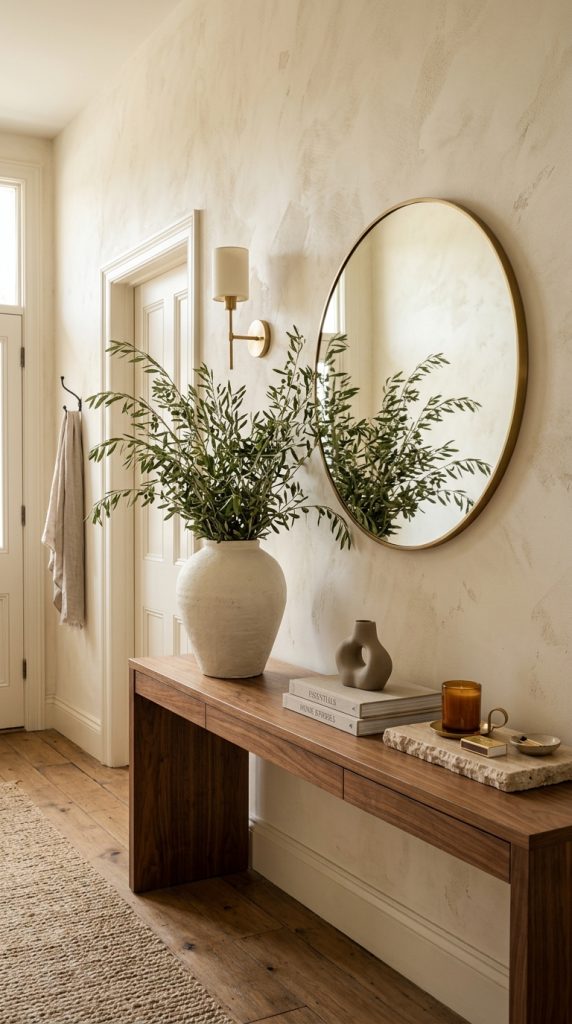
Ceramic is particularly versatile because it can look sophisticated without feeling overly formal.
Choose a vessel with a shape that complements the furniture rather than competing with it.
A handmade-looking ceramic vase can add character to a modern wood console. A smooth stone-colored vessel works beautifully in minimalist interiors. Dark ceramic provides contrast against pale walls, while warm white can maintain a softer neutral palette.
Instead of filling the vase with an enormous bouquet, consider a smaller arrangement of branches.
Suitable options include:
- olive branches
- eucalyptus
- dried grasses
- delicate flowering branches
- preserved greenery
- seasonal foliage
The slightly irregular shapes of branches create movement and keep the arrangement from appearing overly manufactured.
A tall vase is especially useful when the console itself is low or visually horizontal.
It introduces another vertical layer without requiring additional wall decoration.
Keep the arrangement proportionate to the table. The vase should have enough presence to be noticed while leaving enough visual room for the other accessories.
5. Layer Two or Three Books
Books add personality while also providing a practical styling layer.
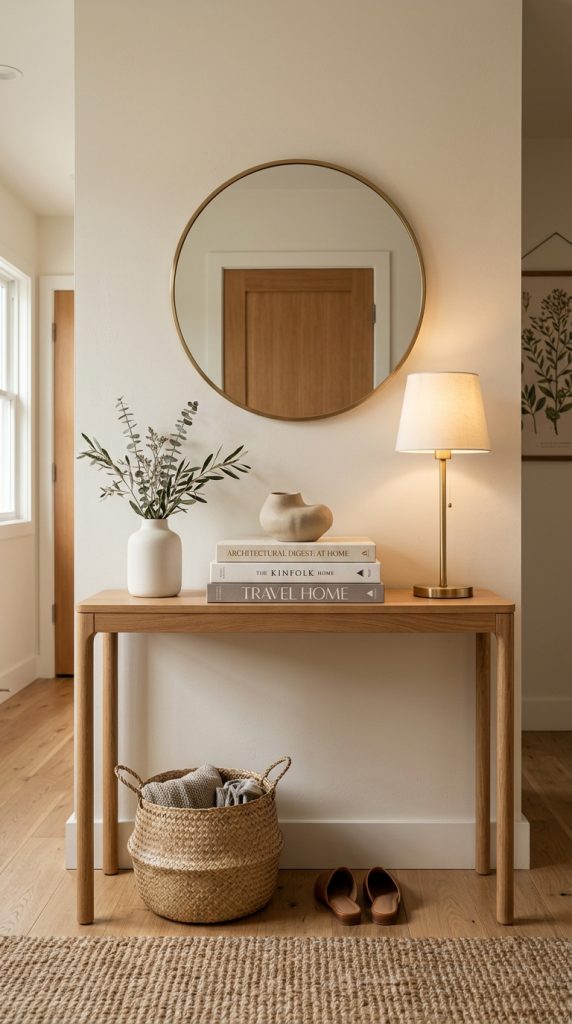
A small horizontal stack can raise a decorative object, create visual weight, or bridge the height difference between larger and smaller accessories.
Choose books that you genuinely enjoy whenever possible. Their presence should make the entryway feel lived-in rather than staged.
Neutral covers work particularly well in elegant interiors:
- cream
- beige
- warm brown
- charcoal
- black
- muted green
- soft taupe
Two or three books are generally enough.
A small ceramic object, candle, or decorative bowl can sit on top of the stack.
Books are especially useful when the other accessories are tall. They introduce a lower horizontal layer that keeps the composition from becoming a collection of vertical objects.
They can also connect the entryway to the personality of the people who live in the home.
6. Add One Sculptural Object
A single sculptural object can prevent an elegant console from feeling too predictable.
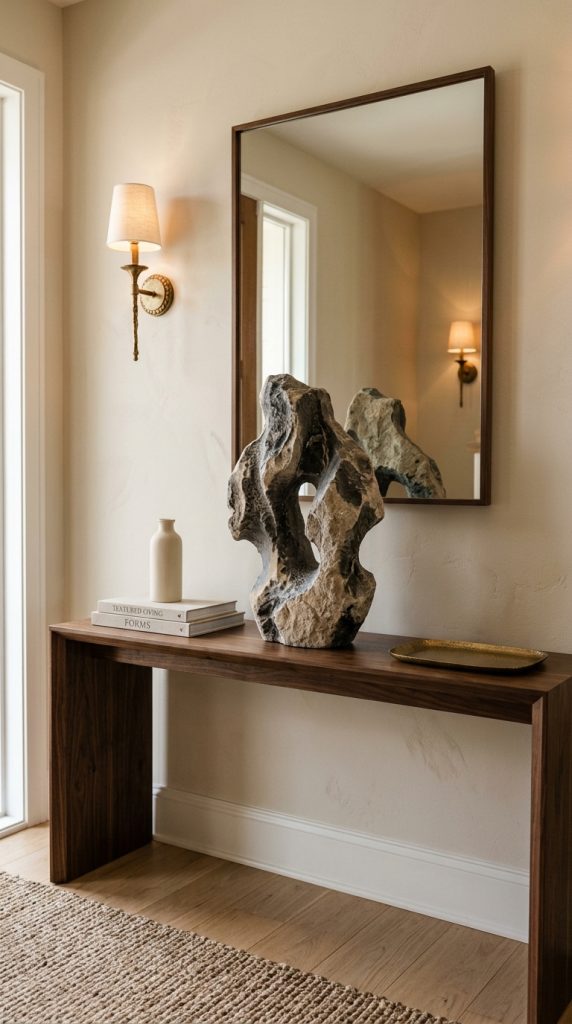
This could be an abstract ceramic form, stone sculpture, wooden object, metal shape, architectural piece, decorative knot, or handcrafted vessel.
The purpose is not necessarily to communicate a particular theme.
Instead, look for something with an interesting silhouette.
Shape can become the decoration.
If your console has straight architectural lines, a rounded sculpture can soften it. If you already have a round mirror, a more angular object can provide contrast.
The material can introduce another layer of texture.
Stone feels grounded.
Wood feels warm.
Metal adds structure.
Ceramic feels artistic and tactile.
Glass can provide lightness.
One strong sculptural piece is usually more effective than several small decorative objects competing for attention.
Let the sculpture provide personality without asking it to share the spotlight with too many other statement pieces.
7. Add a Candle for Warmth and Atmosphere
A candle is a small accessory that can have a surprisingly strong effect on an entryway.
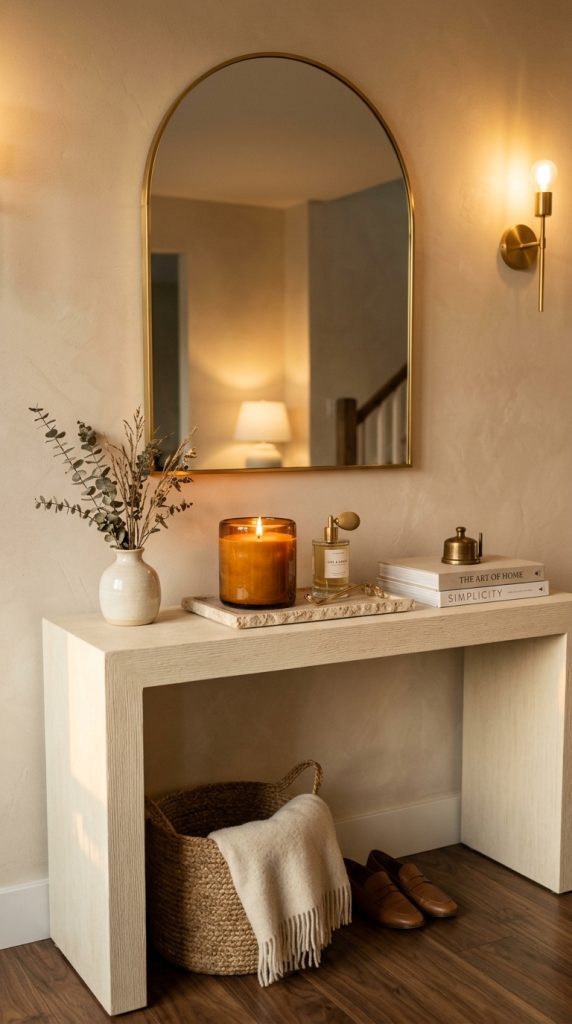
Its container contributes to the visual design, while its fragrance can influence how the home feels when someone enters.
For a refined arrangement, consider candles housed in ceramic, amber glass, stone, brass, or other understated vessels.
Warm scents such as cedar, sandalwood, amber, fig, vanilla, or bergamot can create an inviting atmosphere.
Choose one fragrance direction rather than combining several strong scents in a small space.
The candle can sit directly on the console, on top of a small stack of books, or inside a decorative tray.
A candleholder can also function as a sculptural accessory even when no candle is burning.
If you prefer not to use an open flame in an entryway, a high-quality flameless candle can provide a similar visual effect.
Always keep real candles away from curtains, branches, paper, and other combustible materials.
8. Include One Personal Object
A polished entryway should still feel like someone’s home.
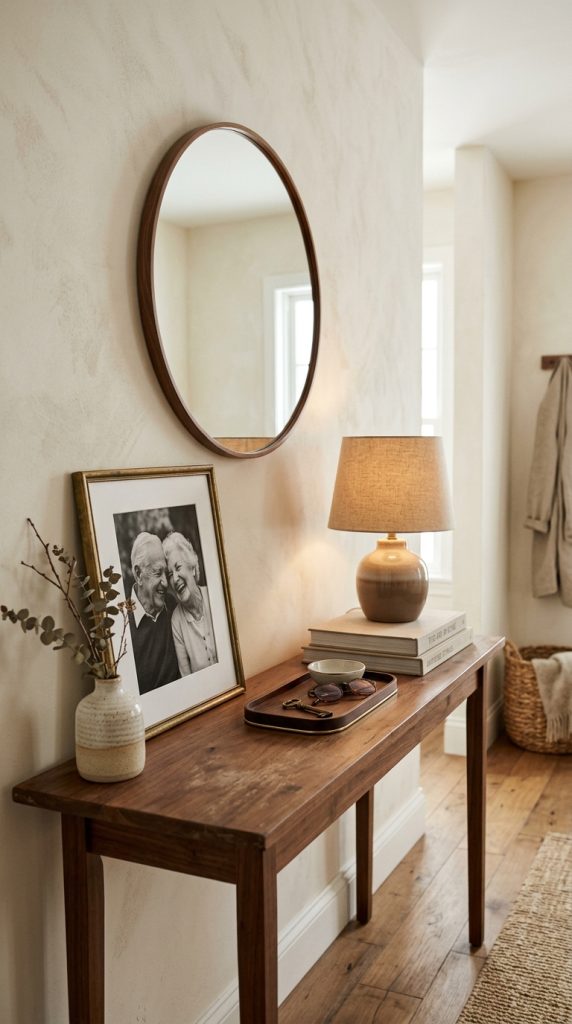
One personal object can make a major difference.
Consider displaying:
- a framed photograph
- a small travel souvenir
- an inherited object
- handmade pottery
- a favorite book
- a vintage box
- a small artwork
- a meaningful sculpture
The goal is not to turn the console into a family archive.
One carefully selected object can communicate more personality than a collection of unrelated pieces.
A framed photograph can be particularly effective when the frame connects with another material in the entryway.
Walnut can echo a wooden console.
Brass can connect with lighting.
Matte black can repeat hardware.
Natural oak can complement flooring.
This creates continuity while allowing the personal object to remain individual.
9. Add a Small Plant or Natural Greenery
Greenery introduces life and softness into an entryway.
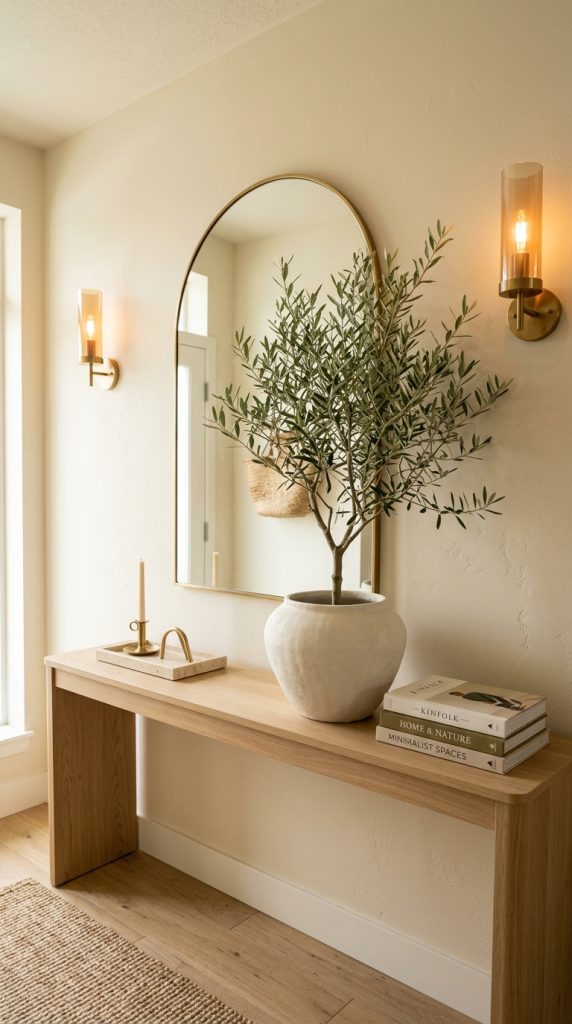
If the area receives enough natural light, a small living plant can work beautifully. In darker spaces, preserved, dried, or high-quality faux greenery can provide a similar visual effect without demanding unsuitable growing conditions.
Choose greenery according to the scale of the console.
A small table does not need an enormous plant.
A larger console can support a more substantial arrangement.
The container is also part of the design.
A ceramic planter creates a clean, sophisticated look.
A woven vessel introduces natural texture.
A stone pot reinforces an organic palette.
Greenery is particularly effective when the console contains hard materials such as marble, glass, metal, or polished wood. The organic shapes soften those surfaces.
You can also use greenery to connect the entryway with other rooms. If olive branches, eucalyptus, or muted greenery appear elsewhere in the home, repeating them near the front door can create visual continuity.
10. Complete the Arrangement With a Layered Composition
The final accessory is not necessarily a physical object.
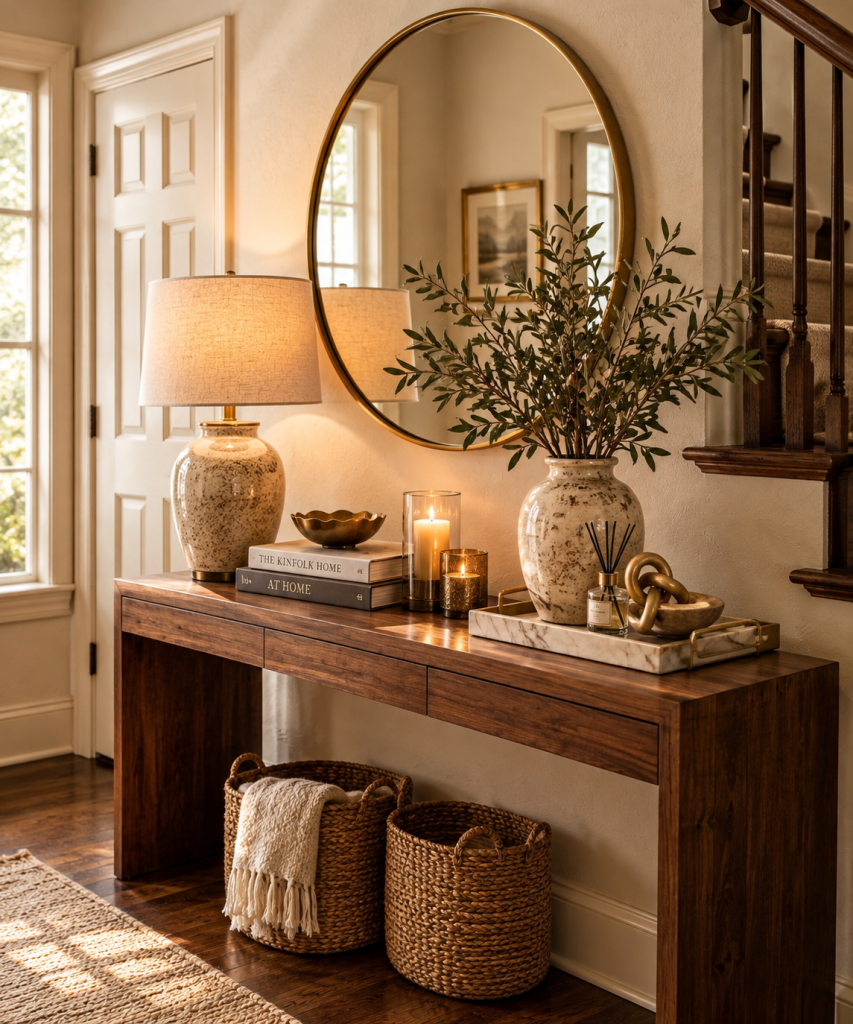
It is the way everything works together.
Once the mirror, lamp, tray, vase, books, sculpture, candle, personal piece, and greenery have been considered, select only the pieces that genuinely improve the arrangement.
The goal is a composition with different visual levels.
A typical combination might include:
Tall: lamp or vase
Medium: books or framed object
Low: tray, bowl, or candle
This creates movement across the tabletop.
A symmetrical arrangement can work beautifully in traditional interiors, particularly when using matching lamps on both sides.
An asymmetrical composition often feels more relaxed and contemporary.
For example, place a lamp on one side, a small stack of books toward the center, and a low tray or bowl on the opposite side.
The mirror or artwork above can remain centered.
The arrangement does not need mathematical symmetry.
It needs visual balance.
A darker object can carry more visual weight than a lighter object of the same size. A large lamp may balance several smaller accessories. A substantial vase may require fewer surrounding objects.
Step away from the console after arranging it and look at the entire wall rather than only the tabletop.
That broader view makes it easier to see whether the composition feels balanced.
Universal Styling Rules for an Elegant Console Table
Rather than repeating the same styling advice for every accessory, use these universal principles throughout the entire arrangement.
Start With One Strong Vertical Anchor
Begin with the wall.
A mirror or large piece of artwork establishes the primary focal point and gives the console a sense of scale.
A useful starting point is an anchor that is narrower than the console so the furniture remains visually grounded. Recent console-styling guidance similarly recommends treating the mirror or artwork and console as one composition rather than unrelated pieces.
Create Three Height Levels
Avoid placing accessories in one flat row.
Combine:
- one tall element
- one medium layer
- one low element
A lamp or vase can provide height. Books or a framed object can occupy the middle layer. A tray, bowl, or candle can create the lowest level.
This simple variation gives the eye somewhere to move.
Give Function a Dedicated Zone
Because the entryway is a working space, reserve part of the console for everyday necessities.
A tray or bowl can contain keys, sunglasses, and other small items.
If shoes, bags, or coats tend to collect nearby, consider baskets, drawers, hooks, or another dedicated storage solution rather than forcing the tabletop to handle everything. Current entryway guidance emphasizes combining decorative styling with practical storage to prevent everyday clutter.
Keep Materials Related
You do not need everything to match.
Instead, repeat a few materials or finishes.
For example:
Walnut + ceramic + aged brass
Oak + linen + stone
Black + ivory + wood
Marble + bronze + glass
Repeating a finish once or twice throughout the entryway creates cohesion without making the room look like a matching furniture set.
Vary Shapes
If every piece has the same silhouette, the arrangement can feel flat.
Combine straight and curved forms.
Pair a rectangular console with a round mirror.
Place a curved vase beside angular books.
Use a sculptural object against a simple architectural frame.
Shape variation creates interest without requiring more accessories.
Leave Meaningful Empty Space
Do not feel obligated to fill every inch.
Empty tabletop space allows decorative objects to remain visible and gives you somewhere to place everyday items.
Recent console-styling guidance commonly recommends leaving a significant portion of the surface open rather than treating the entire table as a display shelf.
If the console feels crowded, remove something before adding anything else.
Consider the Walking Path
The console must fit the architecture of the entryway.
Measure the furniture before purchasing it and make sure doors can open comfortably and people can move through the area without bumping into the table or accessories.
For narrow hallways, shallow consoles and wall-mounted solutions can preserve circulation while still providing the visual effect of an entryway table.
Use Lighting to Finish the Mood
A beautiful console can disappear after sunset if the entryway depends entirely on overhead lighting.
A table lamp, wall sconce, or appropriate cordless light source can provide a softer layer.
Warm illumination is particularly effective when paired with wood, ceramic, linen, brass, or stone.
The lighting should support the arrangement rather than dominate it.
Choose Personality Over Perfect Matching
A home feels more sophisticated when it contains objects with meaning and character.
Mix contemporary pieces with something vintage.
Combine a new ceramic vase with an inherited photograph.
Place a favorite book beside a modern sculpture.
These small contrasts can make the entryway feel collected rather than purchased as a complete set.
Edit Before You Finish
Once the console is styled, look at it from the doorway.
Ask:
- Is there an obvious focal point?
- Can I still use the surface?
- Are the accessories different heights?
- Is anything competing with the mirror or artwork?
- Does the color palette feel connected?
- Does the entryway still feel easy to walk through?
- Does every object have a purpose?
If something feels unnecessary, remove it.
The goal is not to create the fullest possible arrangement.
It is to create the clearest one.
Styling a Narrow Console Table
A narrow console requires particularly careful selection.
Choose pieces with compact footprints and strong vertical presence.
A slim lamp, small tray, narrow vase, and one decorative object may be enough.
Avoid large bowls, oversized sculptures, or accessories that extend into the walking path.
Wall-mounted lighting can be useful when the tabletop is extremely shallow.
The most important rule is to protect circulation.
The entryway should feel open even when the console is fully styled.
Styling a Large Console Table
A large console provides additional surface area, but that does not mean every section needs decoration.
You can introduce a pair of lamps, a larger vase, a substantial tray, or a wider arrangement of books and accessories.
However, preserve visual pauses between groups.
A wide walnut console with two lamps, a large mirror, and one low bowl can feel more luxurious than the same table covered with dozens of objects.
Scale the accessories upward rather than simply increasing their quantity.
Modern Elegant Entryway
For a modern elegant look, focus on clean forms and a restrained palette.
A combination such as walnut, cream, black, brass, and stone can create depth without visual noise.
Choose an oversized round or arched mirror, one sculptural lamp, a ceramic vase, and a simple tray.
Keep decorative objects purposeful.
Texture becomes particularly important when the color palette is minimal.
Ceramic, stone, wood, linen, and woven materials prevent the space from feeling sterile.
Traditional Elegant Entryway
Traditional interiors can support greater symmetry.
Consider a rectangular mirror, paired lamps, a wooden console, brass details, books, and a decorative bowl.
A vintage or antique-inspired accessory can introduce character.
Warm wood and aged finishes usually feel more timeless than an arrangement dominated by glossy, perfectly matching surfaces.
Organic Modern Entryway
Organic modern styling combines clean architecture with natural materials.
Try a natural oak console with a rounded mirror, handmade ceramic vase, branches, stone tray, and linen-shaded lamp.
A palette of cream, sand, taupe, warm brown, natural wood, and muted green creates a calm foundation.
Current interior-design reporting also highlights warm earth tones, tactile materials, meaningful decor, and a mixture of vintage-inspired pieces rather than overly coordinated sets.
Luxury Entryway
Luxury styling is less about expensive accessories and more about proportion, materials, and restraint.
Choose a few substantial pieces.
For example:
- walnut console
- oversized mirror
- sculptural lamp
- stone vase
- aged-brass tray
- two carefully selected books
Keep the surface open.
Use materials that feel tactile and substantial.
Instead of adding more accessories to make the console appear luxurious, allow the quality and scale of the existing pieces to create the effect.
How to Keep the Console Looking Elegant Every Day
Even the most carefully styled console can become cluttered when everyday life takes over.
Create a simple routine.
Keys go into the bowl.
Mail gets removed.
Bags return to their storage area.
Books are straightened.
Decorative pieces return to their original positions.
A tray should control daily objects rather than permanently store everything.
If the same item repeatedly ends up on the console, that is useful information. It probably needs a permanent home nearby.
Good decorating works with your habits instead of constantly requiring you to fight them.
Seasonal Updates Without Redecorating the Whole Table
The easiest way to update a console for the seasons is to keep the main structure unchanged.
Keep the mirror, lamp, and tray.
Change the botanical element, candle, or one decorative object.
For fall, you might introduce dried branches, amber glass, warm brown ceramics, or muted rust tones.
For winter, use evergreen branches, darker vessels, or subtle metallic accents.
For spring, choose lighter greenery and softer ceramics.
For summer, natural textures and lighter colors can refresh the arrangement.
This approach keeps seasonal decorating sophisticated instead of turning the entryway into a heavily themed display.
Final Thoughts
An elegant console table does not require a large collection of accessories.
It requires thoughtful choices.
Start with a strong mirror or artwork.
Add a lamp or tall vase for vertical interest.
Give everyday objects a home with a tray or bowl.
Introduce books, greenery, a candle, or one sculptural piece for texture and personality.
Then edit.
The most successful console arrangements feel intentional without appearing overworked.
They combine beauty with function.
They provide enough decoration to make the entryway memorable while leaving enough space for everyday life.
Whether your console is a substantial walnut piece in a spacious foyer or a slim table in a narrow hallway, the principle remains the same:
Choose fewer, better-connected pieces and give each one a clear role.
A beautiful entryway does not need to look like a showroom.
It should feel like a natural extension of the home beyond the front door—welcoming, organized, personal, and effortlessly elegant.
Leave a Reply