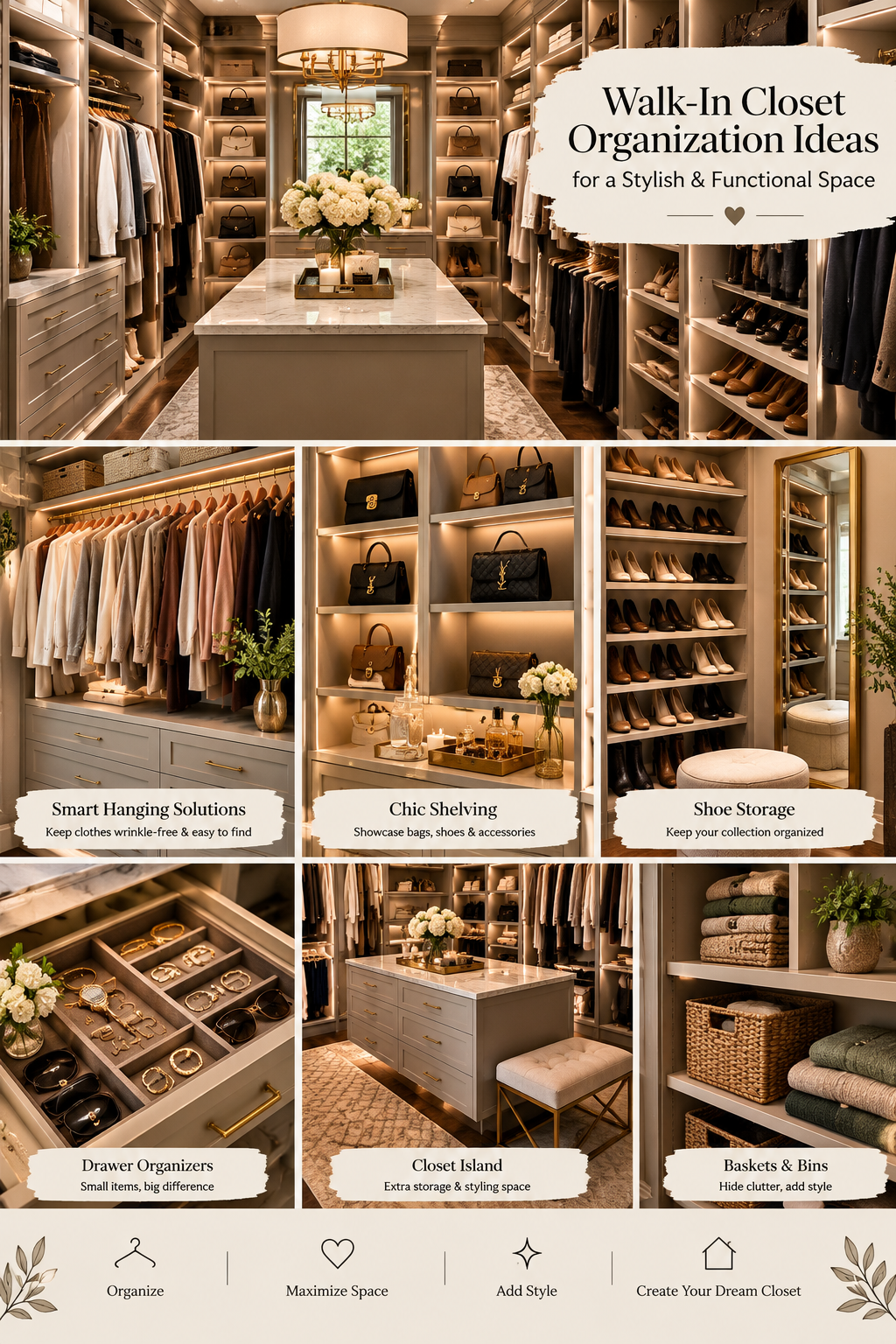
A walk-in closet can be one of the most useful spaces in a home, but having extra square footage does not automatically make a closet organized.
Without a thoughtful system, even a large walk-in can become difficult to navigate. Clothes end up packed too tightly on rods, shoes collect along the floor, handbags occupy random shelves, accessories disappear into drawers, and seasonal pieces take over valuable everyday storage.
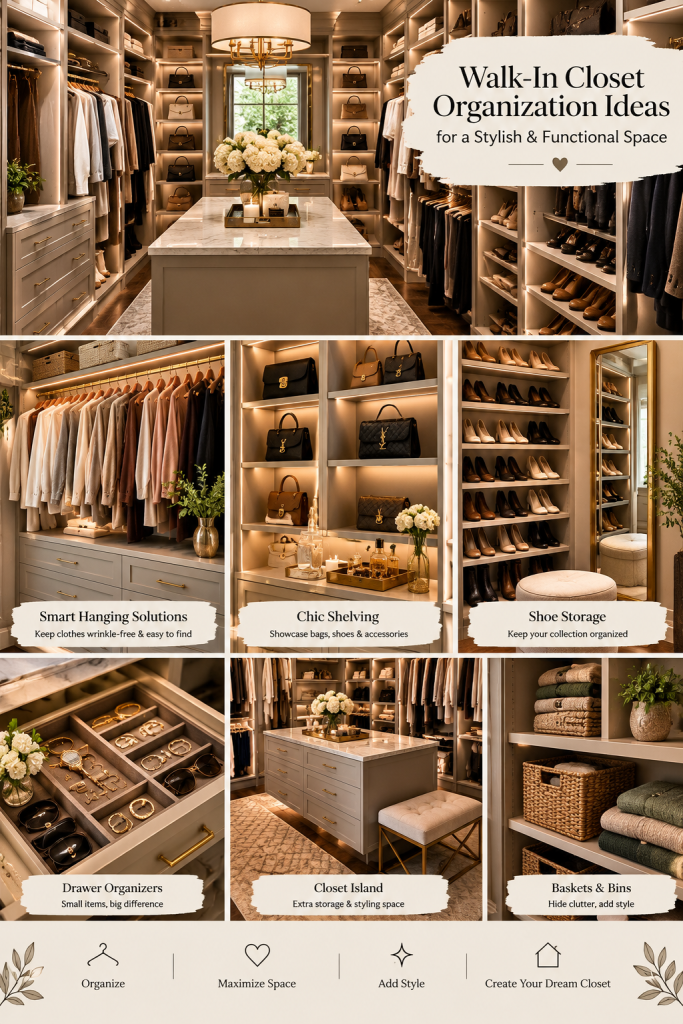
The real goal of a well-designed walk-in closet is not simply to store more things.
It is to make everything easier to see, reach, use, and put away.
A successful closet should support the way you actually get dressed.
If you reach for dresses every morning, they should be easy to access. If you own a large shoe collection, shoes need a dedicated zone. If handbags are important to your wardrobe, they should not be squeezed onto a shelf designed for folded clothing. If you frequently plan outfits in advance, a valet rod or designated outfit-planning area can make the morning routine much easier.
Modern closet design is increasingly moving toward this type of personalized organization. Designers are treating walk-in closets as carefully planned rooms rather than simple storage spaces, incorporating different types of hanging storage, drawers, shelves, lighting, mirrors, islands, and display areas according to individual routines.
Another important change is the growing interest in making closets feel beautiful.
Warm wood finishes, elegant lighting, glass-front storage, decorative hardware, upholstered seating, mirrors, and carefully displayed accessories can turn a practical wardrobe area into something that feels more like a private boutique.
This does not mean every closet needs an enormous island or custom cabinetry.
Even a modest walk-in closet can feel significantly more functional when its storage is divided into clear zones and its vertical space is used efficiently.
For example, double hanging rods can increase hanging capacity without expanding the footprint. Floor-to-ceiling shelving can make use of otherwise wasted upper wall space. Pull-out drawers can make small accessories easier to locate. Shoe shelves can prevent footwear from spreading across the floor. Baskets can contain less frequently used items.
Lighting is equally important.
A poorly lit closet can make organization difficult because colors, textures, and individual pieces become harder to distinguish. Current closet-design guidance recommends layered lighting, including general illumination plus integrated lighting within shelving or cabinets.
A stylish closet also benefits from visual calm.
This does not necessarily mean hiding everything behind doors. Open shelving can work beautifully when it is reserved for frequently used or attractive pieces, while drawers and closed cabinets can conceal items that create visual noise.
The key is assigning every category a logical home.
Once the storage system is planned around your wardrobe, maintaining it becomes much easier.
Before beginning, completely emptying the closet and sorting clothing by category is a useful first step. Organization experts commonly recommend editing the wardrobe before designing the final storage arrangement so that the system reflects what you actually keep and use.
Then think about your closet in terms of zones rather than individual shelves.
Where should everyday clothing go?
Where should formalwear go?
Where will shoes live?
Where should handbags be displayed?
Where will accessories be stored?
Where will laundry go?
Where can you prepare an outfit?
Once these questions are answered, the closet becomes much easier to plan.
Below are ten practical and stylish walk-in closet organization ideas that combine storage efficiency with an elevated interior-design aesthetic.
1. Divide the Closet Into Dedicated Clothing Zones
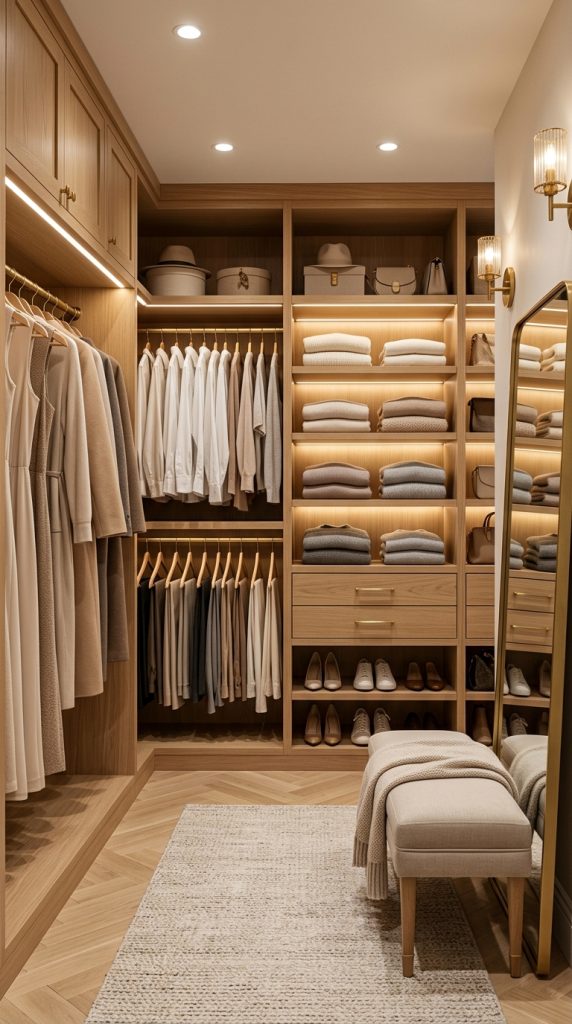
One of the simplest ways to make a walk-in closet easier to use is to divide it into dedicated clothing zones.
Instead of treating every rod and shelf as interchangeable storage, give different parts of the closet specific jobs.
For example, one section can hold dresses and long coats. Another can contain shirts and blouses. A lower hanging section can accommodate pants and skirts. Shelves can be reserved for folded sweaters, denim, or knitwear.
This creates a natural flow.
You know where to look when you need something, and you know where to return it after wearing it.
A useful starting point is to organize clothing according to how you use it, not simply how much of each category you own.
Everyday clothing should occupy the easiest-to-reach areas.
Occasional clothing can be placed slightly higher or farther away.
Special-event pieces can occupy a dedicated section rather than taking up prime everyday space.
Use different hanging heights
A single continuous rod may look simple, but it can waste valuable vertical space.
Double-hanging sections are especially useful for shorter garments such as shirts, blouses, folded trousers, and skirts. Longer sections can be reserved for dresses, coats, jumpsuits, and other full-length pieces.
Using different rod heights allows more clothing to fit within the same wall area.
Current walk-in closet guidance specifically recommends combining storage types and varying rod and shelf heights to make better use of available space.
Organize within each zone
Once clothing is divided by category, you can organize further.
For example, dresses can be grouped by length or occasion.
Shirts can be grouped by sleeve length.
Trousers can be grouped separately from skirts.
You can then use color organization within each category if that makes items easier for you to locate.
The important thing is consistency.
A system only works when you can remember it.
Keep frequently used clothing at eye level
The most accessible areas of the closet should contain pieces you wear regularly.
Upper shelves can hold seasonal clothing, luggage, extra bedding, or other less frequently used belongings.
This creates a natural hierarchy between everyday and occasional storage.
The result is a closet that feels easier to navigate because everything has a logical location.
2. Use Floor-to-Ceiling Shelving to Maximize Vertical Space

The walls of a walk-in closet provide valuable storage capacity, particularly above normal eye level.
Instead of leaving a large empty area between the top shelf and the ceiling, consider extending shelving or cabinetry upward.
Vertical storage is especially helpful when the closet has limited floor space.
Upper shelves can hold:
- seasonal clothing
- handbags
- luggage
- extra blankets
- storage boxes
- special-occasion accessories
- rarely used shoes
- travel items
The key is not to use high shelves for things you need every morning.
Those areas are best reserved for items that can be accessed occasionally.
Use attractive storage containers
Upper shelves can easily become visually messy when they contain a collection of mismatched boxes.
Use coordinated baskets, fabric bins, or storage boxes instead.
Neutral colors such as ivory, beige, taupe, warm gray, or natural woven fibers can create a calmer appearance.
Labels can make less frequently used storage much easier to manage.
For example:
Winter Accessories
Travel
Special Occasion
Seasonal Shoes
Extra Linens
This prevents you from opening every container whenever you need something.
Make vertical storage part of the architecture
Floor-to-ceiling cabinetry can make a closet look more intentional because the storage appears integrated into the room.
Rather than seeing a collection of individual shelves, the entire wall becomes one cohesive storage system.
This approach also reflects a broader design preference for built-in storage that blends with architecture rather than looking like temporary furniture.
Add safe access
If upper storage is difficult to reach, keep a stable step stool nearby.
In larger luxury closets, a rolling library-style ladder can become both a practical feature and an architectural element.
The goal is to make every part of the storage system genuinely usable.
3. Create a Dedicated Shoe Organization Wall

Shoes deserve their own storage strategy because they are awkward to organize with ordinary shelves.
When footwear is scattered across the floor, it immediately makes a walk-in closet feel less organized.
A dedicated shoe wall solves this problem while giving you an opportunity to display your collection attractively.
Adjustable shelves are particularly useful because different types of shoes require different amounts of vertical space.
Flat sandals need very little room.
Sneakers require more.
Ankle boots need additional height.
Tall boots may require an even larger compartment.
Adjust the shelves to the collection
Avoid designing every shoe shelf at exactly the same height.
Adjustable shelves allow you to change the configuration as your collection changes.
This makes the closet more adaptable.
Use the vertical wall
A full-height shoe wall can hold a surprising number of pairs without using much floor area.
For a boutique-inspired appearance, arrange shoes in a consistent direction and leave enough space between pairs so they remain visible.
You can organize them by:
- type
- color
- frequency of use
- season
- occasion
Choose whichever method makes finding your shoes fastest.
Use lower storage for everyday shoes
Shoes you wear frequently can remain within easy reach.
Special-occasion footwear can be placed higher.
Seasonal shoes can move into upper storage or clearly labeled boxes.
This keeps the most useful footwear accessible without sacrificing capacity.
Add lighting carefully
If your shoe shelves are open, integrated LED lighting can make the collection easier to see.
Lighting positioned inside or beneath shelving can create a subtle boutique effect while improving functionality.
Architectural Digest notes that retail-inspired lighting is becoming an important part of modern closet design because integrated lighting can enhance the visibility of clothing, shoes, colors, and textures.
4. Organize Handbags and Accessories Like a Boutique Display
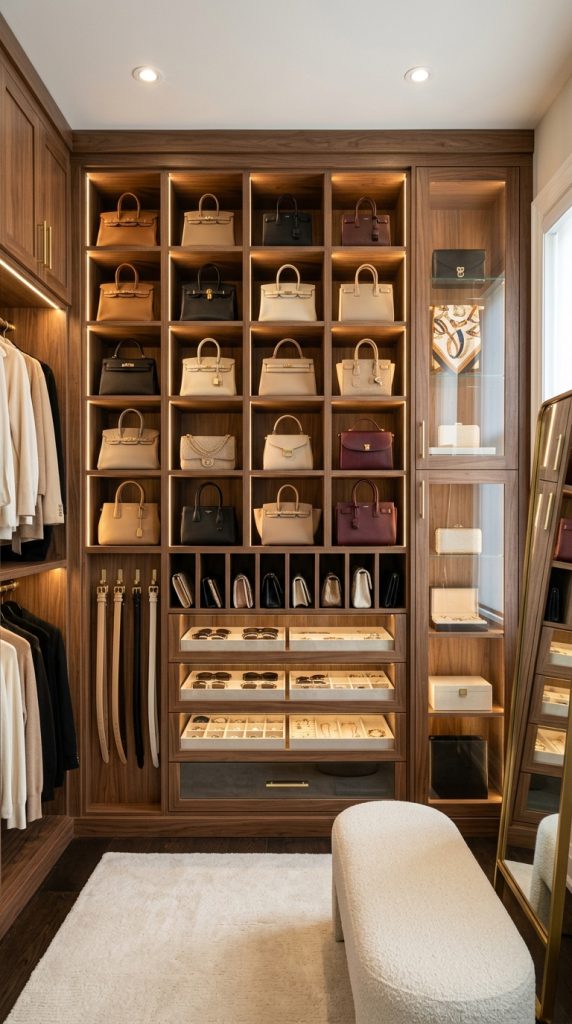
Handbags, belts, scarves, hats, and other accessories are often difficult to store because they have different shapes and sizes.
Instead of forcing all of them into one drawer or shelf, create smaller dedicated zones.
Handbags can be displayed vertically on shelves.
Small purses can stand upright inside cubbies.
Clutches can fit into narrow compartments.
Belts can be stored on hooks or specialized organizers.
Scarves can be folded into drawers or rolled into individual compartments.
Hats can occupy higher shelves or dedicated wall hooks.
Give handbags enough room
Avoid stacking handbags on top of one another if you use them frequently.
When bags are squeezed together, it becomes difficult to see what you own and even harder to remove one without disturbing the others.
Open cubbies can work particularly well for handbags because each item remains visible.
For valuable or delicate pieces, glass-front cabinetry can offer display visibility while providing additional protection from dust.
Protect the shape of bags
Store structured handbags upright when possible.
Use appropriate inserts or tissue material for delicate bags if necessary.
Avoid crushing soft materials under heavier pieces.
Organization should protect your belongings, not simply make them fit.
Create an accessory drawer
Small items such as jewelry, sunglasses, watches, belts, and hair accessories can quickly disappear into large drawers.
Use drawer dividers or shallow compartments to separate categories.
Expandable organizers and adjustable inserts can be particularly useful because they allow storage to change as your collection changes.
Turn beautiful accessories into decor
If you have a few handbags or accessories that are visually appealing, display them intentionally.
A row of neutral handbags against warm wood cabinetry can create a sophisticated boutique appearance without adding decorative clutter.
5. Install Drawer Organization for Small Items
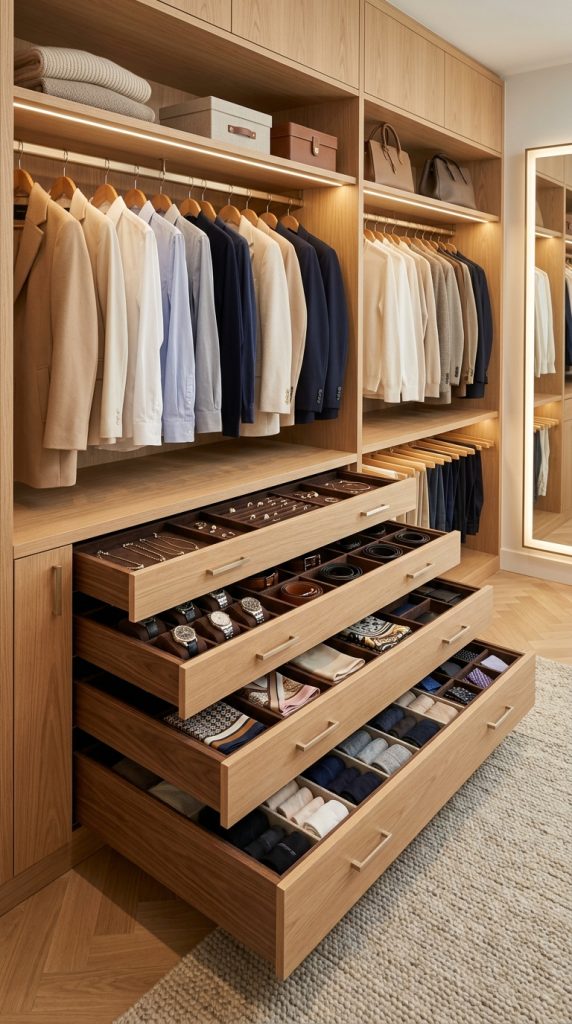
Drawers are essential in a well-organized walk-in closet because they provide a place for smaller items that would otherwise create visual clutter.
They work particularly well for:
- underwear
- socks
- jewelry
- belts
- scarves
- sleepwear
- workout accessories
- small personal items
The key is dividing large drawers into smaller compartments.
Without dividers, even a beautiful drawer can quickly become a tangled collection of unrelated objects.
Use shallow drawers for accessories
Deep drawers are useful for larger folded clothing.
Shallow drawers are better for small accessories because individual items remain visible.
Jewelry can be separated into sections for earrings, necklaces, bracelets, and watches.
Socks can be divided by type.
Belts can be rolled or placed into narrow compartments.
Keep categories together
Avoid creating a system that requires you to remember too many locations.
If all scarves are in one drawer, keep them together.
If all jewelry is in another, keep that category consistent.
The purpose of organization is to reduce mental effort.
Consider soft-close drawers
If you are building a new custom closet, smooth-running drawers with soft-close mechanisms can make the space feel more refined.
They also create a quieter experience, particularly in bedrooms where you may use the closet early in the morning or late at night.
Choose finishes that complement the room
Warm wood drawers can create a furniture-like appearance.
Cream cabinetry can make a smaller closet feel brighter.
Dark cabinetry can create a dramatic boutique atmosphere.
The interior storage does not need to look purely utilitarian.
It can contribute to the design of the room.
6. Add a Center Island When the Space Allows
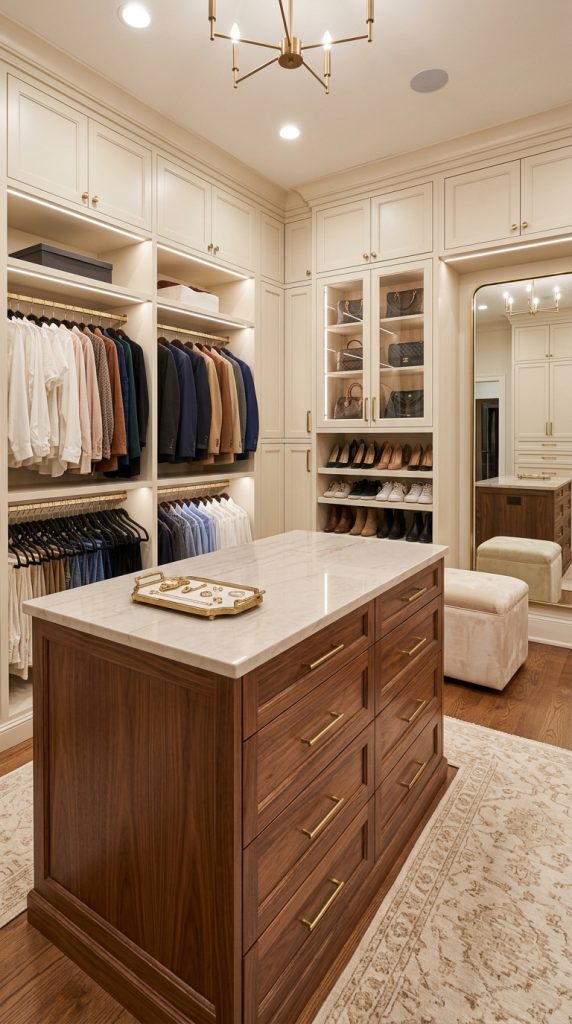
A center island can completely change how a large walk-in closet functions.
It provides additional drawers, a folding surface, and a central visual anchor.
However, an island should only be added when the room has enough circulation space around it.
A beautiful island that makes the closet difficult to walk through is not a successful solution.
The surrounding clearance should be considered before installation. Angi recommends planning sufficient room for comfortable movement through the closet rather than maximizing furniture at the expense of circulation.
Use the island for small storage
The drawers can hold:
- jewelry
- watches
- underwear
- scarves
- accessories
- folded clothing
- small personal items
This frees wall shelving for larger categories.
Create a folding station
A smooth countertop provides a convenient place to fold clothing.
Materials such as quartz, wood, marble-look surfaces, or natural stone can make the island feel like a piece of furniture rather than a basic storage unit.
Add a decorative tray
A small tray on the island can hold perfume bottles, jewelry, or other frequently used items.
Keep the surface mostly open so the island remains useful.
Use the island as a design feature
In a larger closet, the island can introduce a contrasting material.
For example:
Warm oak cabinetry + stone countertop.
Cream cabinetry + walnut island.
Dark cabinetry + light stone.
This adds visual depth without requiring excessive decoration.
7. Create a Dedicated Outfit-Planning Area
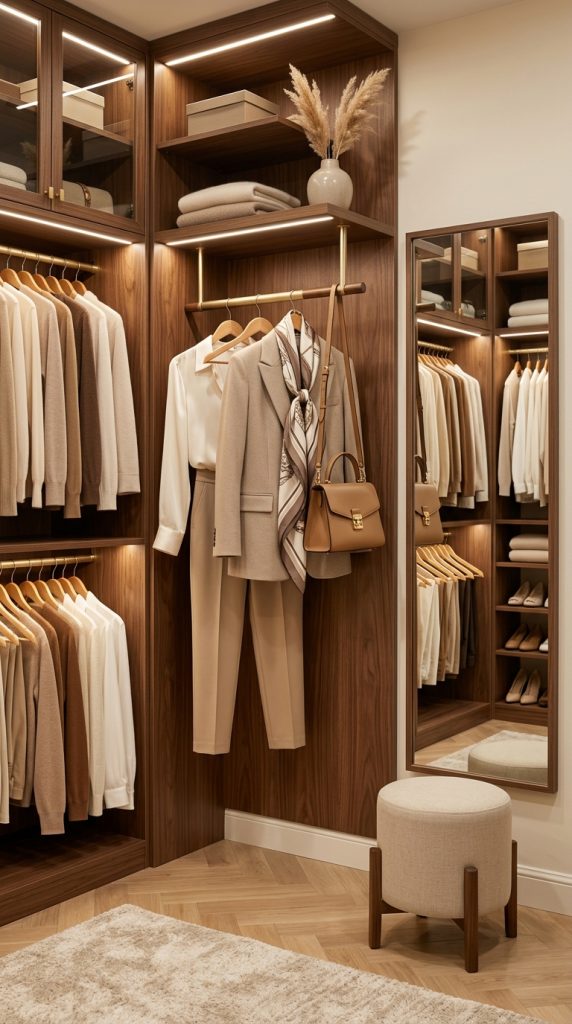
One of the most useful upgrades for a walk-in closet is a small area dedicated to planning outfits.
A simple valet rod can provide a temporary place to hang tomorrow’s clothing.
This eliminates the need to search through the wardrobe in the morning.
A valet rod can hold:
- blouse or shirt
- trousers
- jacket
- dress
- accessories
- scarf
- belt
Current walk-in closet trends include valet rods specifically because they help with outfit planning and temporarily hold prepared clothing without disrupting the main wardrobe.
Add hooks nearby
A few strategically placed hooks can provide another useful temporary storage area.
Use them for:
- tomorrow’s outfit
- recently worn clothing
- robes
- hats
- scarves
Avoid allowing hooks to become permanent dumping points.
Their purpose is temporary organization.
Place a mirror nearby
If space allows, an outfit-planning area works especially well near a full-length mirror.
This creates a small dressing zone within the larger closet.
You can see the outfit, adjust accessories, and return everything to its proper storage location afterward.
Make the area visually distinct
A different wall finish, small bench, or decorative mirror can help establish the dressing zone without requiring a physical partition.
The result feels more intentional and makes the closet function like a private dressing room.
8. Use Layered Lighting to Make the Closet Easier to Use
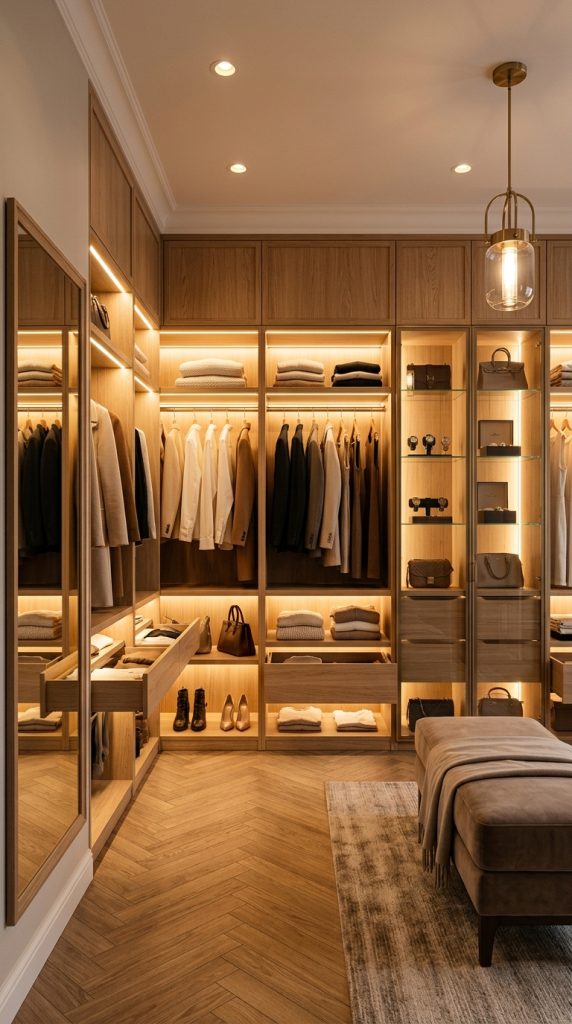
Lighting should be treated as part of the organization system rather than an afterthought.
A closet with excellent storage but poor lighting can still be frustrating.
You need to see:
- clothing colors
- fabric textures
- shoes
- accessories
- drawer contents
- labels
- mirrors
A layered lighting plan can solve this.
Start with general lighting
A central ceiling fixture provides overall illumination.
Depending on the style of the closet, this could be:
- recessed lighting
- a flush mount
- a decorative chandelier
- multiple ceiling fixtures
- a linear light
A decorative fixture can give a large walk-in a more luxurious character.
Add shelf lighting
LED strips beneath shelves or inside cabinets can illuminate dark areas.
This is particularly useful for shoes, handbags, and folded clothing.
Illuminate the mirror
A full-length mirror should be positioned where you can see your clothing clearly.
Additional lighting around the mirror can help eliminate harsh shadows.
Use warm but accurate lighting
A closet should feel inviting, but color accuracy is important.
You want to distinguish black from navy, cream from white, and warm brown from cool brown.
For this reason, lighting quality matters as much as the decorative appearance of the fixture.
Layered lighting is now a major feature in high-end closet design, with integrated shelf illumination being used to make storage both more functional and visually sophisticated.
9. Incorporate a Comfortable Dressing and Seating Area

If your walk-in closet has enough room, a small seating area can make it much more comfortable.
You do not need a full sofa.
A compact upholstered bench, ottoman, stool, or accent chair can be enough.
A seat provides somewhere to:
- put on shoes
- fold clothing
- prepare outfits
- place a garment temporarily
- pause while getting dressed
Choose multifunctional furniture
A storage ottoman can provide seating while hiding additional belongings.
This is particularly useful when the closet has limited space.
Current storage design guidance increasingly emphasizes furniture that performs more than one function, particularly in spaces where square footage needs to work harder.
Match the seating to the closet
For a warm luxury closet, consider:
- cream boucle
- taupe linen
- warm brown leather
- textured beige upholstery
- natural wood
For a contemporary closet, a sculptural stool can provide a cleaner appearance.
Avoid overcrowding
A seat should improve the closet rather than reduce the walking space.
If the room is narrow, choose a compact bench that can sit against the wall when not being used.
10. Create a Boutique-Inspired Display With Warm Wood and Glass
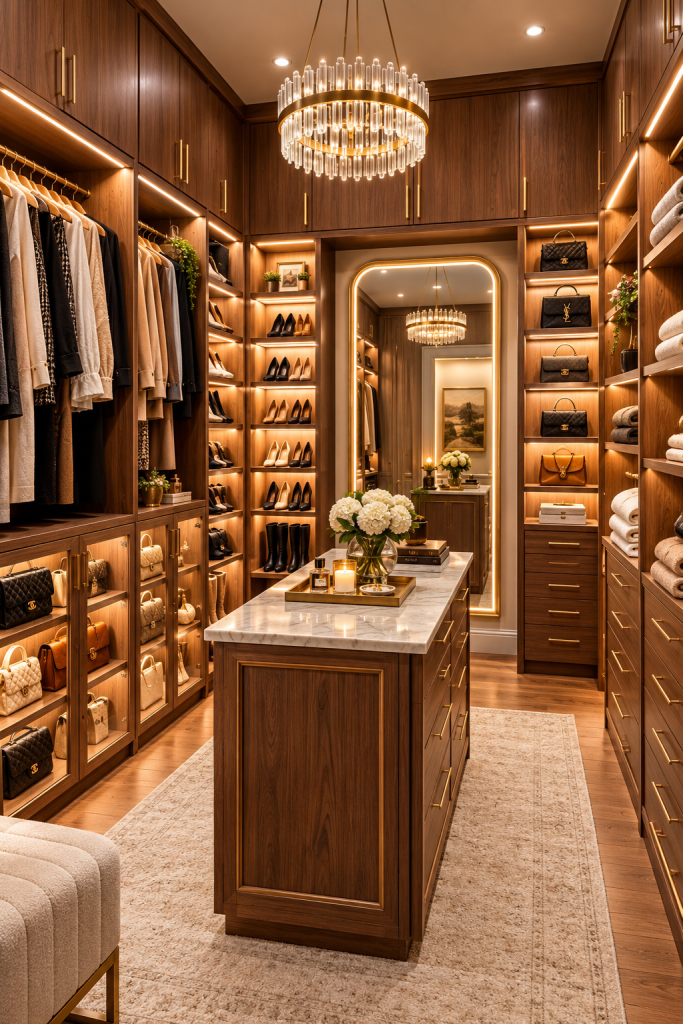
The final step is bringing organization and style together.
Instead of making the closet feel like a utility room, create a boutique-inspired environment where selected clothing and accessories become part of the visual design.
Warm wood is particularly effective for this.
Natural oak and walnut can make storage feel warmer and more furniture-like than stark white cabinetry. Current 2026 closet discussions increasingly highlight warm wood tones as an alternative to purely white storage systems.
Combine open and closed storage
Open shelving is ideal for:
- favorite handbags
- shoes
- folded sweaters
- attractive accessories
Closed cabinetry is better for:
- clutter-prone items
- seasonal belongings
- personal products
- less attractive storage categories
The combination creates visual balance.
Use glass strategically
Glass-front cabinets can display special pieces while protecting them from dust.
Smoked glass can create a more dramatic appearance.
Clear glass keeps the space light and allows the contents to remain visible.
Add a warm material palette
Consider combining:
- natural walnut
- oak
- cream
- brushed brass
- soft beige
- stone
- glass
- subtle black accents
This creates a sophisticated wardrobe environment without excessive decoration.
Let your wardrobe become the decor
Beautiful clothing can contribute to the design.
A carefully arranged row of neutral clothing, coordinated handbags, elegant shoes, and neatly folded knitwear can create the visual richness of a boutique.
The key is organization.
Once everything is arranged intentionally, the wardrobe itself becomes part of the room.
How to Organize a Small Walk-In Closet
A small walk-in closet needs a different strategy from a large dressing room.
The priority should be capacity without crowding.
Start by using the walls efficiently.
Double-hanging rods can create additional hanging capacity.
Floor-to-ceiling shelving can take advantage of vertical space.
Shallow drawers can hold small accessories.
Wall hooks can handle temporary items.
A full-length mirror can be mounted on a door or wall rather than taking up valuable floor space.
Avoid oversized islands and bulky seating unless the room has enough clearance.
Instead, use narrow solutions that preserve movement.
A small closet can still look luxurious.
Warm wood, consistent hangers, integrated lighting, and coordinated storage containers can make a compact space feel intentional.
How to Organize a Luxury Walk-In Closet
Luxury does not require filling the room with expensive features.
The feeling usually comes from proportion, materials, lighting, and consistency.
A luxury closet might include:
- custom cabinetry
- warm wood
- glass-front doors
- integrated LED lighting
- a center island
- full-length mirror
- upholstered seating
- dedicated shoe storage
- handbag display
- jewelry drawers
- valet rod
However, the layout should still be based on how the owner actually uses the wardrobe.
A huge closet with inefficient storage is less useful than a smaller closet that places everything exactly where it belongs.
How to Organize a Shared Walk-In Closet
Shared closets work best when each person has clearly defined zones.
Divide the space before filling it.
Each person can have:
- hanging storage
- shelves
- drawers
- shoe space
- accessories
- seasonal storage
Shared areas can include the island, mirror, seating, or laundry section.
Clear boundaries reduce confusion and make putting things away easier.
You can also use different sections of the closet for different wardrobe categories rather than dividing every shelf equally.
For example, one side might prioritize long garments while the other has more double-hanging space.
The system should reflect each person’s wardrobe.
How to Organize Seasonal Clothing
Seasonal clothing can consume enormous amounts of closet space if everything remains equally accessible throughout the year.
If your closet has sufficient room, you may not need a seasonal rotation.
But in smaller walk-ins, moving less frequently used items to upper shelves or clearly labeled storage can create valuable space.
Store:
- winter coats
- heavy sweaters
- summer beachwear
- special occasion pieces
- seasonal accessories
in designated containers.
Before storing anything, make sure it is clean and completely dry.
Use labels so you can identify the contents without opening every container.
When the season changes, rotate only what is necessary.
This prevents seasonal transitions from becoming a complete closet reorganization.
How to Keep Shoes From Taking Over the Floor
The floor should remain primarily a circulation area.
If shoes repeatedly accumulate there, the problem is usually not a lack of discipline.
It is often a lack of convenient shoe storage.
Create a dedicated shoe zone at a height that makes sense for your collection.
Use open shelves for frequently worn shoes.
Use boxes for delicate or seasonal pairs.
Place everyday shoes where they can be returned easily.
If you have tall boots, provide dedicated vertical compartments rather than laying them across the floor.
The easier it is to put shoes away, the more likely the system is to remain organized.
How to Make a Walk-In Closet Look More Expensive
There are several ways to create an elevated appearance without completely rebuilding the space.
Use matching hangers
Uniform hangers immediately make a closet look more cohesive.
Choose one material and shape rather than a mixture of plastic, wire, and wood.
Upgrade the hardware
Changing basic handles and knobs to more refined hardware can make cabinetry feel more intentional.
Brushed brass, aged brass, matte black, and understated bronze can all work depending on the design.
Improve the lighting
Good lighting can dramatically change the appearance of storage.
Integrated shelf lighting can highlight clothing and accessories while making the room easier to use.
Introduce warm materials
Warm wood can make a closet feel less sterile.
Walnut, oak, and other natural finishes add texture and depth.
Coordinate storage containers
Mismatched bins can make even a beautiful closet look chaotic.
Use a consistent family of baskets or boxes on upper shelves.
Display selectively
Do not display every possession.
Choose your most attractive shoes, handbags, accessories, or folded pieces for open shelving.
The rest can remain behind doors or inside drawers.
Common Walk-In Closet Organization Mistakes
Even expensive closet systems can fail when the planning is wrong.
Using one storage type everywhere
A closet needs different storage for different belongings.
Clothing, shoes, handbags, accessories, and folded items do not all require the same shelf or rod.
Ignoring vertical space
Leaving large empty areas above storage wastes capacity.
Use upper shelves for items that are not needed daily.
Creating shelves that are too deep
Deep shelves can cause items to disappear behind one another.
Choose dimensions based on what the shelf will actually store.
Adding an island too early
A center island can be beautiful, but it should never come at the expense of comfortable circulation.
Overfilling open shelving
Open shelves should remain visually manageable.
If every shelf is packed tightly, the closet can feel chaotic.
Poor lighting
A beautiful closet becomes frustrating when you cannot see its contents clearly.
No designated laundry area
Worn clothing often becomes the source of visible clutter.
A built-in hamper or concealed laundry section can help keep the floor and seating areas clear.
Modern closet systems increasingly incorporate concealed hampers and sorting compartments for precisely this reason.
Organizing for appearance instead of routine
A closet should look beautiful, but it must also work.
If the items you use every day are stored in inconvenient locations simply because the arrangement looks attractive, the system will not remain functional.
A Simple Walk-In Closet Organization Formula
If you are starting from scratch, follow this sequence.
Step 1: Empty the closet.
Remove everything so you can see the actual space.
Step 2: Edit your wardrobe.
Separate what you keep, donate, sell, repair, relocate, or store seasonally. This type of editing is a recommended first step in professional closet organization.
Step 3: Measure the room.
Record wall lengths, ceiling height, doors, windows, outlets, and existing architectural features.
Step 4: Create zones.
Plan separate areas for hanging clothing, folded pieces, shoes, handbags, accessories, and laundry.
Step 5: Assign priority.
Place everyday belongings in the easiest-to-reach areas.
Step 6: Use vertical space.
Reserve high shelves for seasonal and occasional items.
Step 7: Add lighting.
Plan general illumination and task lighting before finalizing storage.
Step 8: Add specialized features.
Consider valet rods, jewelry drawers, pull-out shelves, shoe racks, or a center island based on your actual needs.
Step 9: Add comfort.
If space permits, introduce a mirror, bench, ottoman, or small seating area.
Step 10: Style selectively.
Finish with warm materials, coordinated hangers, attractive containers, and a few carefully displayed accessories.
How to Maintain an Organized Walk-In Closet
A closet is not truly organized if it looks perfect for one week and then becomes difficult to use.
The best systems are easy to maintain.
When you remove clothing, return it to the same category.
When you buy something new, decide where it will live before bringing it into the closet.
When an item no longer fits your lifestyle, remove it instead of allowing it to occupy valuable space indefinitely.
Periodically review upper shelves and seasonal storage.
If you notice one category repeatedly overflowing, reconsider the amount of storage dedicated to it.
You may need more space for one category and less for another.
This is one reason adjustable storage systems are valuable.
Your wardrobe changes.
Your storage should be able to change with it.
Final Thoughts
A well-organized walk-in closet should make getting dressed easier, not simply make the room look impressive.
The most successful designs combine clear zones, appropriate storage, accessible everyday items, smart vertical organization, good lighting, and carefully selected design details.
Start by understanding your wardrobe.
Then design the storage around it.
Use double-hanging sections where shorter clothing allows it. Reserve long-hanging areas for dresses and coats. Use floor-to-ceiling shelving for seasonal and occasional belongings. Give shoes, handbags, and accessories their own dedicated zones. Add drawer dividers for small items. Consider a valet rod for outfit planning. If the room is large enough, introduce a center island or seating area.
Then bring in the visual details.
Warm wood can make the space feel sophisticated.
Glass can create a boutique-style display.
Integrated lighting can make shelves and clothing easier to see.
Coordinated hangers and storage containers can reduce visual noise.
A beautiful mirror can make the closet feel more like a dressing room.
The most important principle is simple:
Organize the closet around the way you actually live.
A stunning walk-in closet is not defined by how many shelves, drawers, or luxury features it contains.
It is defined by how effortlessly you can find what you need, put things away, plan an outfit, and move through your morning routine.
When every category has a logical home and the room itself feels calm and inviting, organization becomes much easier to maintain.
The result is more than a tidy closet.
It becomes a stylish, functional personal space that makes everyday life feel a little more effortless.
Leave a Reply