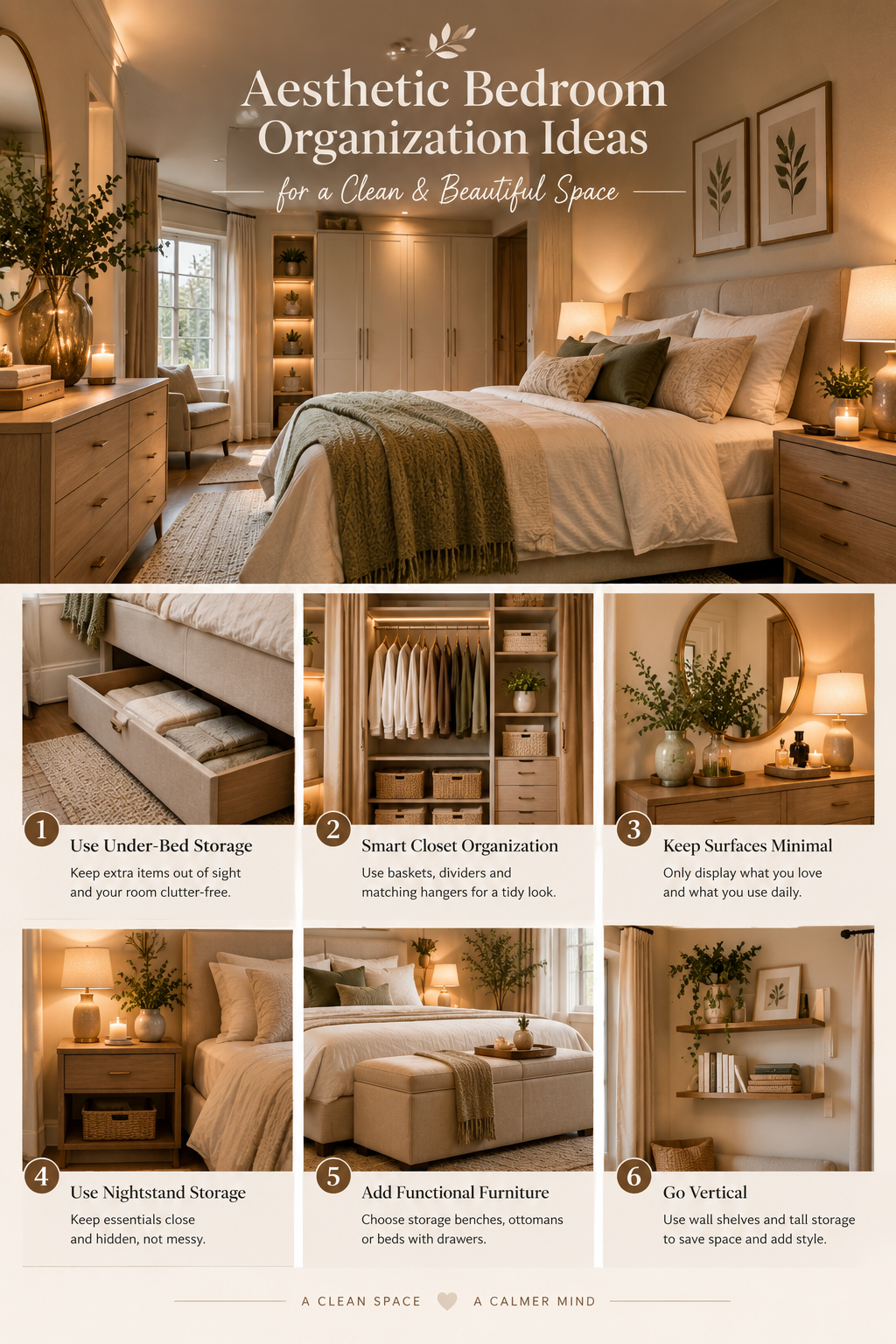
A beautifully organized bedroom can completely change the way a home feels. When clothing is easy to find, surfaces remain visually calm, accessories have designated places, and furniture works efficiently, the bedroom becomes more than a place to sleep. It becomes a peaceful personal retreat that feels comfortable, polished, and effortless to maintain. That is why aesthetic bedroom organization ideas have become such a popular home-decor topic for people who want their rooms to look beautiful while still functioning well for everyday life.
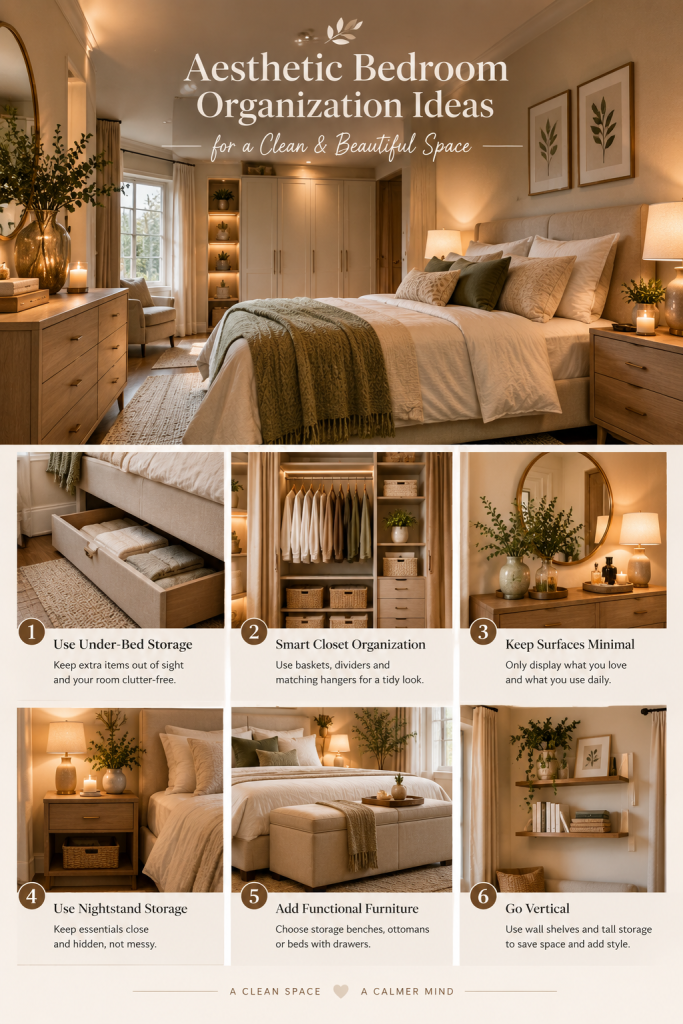
An organized bedroom does not have to look extremely minimalist or empty. You can have books, clothing, decorative objects, artwork, bedding, plants, and personal belongings while still creating a clean appearance. The secret is designing a system that separates what needs to be visible from what should remain concealed. Beautiful organization is not about hiding everything. It is about giving every category of belongings an appropriate home and then styling the visible areas intentionally.
For Pinterest-inspired bedrooms, this distinction is especially important. A room may look gorgeous in a photograph because the composition is carefully controlled, but the best bedroom organization ideas are the ones that can actually survive everyday routines. Clothes need to be accessible. Jewelry needs to be easy to reach. Shoes need a defined location. Bed linens need somewhere practical to live. Chargers, books, beauty products, bags, and seasonal clothing should not have to compete for the same surface.
The strongest approach is to organize the bedroom according to how you actually use it.
Instead of purchasing random storage containers first, begin by looking at the room as a series of zones. The sleeping zone should support rest. The wardrobe zone should make dressing easy. The bedside zone should contain nighttime essentials. A vanity or beauty zone should keep small products contained. If the bedroom includes a work area, that space needs its own system so paperwork and electronics do not gradually spread into the sleeping area.
This type of zoning is particularly useful in smaller bedrooms. Recent organization guidance continues to emphasize making use of overlooked areas such as under the bed, vertical walls, wardrobe height, and multifunctional furniture rather than simply adding more freestanding storage. (Architectural Digest)
Aesthetic organization also depends heavily on visual consistency. Storage does not have to look like storage. A beautiful wooden cabinet can hide everyday items. A fabric-lined drawer can keep accessories organized while maintaining a refined appearance. A built-in wardrobe can disappear into the wall when its finish matches the surrounding architecture.
Color is another important consideration. If every storage box, hanger, container, and accessory has a different color, even a technically organized bedroom can look visually busy. Choosing a limited palette makes the room feel more intentional. Cream, warm white, beige, natural wood, muted gray, soft olive, and gentle brown can create a sophisticated foundation, although colorful bedrooms can also look beautiful when the organization system follows a deliberate color story.
The goal is not to create a bedroom that looks untouched. A beautiful room should still feel lived in.
A book beside the bed can be inviting. A folded blanket can add softness. A small jewelry tray can become part of the decor. A carefully arranged clothing rail can even become a design feature. Organization and decoration can work together instead of competing.
Lighting also contributes to the feeling of cleanliness. Dark corners can make a room appear more crowded, while thoughtful lighting reveals storage areas and makes the entire bedroom feel more open. Layered lighting is especially useful around wardrobes, dressing areas, bedside tables, and shelves. Place lights at appropriate places so storage zones remain functional without turning the bedroom into an overly bright space.
Another important principle is accessibility. Items that are used every day should be the easiest to reach. Seasonal or occasional belongings can be placed higher, farther back, or beneath furniture. This simple distinction prevents storage systems from becoming frustrating.
For example, everyday clothing should not be stored behind rarely used luggage. Your most-used skincare products should not be buried underneath products you only use occasionally. Bed linens should be accessible without requiring you to empty an entire cabinet.
A good organization system reduces small daily decisions.
When everything has a logical place, putting something away becomes almost automatic.
This is also why beautiful organization should not depend on perfection. If a system requires every object to be folded in exactly the same way or every shelf to remain perfectly styled, it may become difficult to maintain. Practical organization should accommodate real life.
The ideas below combine storage, layout, styling, and visual design in different ways. Each one focuses on a separate part of the bedroom, so you can choose the solutions that suit your room rather than repeating the same storage trick everywhere.
Whether you have a spacious primary bedroom, a compact apartment bedroom, a guest room, or a bedroom with limited closet space, these aesthetic bedroom organization ideas can help create a cleaner, calmer, and more beautiful environment.
1. Turn the Space Under Your Bed Into an Organized Hidden Storage Zone
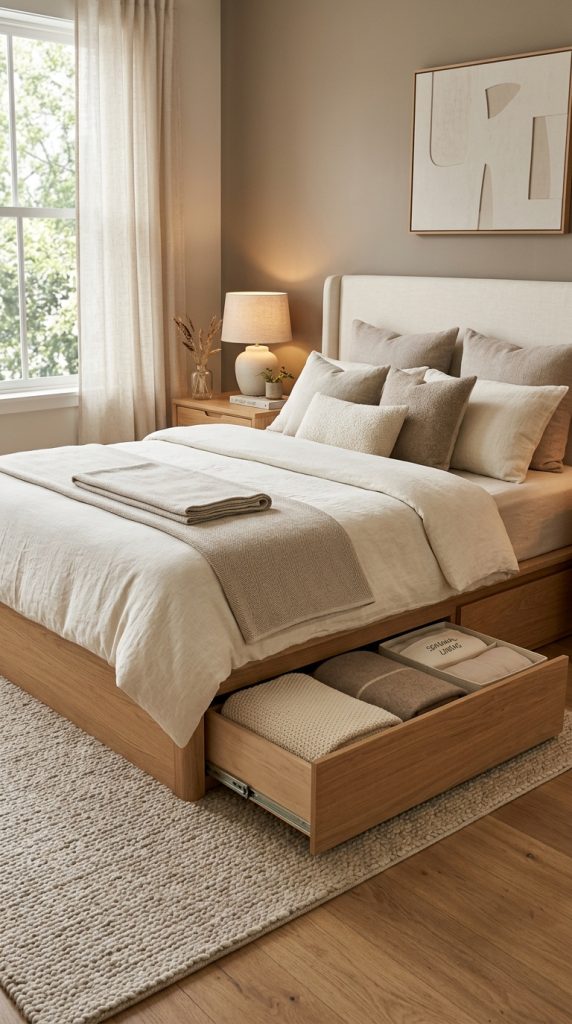
The area underneath a bed is one of the most valuable spaces in a bedroom because it provides storage without requiring additional floor space. Instead of allowing this area to become a forgotten collection of miscellaneous belongings, turn it into a deliberate storage zone for items that do not need to be accessed every day.
Under-bed storage works particularly well for seasonal clothing, spare bedding, extra pillows, handbags, luggage accessories, and other belongings that need protection but do not require daily access. Current bedroom-storage guidance frequently highlights under-bed drawers and lift-up beds as practical ways to increase storage capacity without adding another large furniture piece. (Architectural Digest)
The first step is choosing the right type of storage according to the bed design.
If your bed has built-in drawers, assign each drawer a category rather than filling them randomly. One drawer might contain spare sheets, another winter clothing, and another extra blankets.
If the bed has open space underneath, shallow rolling containers are useful because they can be pulled out without moving the furniture.
For a more polished appearance, choose containers that have solid sides or fabric covers. This keeps dust away from textiles and prevents the underside of the bed from becoming visually chaotic.
Before storing anything underneath the bed, measure the available height. A container that is too tall will be difficult to remove and may scratch the floor or interfere with the bed frame.
Choose shallow storage that fits comfortably.
You can also use labels, but keep them subtle. Small neutral labels on the front of storage boxes can make it easy to identify contents without disrupting the bedroom’s aesthetic.
The organization should follow frequency of use.
Store rarely needed belongings farther toward the back.
Keep things you access every few months closer to the sides.
Avoid storing everyday clothing underneath the bed if you have another convenient option. Constantly pulling out containers can become inconvenient and may discourage you from maintaining the system.
Under-bed storage can also be especially helpful in guest bedrooms. Extra bedding can remain hidden until visitors arrive, leaving the rest of the room free from unnecessary cabinets.
For children’s or teenagers’ rooms, the same principle can be used for seasonal clothing, school supplies, or hobby materials.
The visual advantage is significant. Because the storage remains concealed, the bedroom keeps its open appearance.
This is especially valuable in smaller rooms where another dresser or cabinet might consume valuable walking space.
A storage bed can also become a major furniture feature. An upholstered platform bed with hidden storage can combine comfort, style, and functionality in one piece.
When choosing a new bed, consider both the sleeping surface and the storage capacity underneath.
A beautiful bed that provides no storage may require another large furniture item later.
The best organization solutions often come from furniture that performs multiple jobs.
Keep the area underneath the bed reserved for clean, organized categories rather than miscellaneous objects. That small distinction can turn an overlooked space into one of the most useful storage areas in the entire bedroom.
2. Design a Floor-to-Ceiling Wardrobe That Becomes Part of the Architecture
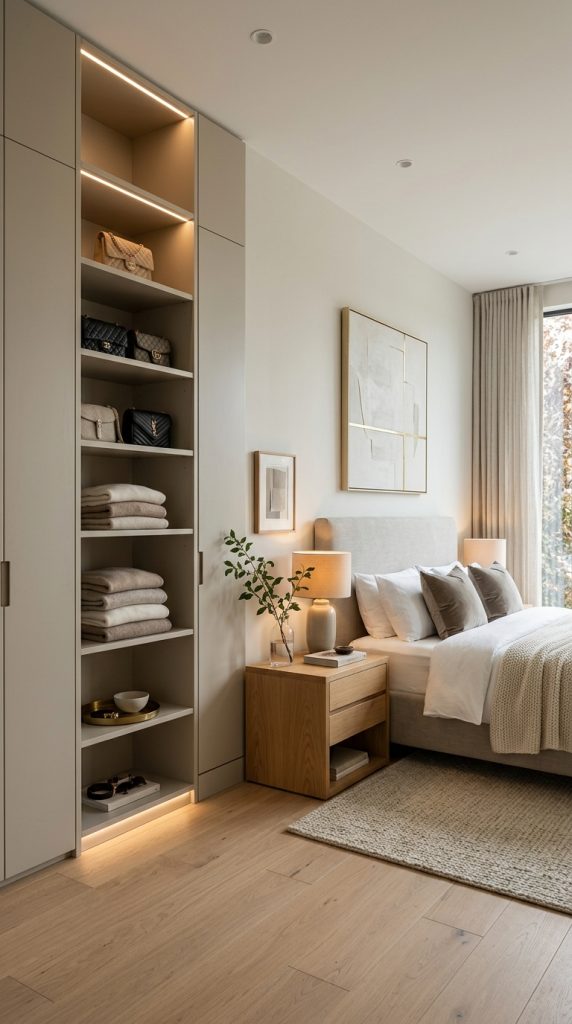
A wardrobe is often the largest storage feature in a bedroom, which means its appearance can dramatically influence the room.
Instead of treating the wardrobe as a separate bulky object, consider making it feel like part of the architecture.
Floor-to-ceiling cabinetry is particularly effective because it uses the vertical space that would otherwise remain unused. It can also create a more seamless visual effect when the doors, walls, and surrounding finishes are coordinated. Contemporary bedroom-storage advice increasingly highlights full-height wardrobes as a way to combine substantial storage capacity with a cleaner architectural appearance. (Boucl Home)
If you are designing a custom wardrobe, take the cabinetry as close to the ceiling as practical.
This creates additional space for less frequently used belongings such as suitcases, formal clothing, spare bedding, or seasonal accessories.
The lower and middle sections should contain items that are accessed regularly.
Think of the wardrobe as a vertical hierarchy.
Everyday clothing belongs at comfortable reach.
Occasional items can occupy upper compartments.
Shoes and folded accessories can use lower drawers or shelves.
This arrangement reduces unnecessary movement and makes the wardrobe easier to use.
The exterior finish is equally important.
For a calm aesthetic, match the wardrobe fronts closely to the wall color.
Cream cabinetry against a warm ivory wall can almost disappear visually.
Natural wood can create a more luxurious appearance, particularly when paired with neutral bedding and soft textiles.
For a more contemporary room, flat-panel doors with minimal hardware can create a clean appearance.
If you prefer a softer bedroom, consider reeded or lightly textured wardrobe doors.
Glass-front sections can be used selectively for handbags, shoes, or carefully arranged clothing.
Avoid turning every wardrobe section into an open display.
The purpose of the wardrobe is still organization.
Internal storage should be designed around your actual belongings.
Include a mixture of:
- Hanging space
- Drawers
- Adjustable shelves
- Shoe storage
- Small accessory compartments
Different clothing categories need different storage conditions.
Long dresses and coats require taller hanging sections.
Folded knitwear needs deeper shelves.
Smaller garments can benefit from drawers.
Shoes should ideally remain separated from clothing.
If the wardrobe has limited internal lighting, add discreet illumination that turns on when doors open.
Place lights at appropriate places inside wardrobe compartments and near dressing areas so darker sections remain easy to use.
The exterior should remain visually calm.
Avoid placing multiple decorative objects on top of the wardrobe if the unit already reaches the ceiling.
If there is an intentional open section, style it with only a few pieces.
A floor-to-ceiling wardrobe can also help smaller bedrooms because it replaces several separate storage pieces with one coordinated system.
Instead of having a wardrobe, dresser, shoe rack, and cabinet competing for space, one integrated wall can handle multiple categories.
The result is cleaner visually and often more practical.
3. Create an Aesthetic Bedside Station With Functional Hidden Storage
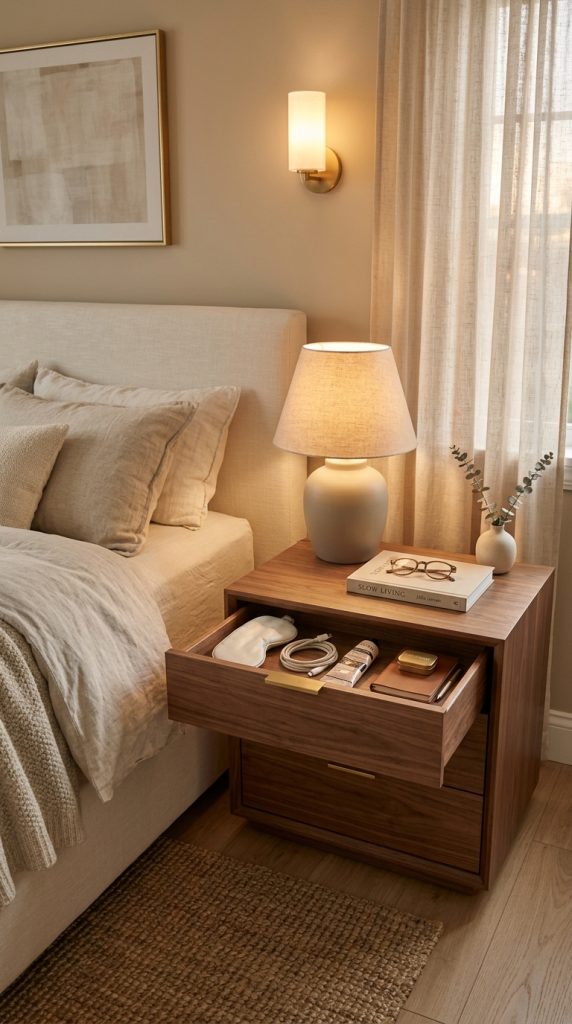
The bedside area is one of the smallest zones in the bedroom, yet it can become one of the messiest.
Phones, chargers, books, glasses, skincare, tissues, water bottles, and miscellaneous objects often accumulate around the bed because they are used frequently.
The solution is not necessarily a larger bedside table. It is a better-designed bedside station.
Choose a nightstand with at least one drawer or concealed compartment.
This gives everyday objects a private home while leaving the upper surface available for a small number of attractive items.
A good bedside surface might contain:
A warm table lamp.
One book.
A small ceramic object.
A glass of water.
That is enough.
The drawer can hold chargers, hand cream, sleep accessories, glasses, or other nighttime essentials.
Use a small internal divider if the drawer contains several categories.
This prevents tiny objects from becoming mixed together.
The height of the bedside table should also relate comfortably to the mattress. A table that is too low or too high can be inconvenient.
If floor space is limited, consider a wall-mounted bedside shelf.
This eliminates the legs and can make the area feel visually lighter.
It is particularly useful in very narrow bedrooms where traditional nightstands make circulation difficult.
A floating shelf can hold a lamp, book, and small accessory while leaving the floor completely clear.
Another option is a headboard with integrated bedside storage.
This combines several functions in one structure and can eliminate the need for separate nightstands.
For example, a built-in headboard might contain shallow shelves for books, charging ports, and small personal items.
This creates a strong architectural feature while reducing furniture.
The color and material of the bedside zone should coordinate with the rest of the bedroom.
Warm wood can create a cozy appearance.
Cream lacquer can feel contemporary.
Dark walnut can add sophistication.
Avoid introducing a completely unrelated finish unless you intentionally want the nightstands to become accent pieces.
Lighting is particularly important here.
Place lights at appropriate places, such as compact bedside lamps, wall sconces, or integrated headboard lighting, so the sleeping area has enough illumination without requiring a harsh overhead light.
Cable management is another detail that makes a surprisingly large difference.
Use cable clips or a hidden charging station to keep wires from spilling across the bedside surface.
A beautiful nightstand can quickly look messy if several cables are visible.
The objective is to make the bedside zone feel effortless.
Everything you need should be nearby, but very little should need to remain visible.
4. Organize Your Closet as a Color-Coordinated Boutique Display
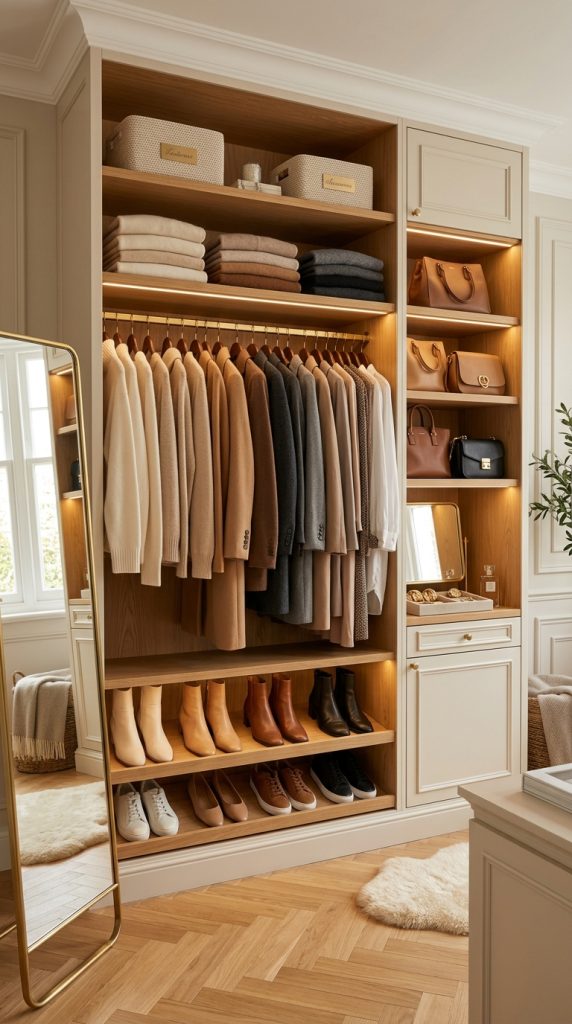
A closet can become both a practical storage system and an attractive visual feature when clothing is arranged intentionally.
Instead of organizing garments only according to available space, consider creating a boutique-style arrangement.
Begin by separating clothing into broad categories.
For example:
- Everyday tops
- Trousers
- Dresses
- Jackets
- Occasion wear
- Homewear
Then arrange each category in a logical sequence.
Within a category, you can organize by color.
A gradual progression from light to dark creates a visually satisfying appearance and makes clothing easier to locate.
Neutral clothing can be grouped together while stronger colors can form their own sections.
The objective is not perfection. It is creating a system that allows you to see what you actually own.
Matching hangers can dramatically improve the appearance of a wardrobe.
Choose one hanger style and use it consistently.
Slim hangers are particularly useful because they take up less horizontal space than thick wooden versions.
However, if you love wooden hangers, use them consistently and allow enough space between garments.
Overcrowding the hanging rail makes clothing difficult to see and can cause fabrics to wrinkle.
Use vertical dividers or shelf organizers for folded clothing.
Rather than creating enormous stacks, make manageable categories.
For example, separate:
T-shirts.
Sweaters.
Jeans.
Sleepwear.
Workout clothing.
This makes the wardrobe easier to maintain.
If you use open clothing rails, treat them like a decorative feature.
Choose the garments that remain visible carefully.
An edited selection of neutral clothing can create an elegant boutique effect.
Current design coverage also notes that open clothing rails work best when the visible wardrobe is deliberately edited rather than allowed to become an uncontrolled accumulation. (Boucl Home)
A wardrobe can also benefit from a dedicated accessory area.
Scarves, belts, and handbags can be organized on hooks or specialized inserts.
Keep accessories visible only if they are visually pleasing and frequently used.
Otherwise, concealed drawers are preferable.
Shoes should have their own location.
A dedicated shoe shelf prevents footwear from spreading across the bedroom floor.
Arrange shoes by frequency of use, with everyday pairs easiest to reach.
If your wardrobe has limited depth, vertical shoe storage can save valuable space.
Lighting can transform the closet experience.
Place lights at appropriate places inside hanging sections, above shelves, or along wardrobe interiors so you can clearly distinguish colors and fabrics.
A well-lit wardrobe can feel more like a boutique dressing room.
The final result should be visually calm but practical enough for everyday use.
5. Give Accessories Their Own Beautiful Organization System
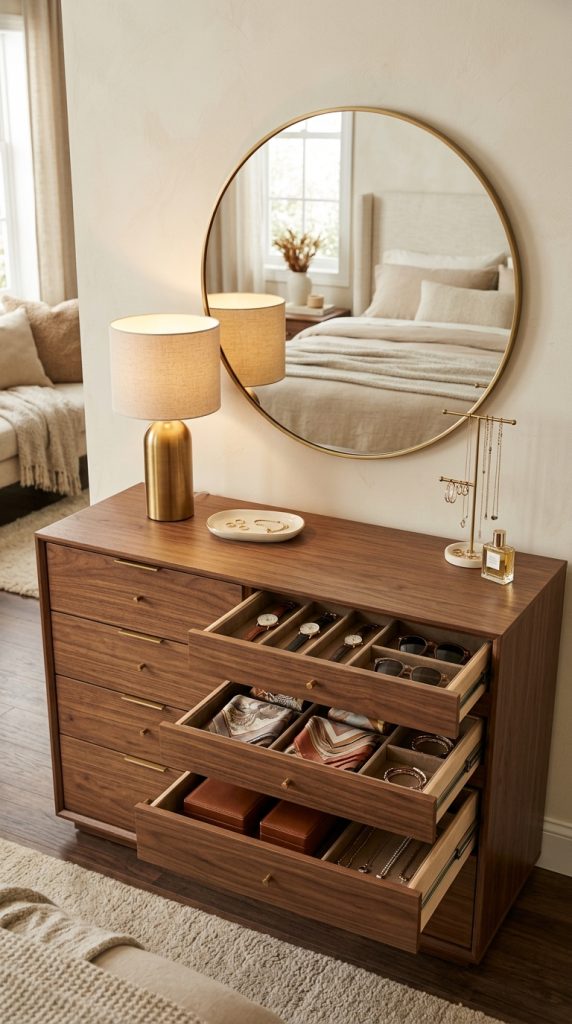
Small accessories are often responsible for making a bedroom look untidy because they are easy to leave on surfaces.
Jewelry, watches, sunglasses, hair accessories, belts, scarves, and small bags can quickly accumulate on dressers and nightstands.
Instead of storing them randomly, create one dedicated accessory station.
A drawer with compartments is ideal for jewelry because it protects delicate pieces while keeping them sorted.
Separate categories rather than mixing everything together.
For example:
Earrings in one compartment.
Rings in another.
Bracelets in a third.
Necklaces can hang vertically to prevent tangling.
A velvet-lined organizer can make the drawer feel luxurious while protecting delicate items.
If you prefer visible organization, a beautiful jewelry stand can become part of the bedroom decor.
However, limit the display to pieces you wear regularly.
A wall-mounted accessory board can work well for scarves, hats, and lightweight bags.
Use hooks at different heights to create an attractive composition while keeping everything accessible.
For handbags, consider a dedicated shelf rather than stacking them on the floor.
Stuffing bags lightly with tissue or soft fabric can help them maintain their shape.
Keep everyday bags at a comfortable height.
Special-occasion pieces can occupy higher shelves.
Sunglasses can be organized in a shallow drawer insert or displayed in a small compartmented box.
Hair accessories benefit from narrow containers because they are small and easy to scatter.
The important principle is separation.
Small items should not all share one container.
When categories are separated, returning something to its correct place becomes simple.
This is particularly helpful in the morning when you are getting ready quickly.
The organization station should also fit the visual identity of the room.
A natural wood organizer can complement an organic bedroom.
A brass or glass tray can work in a glamorous space.
A matte black organizer can suit a modern bedroom.
Do not purchase several unrelated organizers simply because they are attractive individually.
Choose pieces that look like part of the same system.
If you have a dressing table, use the drawers strategically.
Keep daily beauty products in the most accessible drawer.
Less frequently used items can move to lower storage.
Avoid covering the entire vanity surface with products.
One beautiful tray can contain the few items you use most often.
Place lights at appropriate places around the accessory or dressing station so small details remain easy to see.
A dedicated accessory system can make the entire bedroom look cleaner because small objects stop migrating between furniture surfaces.
6. Use a Storage Bench to Organize the Window or End-of-Bed Zone
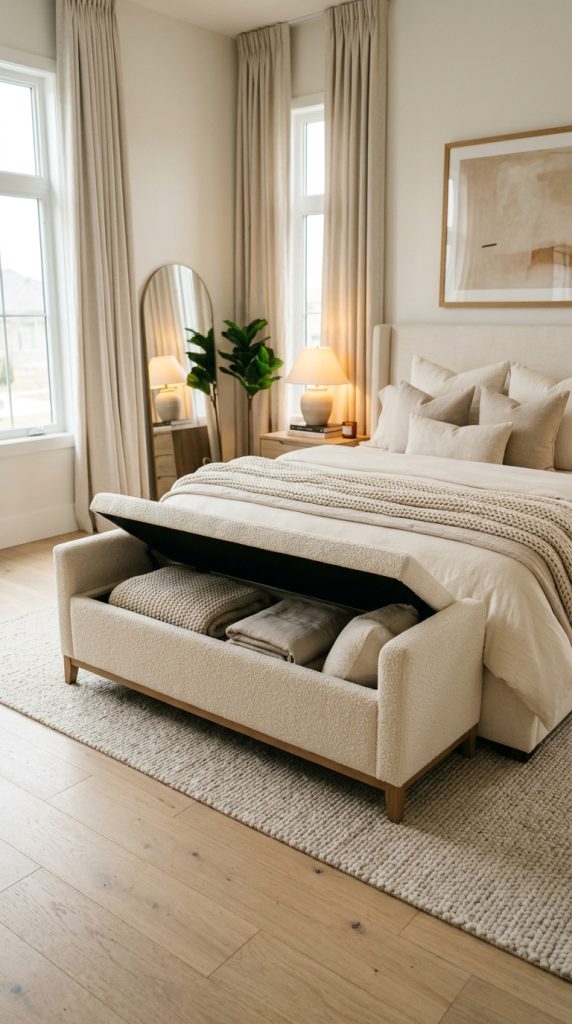
A bedroom bench can be much more than a decorative piece.
When selected with internal storage, it can provide a useful home for blankets, pillows, seasonal textiles, handbags, or other soft items while also creating a comfortable place to sit.
This makes the storage bench particularly valuable in bedrooms where floor space is limited.
The end of the bed is often an underused area.
A properly scaled bench can transform it into a functional zone without requiring a full dresser.
Choose a bench that leaves enough walking space around it.
The furniture should not interfere with opening wardrobes or moving around the bed.
For a smaller bedroom, select a narrow design with a relatively low profile.
A large upholstered bench may look luxurious in a spacious primary suite but can overwhelm a compact room.
If your bedroom has a window seat, consider built-in drawers beneath it.
This creates a beautiful architectural feature while providing hidden storage.
The drawers can hold:
- Extra bedding
- Seasonal blankets
- Decorative cushions
- Reading materials
- Guest linens
Because these items are not usually needed every day, the location is convenient without becoming a high-traffic storage zone.
A window bench can also become a reading corner.
Add one cushion and perhaps a small throw rather than covering the entire seat with accessories.
This keeps the area functional and visually relaxed.
Material selection matters.
A linen-upholstered bench can create a soft, sophisticated appearance.
Natural wood can provide a more minimalist look.
Bouclé can introduce texture in a contemporary bedroom.
Choose a fabric that relates to the bedding rather than matching every element exactly.
If the bedroom already contains several soft textures, a wooden bench may provide useful contrast.
If the room has a lot of hard surfaces, upholstery can soften it.
Lighting can define this zone.
Place lights at appropriate places, such as a slim floor lamp beside a window bench or a wall-mounted reading light nearby.
This turns storage furniture into a genuine part of the bedroom’s lifestyle rather than a purely functional object.
The storage should remain accessible.
Do not fill it with objects you never use.
Its greatest value comes from keeping frequently rotated soft goods organized and out of sight.
7. Transform an Awkward Corner Into a Purposeful Organization Zone
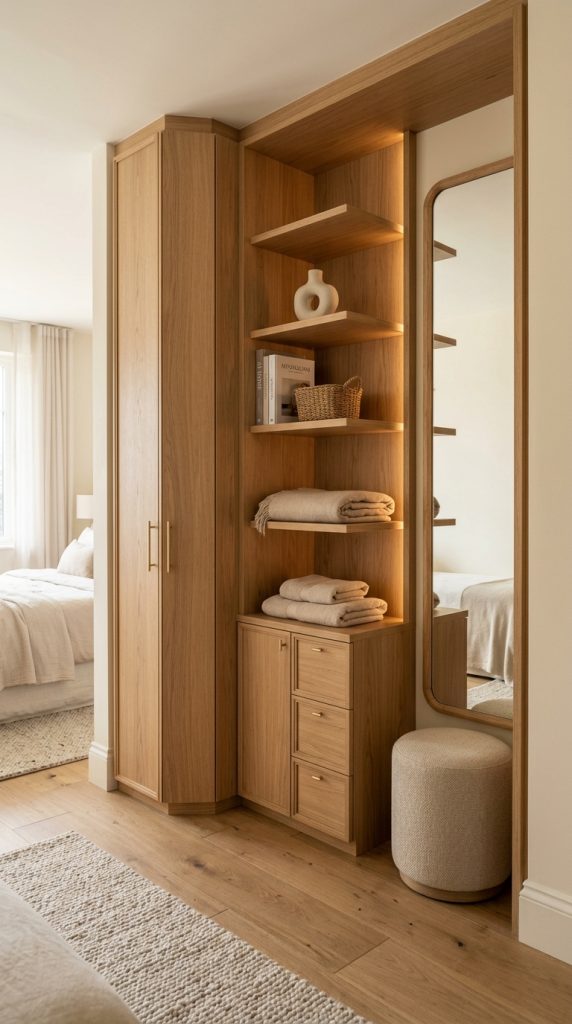
Bedrooms often contain awkward corners that are too small for standard furniture but large enough to become useful.
Instead of allowing these areas to collect miscellaneous objects, assign them a specific function.
A narrow corner might become a compact dressing area.
Another could become a reading zone.
A small alcove could hold a vertical cabinet.
The important part is choosing furniture according to the exact dimensions of the space.
Measure width, depth, and ceiling height before buying anything.
A narrow shelving tower can use vertical space without consuming much floor area.
This can hold books, folded accessories, baskets, or decorative objects.
If the corner is beside a wardrobe, it could become a shoe-storage zone.
A slim vertical shoe cabinet can hold many pairs while maintaining a small footprint.
Another option is a small wall-mounted desk.
This works particularly well if the bedroom needs a work or study area.
Recent design guidance recommends integrating bedroom desks carefully so the workspace does not visually dominate the relaxing function of the room. (Ideal Home)
Use a fold-down desk if the room is very small.
When closed, it becomes almost invisible.
When open, it provides a practical surface for a laptop or notebook.
Keep the associated storage concealed.
A small drawer can hold stationery.
A wall-mounted cable channel can prevent wires from becoming visible.
If the corner is used as a dressing zone, install a narrow mirror.
A vertical mirror can make the area feel larger while providing a practical function.
Add one small stool only if there is enough clearance.
Do not force furniture into an area that is too narrow.
Sometimes the best solution is a single wall-mounted shelf and mirror.
The corner should feel intentional.
Use a consistent finish so it relates to the rest of the bedroom.
For example, a walnut shelf with a walnut-framed mirror can create a cohesive mini-zone.
Or use cream cabinetry against a warm neutral wall for a seamless effect.
Place lights at appropriate places around the corner so it does not become a dark unused pocket.
A small wall sconce or concealed LED strip can be enough.
The objective is to turn an overlooked area into a functional part of the room without making it feel crowded.
8. Create a Dedicated Linen Organization System
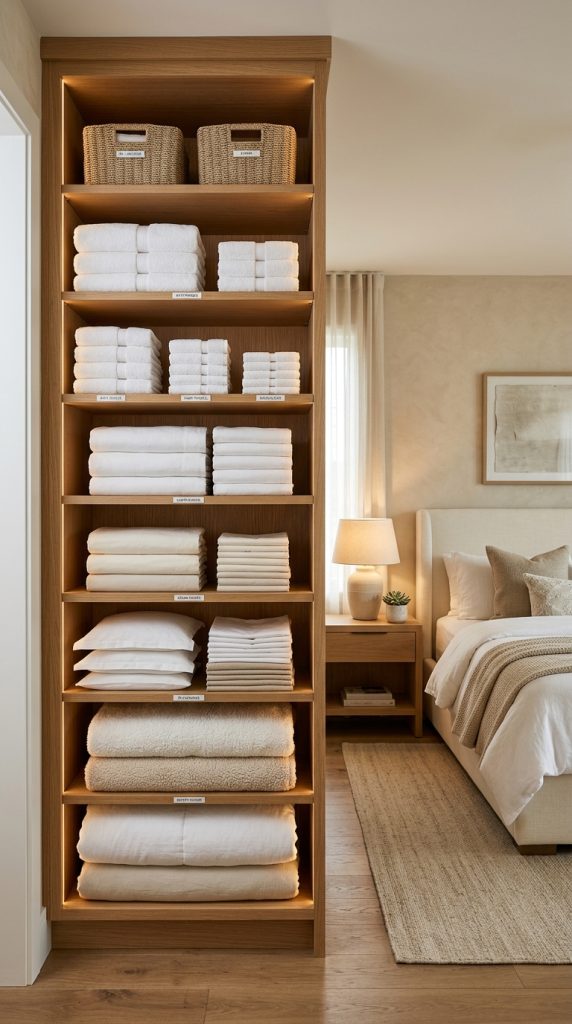
Bed linens, towels, blankets, pillowcases, and seasonal bedding can take up substantial storage space if they are not organized properly.
Instead of mixing all household textiles together, give bedroom linens their own defined system.
Start by grouping matching sets together.
Place the fitted sheet, flat sheet, and pillowcases inside one matching pillowcase when possible.
This keeps complete sets together and makes changing the bed faster.
Fold bulky blankets separately.
Avoid creating extremely tall stacks that become difficult to remove.
A shelf divider can help maintain manageable piles.
If your bedroom wardrobe has a high shelf, this can become the linen zone because these items do not need to be accessed constantly.
Use breathable fabric storage bags for textiles that will remain stored for extended periods.
Avoid overfilling containers because compressed fabrics become difficult to retrieve.
If your bed has under-storage, seasonal bedding can live there.
Keep frequently used sheets closer to the bedroom’s primary storage area.
The linen system should also reflect household routines.
If you change bedding weekly, the current sets need to be easy to reach.
If you have guest bedding that is used only occasionally, store it separately.
Label shelves or containers when necessary.
A small neutral label such as “Guest,” “Winter,” or “Sheets” can be useful.
The goal is to reduce the amount of searching.
Storage containers can also contribute to the aesthetic.
Neutral fabric bins can look elegant inside an open wardrobe.
Woven baskets can work in a bedroom where natural textures are already present.
For a modern room, simple matching boxes create a cleaner appearance.
Avoid using transparent plastic containers everywhere if visual calm is important.
Although clear containers are practical, a wall of visible contents can make an otherwise beautiful wardrobe look busy.
If you use clear containers, reserve them for categories where visibility genuinely improves convenience.
For example, a transparent box may work well for small seasonal accessories.
A closed fabric box may be better for bulky bedding.
The key is matching the container type to the item.
Lighting is useful here as well.
Place lights at appropriate places inside tall linen cupboards or wardrobe shelves so the back of the storage area does not become difficult to see.
A well-organized linen system makes the bedroom easier to maintain because one of the most frequently handled categories has a permanent home.
9. Organize Your Bedroom Entry and Floor With a Dedicated Drop Zone
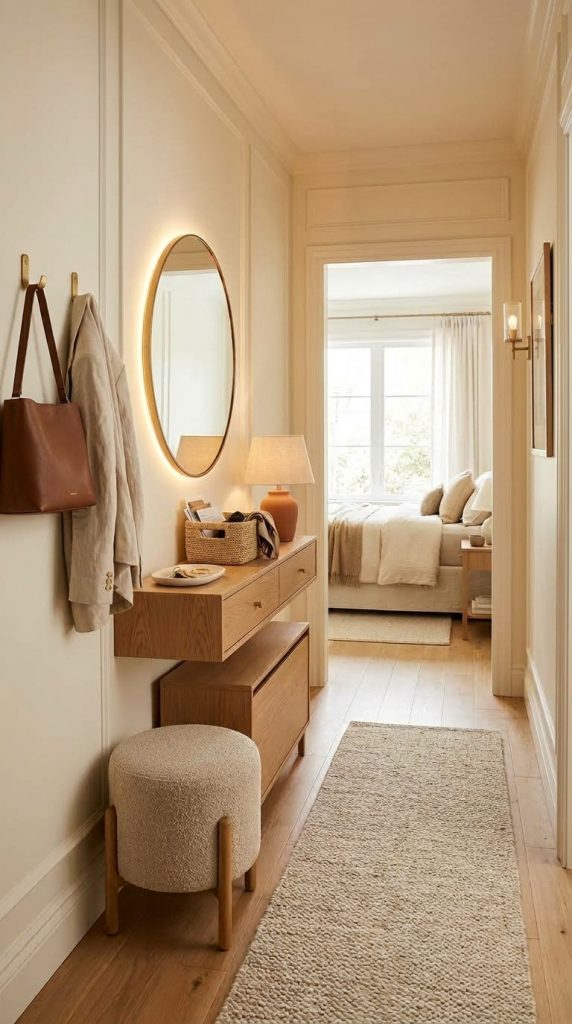
The area near the bedroom entrance can quietly become a major source of clutter.
Bags are placed on the floor.
Shoes remain beside the door.
Jackets land on chairs.
Keys and small belongings move from one surface to another.
A dedicated drop zone prevents this daily accumulation from spreading across the bedroom.
If space allows, install a narrow wall-mounted shelf near the entrance.
It can hold small daily items such as a watch, glasses, or accessories.
Below it, install a few hooks for lightweight bags or robes.
If you have more room, a narrow cabinet can conceal shoes and everyday belongings.
Choose a cabinet with doors so the entry area remains visually clean.
A small bench can provide seating while putting on shoes, but make sure it does not obstruct the door or walking route.
For very compact bedrooms, use vertical storage instead.
A slim hook rail can take advantage of wall space without reducing floor area.
Assign specific hooks to specific categories.
One hook for your everyday bag.
Another for a robe.
Another for frequently used accessories.
This reduces the tendency to place belongings on the bed or floor.
Shoes should ideally have their own designated storage.
A narrow shoe cabinet can be particularly useful because it keeps footwear contained while using little floor depth.
If you prefer open shoe storage, maintain a small number of everyday pairs and keep the rest elsewhere.
The entrance zone should not become an overflow wardrobe.
The purpose is to manage the items that naturally arrive with you when entering the room.
This is particularly helpful if the bedroom also functions as a dressing area.
A small tray can contain daily accessories.
A hook can hold tomorrow’s outfit.
A slim laundry hamper can sit nearby if space allows.
Choose a hamper with a lid or attractive woven construction so it looks like furniture rather than an exposed utility container.
Color coordination can make this area feel more decorative.
Use one finish for hooks and hardware.
Coordinate the bench with the wardrobe.
Select baskets or containers in colors that complement the bedroom palette.
Place lights at appropriate places, particularly near the entrance and storage cabinet, so the drop zone remains functional in the evening.
The benefit is simple: the moment you enter the bedroom, there is a clear place for everything.
That prevents clutter from traveling deeper into the room.
10. Build a Daily Reset System That Keeps the Bedroom Beautiful
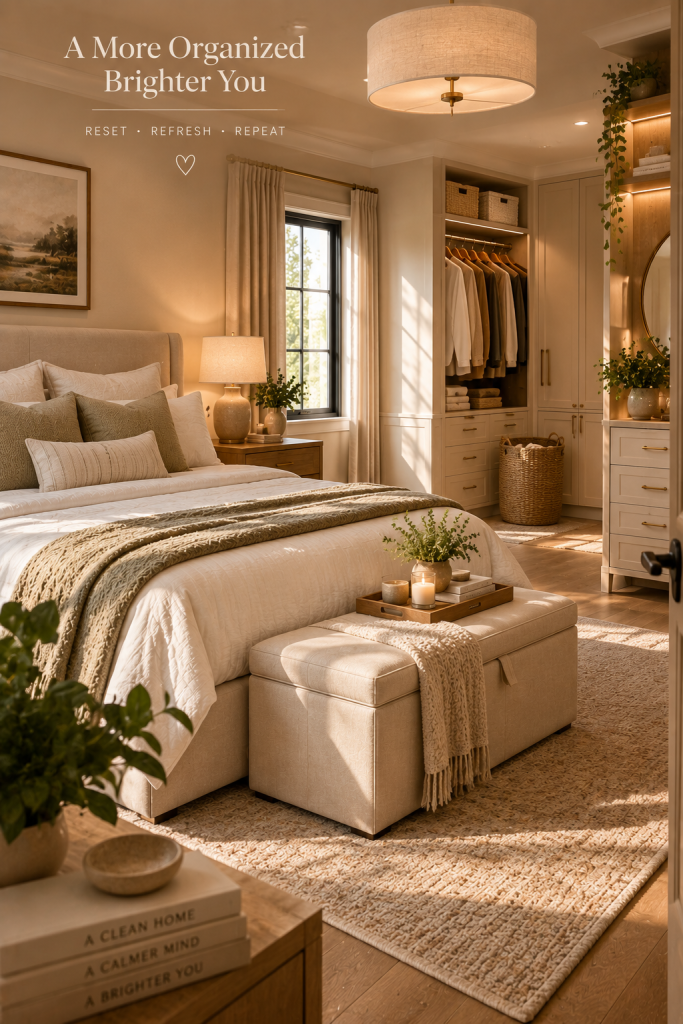
The final organization idea is not a piece of furniture. It is a simple system that makes the organization you create easier to maintain.
A bedroom can be perfectly organized on Sunday and cluttered again by Wednesday if there is no practical daily routine.
The solution is to create a short reset process that takes only a few minutes.
Start by identifying the items that repeatedly appear in the wrong places.
Perhaps clothes accumulate on a chair.
Maybe books remain on the floor.
Perhaps skincare products spread across the dresser.
Maybe charging cables stay on the bed.
These repeated problems reveal where the organization system needs improvement.
Instead of repeatedly cleaning the same mess, give each category a more convenient home.
If clothes are always left on a chair, add a dedicated hook or valet area.
If books accumulate beside the bed, create a small reading shelf.
If accessories spread across the dresser, add a compartment tray.
The best organization system follows behavior rather than fighting it.
Create a simple evening reset.
Return clothing to the wardrobe or laundry hamper.
Clear the bedside surface.
Put accessories away.
Return books to their shelf.
Remove cups or dishes.
Straighten the bedding.
The entire process can take only a few minutes when every item already has a logical destination.
A morning reset can be equally simple.
Open curtains.
Make the bed.
Return sleepwear to its location.
Put away anything that was left out overnight.
This creates an immediate sense of order.
The bedroom should also have a designated laundry system.
A beautiful hamper prevents clothing from being thrown onto chairs or floors.
Choose a hamper that suits the room’s design.
A woven basket works well in an organic bedroom.
A fabric hamper can feel softer.
A slim lidded hamper may be better for a compact room.
Another useful habit is a weekly surface review.
Look at the dresser, nightstand, shelves, and floor.
Remove objects that do not belong.
This prevents small amounts of clutter from becoming overwhelming.
Seasonal editing is also valuable.
At the beginning of a new season, move clothing that will not be used for several months into higher wardrobe storage or under-bed compartments.
Bring the next season’s clothing into the easiest-to-access areas.
Recent organization advice similarly emphasizes removing unused clothing, excess products, and items that no longer serve the room as part of maintaining a calmer bedroom. (Real Simple)
Do not turn the reset into an exhausting cleaning routine.
The purpose is simply to restore the room’s baseline.
Visual calm also depends on stopping clutter before it accumulates.
Before buying a new organizer, ask whether the item solves a real problem.
More containers do not automatically create better organization.
Sometimes the solution is owning fewer duplicate items.
Sometimes it is changing where something is stored.
Sometimes it is simply creating a better daily habit.
Lighting can make the reset feel more pleasant.
Place lights at appropriate places, using warm bedside lamps or soft accent lighting so evening organization does not require harsh overhead illumination.
The bedroom should end the day feeling peaceful rather than chaotic.
A successful organization system is one you can maintain without constantly thinking about it.
When putting something away becomes easier than leaving it out, the room naturally stays cleaner.
That is the real goal of aesthetic bedroom organization: not a perfect photograph, but a beautiful space that continues to look and feel good during ordinary life.
Conclusion
Creating a clean and beautiful bedroom is not about removing every personal item or turning the room into a completely minimalist space. The most effective aesthetic bedroom organization ideas combine practical storage with thoughtful styling so the room remains both functional and visually peaceful.
Under-bed storage can handle seasonal belongings without consuming floor space. A floor-to-ceiling wardrobe can turn clothing storage into part of the room’s architecture. A well-designed bedside station can keep everyday essentials accessible without allowing them to cover the nightstand.
Accessories become easier to manage when jewelry, bags, shoes, and small belongings each have dedicated locations. A storage bench can give unused space a purpose, while awkward corners can become compact dressing, reading, or work zones.
Even linens and bedroom-entry clutter deserve their own systems because these small categories can have a major effect on the overall appearance of the room.
The final piece is maintenance. An organization system only works when it fits your everyday habits. The most beautiful storage solution is not necessarily the most complicated one. It is the one that makes putting things away easy enough that you actually continue doing it.
For a Pinterest-worthy bedroom, focus on clear surfaces, intentional storage, cohesive materials, comfortable access, and a few beautiful details. Let organization become part of the design instead of something hidden behind it.
A clean bedroom should still feel warm, personal, and lived in. Books, textiles, artwork, meaningful objects, and carefully chosen decor can remain visible while less attractive everyday clutter stays contained.
When storage is designed thoughtfully, the bedroom becomes easier to use and easier to enjoy. The result is a space that feels organized without feeling sterile, beautiful without feeling overly styled, and peaceful enough to become a genuine retreat at the end of the day.
Leave a Reply