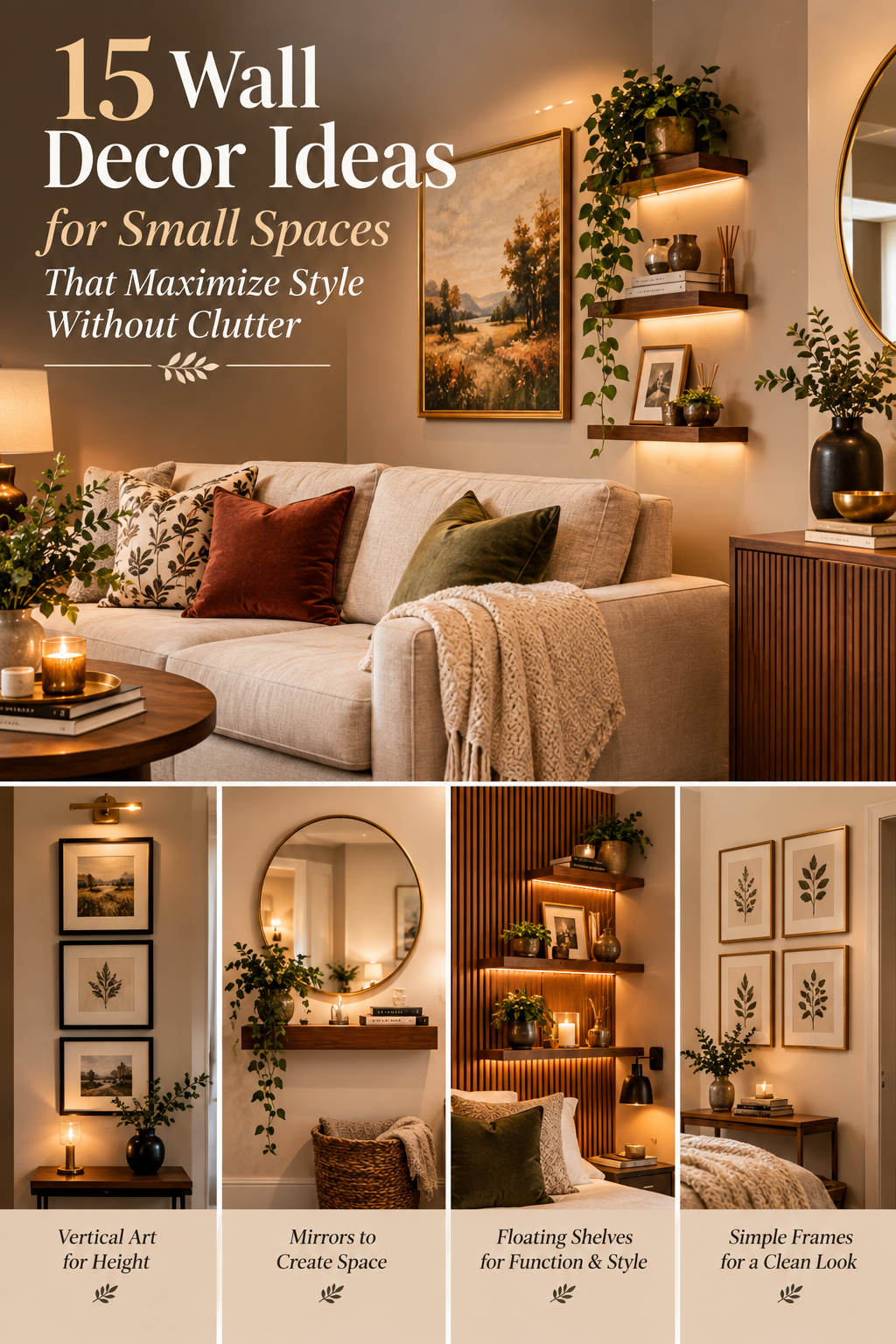
Small rooms can be some of the most beautiful spaces in a home when every design decision is intentional. The challenge is that limited square footage leaves less room for bulky furniture, oversized accessories, and unnecessary decoration. That is exactly why the walls become so important. Instead of allowing vertical space to remain empty, you can turn it into an elegant design feature while keeping the floor open and the room visually calm.
If you are searching for wall decor ideas for small spaces that maximize style without clutter, the best approach is not to put more things on the walls. It is to choose the right pieces, use the available height intelligently, and create visual impact without overwhelming the room.
In a small bedroom, living room, apartment, hallway, home office, dining area, or entryway, wall decor can perform several jobs at once. A large mirror can reflect light and create the impression of additional space. Floating shelves can provide display space without taking up floor area. Wall sconces can add atmosphere while replacing bulky table lamps. A narrow wall-mounted cabinet can provide storage where a traditional piece of furniture would make the room feel cramped.
Current small-space design is increasingly focused on using vertical areas rather than simply adding smaller furniture. Designers are recommending taller shelving, vertical artwork, large-scale pieces, and wall-mounted solutions that encourage the eye to move upward. (Architectural Digest)
Another important shift is the move away from decorating small spaces with countless tiny objects. A collection of small frames, miniature shelves, little signs, and unrelated accessories can quickly become visual noise. One large artwork, one sculptural mirror, or one carefully arranged picture ledge can often create considerably more impact.
This does not mean that small rooms need to be completely minimalist. A small space can still have personality, color, pattern, vintage pieces, artwork, texture, and meaningful objects. The secret is editing. Every item should have a reason to be there.
Think about your wall decor as part of the architecture of the room. Instead of asking, “What can I put on this empty wall?” ask, “What can this wall do for the room?”
Could it make the room appear taller?
Could it reflect more natural light?
Could it provide hidden storage?
Could it create a focal point?
Could it make an awkward corner useful?
Could it display meaningful artwork without taking over the room?
Could it add texture without adding physical bulk?
Those questions lead to much more sophisticated decorating decisions.
Another advantage of wall decor is that it allows you to make a small home feel more personalized without sacrificing valuable floor space. A carefully chosen piece of art can communicate your personality. A vintage mirror can introduce character. A picture ledge can display changing photographs and artwork. A wall-mounted cabinet can hide everyday necessities. A sculptural sconce can become both lighting and decoration.
The ideas below are designed around that balance. Some are purely decorative, while others combine beauty and function. Several can also be adapted to rental apartments, bedrooms, kitchens, entryways, narrow hallways, and small living rooms.
You do not need to use all fifteen ideas. Choose two or three that suit your room and repeat their colors, materials, or shapes throughout the space. This creates a cohesive interior rather than a wall covered with unrelated decorations.
1. Use an Oversized Mirror to Make a Small Room Feel Larger
One of the most effective wall decorating ideas for a small space is an oversized mirror.
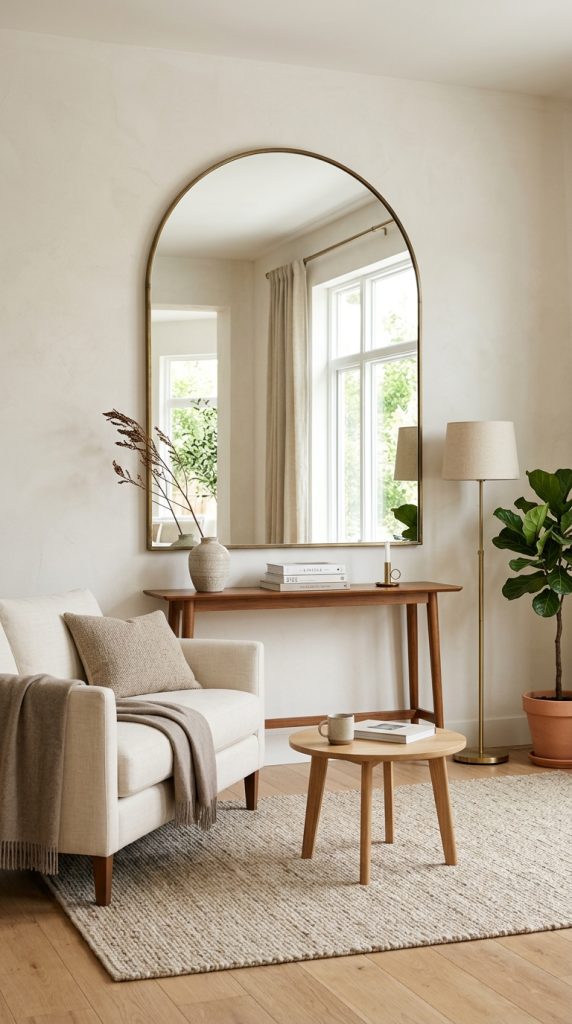
Mirrors are valuable because they provide decoration while also interacting with light and visual depth. A strategically positioned mirror can reflect a window, light fixture, artwork, or attractive part of the room, making the space feel more open.
Current small-room design guidance continues to highlight reflective surfaces as a useful way to create an impression of greater space. (Homes and Gardens)
Instead of using several tiny decorative mirrors, consider one substantial mirror that becomes the main feature of the wall.
Choose the right shape
The shape of the mirror can influence the personality of the room.
A tall rectangular mirror works beautifully when you want to emphasize ceiling height. An arched mirror introduces softness. A round mirror creates contrast against furniture with straight lines. An irregular or organic-shaped mirror can provide an artistic focal point.
For an elegant small living room, place a large mirror above a slim console.
In a bedroom, position a tall mirror near the dresser or opposite a window.
In an entryway, a large mirror can create a useful last-look station while visually expanding the narrow area.
Make the mirror part of the design
Avoid treating the mirror as an isolated object.
Repeat its frame finish elsewhere in the room. For example, an aged-brass mirror can connect beautifully with brass lighting, while a dark wood frame can complement walnut furniture.
If your room already contains many decorative details, choose a simple frameless or thin-framed mirror.
If the room feels plain, a sculptural or antique-inspired frame can provide more personality.
Avoid the mirror overload
More mirrors do not automatically create more space.
Too many reflective surfaces can make a small room feel visually confusing. One strong mirror positioned intentionally is usually more effective than covering every wall with reflections.
The goal is to create depth, not visual distraction.
2. Create a Minimalist Picture Ledge Instead of a Bulky Gallery Wall

Picture ledges are an excellent alternative to traditional gallery walls, especially when you want flexibility without visual heaviness.
A picture ledge is a narrow shelf designed to hold framed artwork, photographs, small objects, or decorative pieces. Because the artwork can simply rest on the ledge, you can change the arrangement without creating multiple holes in the wall.
Design coverage in 2026 has specifically highlighted picture ledges as a more flexible, pared-back alternative to rigid gallery walls. (Homes and Gardens)
Keep the composition edited
For a small room, one or two narrow ledges may be enough.
Use a combination of:
- One larger framed print
- Two smaller artworks
- One photograph
- One small ceramic object
Leave empty sections of the ledge visible.
That negative space keeps the display from feeling crowded.
Use overlapping frames
One of the advantages of a ledge is that frames can overlap slightly.
Place the largest piece toward the back and smaller frames in front.
This creates depth without requiring complicated wall arrangements.
Coordinate the colors
The easiest way to keep a picture ledge sophisticated is to limit the color palette.
For example:
Cream wall + black frames + sepia artwork + natural wood.
Or:
Warm beige wall + walnut frames + muted botanical artwork + ceramic accents.
The pieces do not need to match exactly. They simply need to feel related.
Use the ledge beyond artwork
A picture ledge can also hold:
- Small travel photographs
- Postcards
- Children’s artwork
- Small mirrors
- Pressed botanical prints
- Meaningful objects
This makes the wall display easy to update as your style changes.
3. Decorate With One Large Statement Artwork
Small rooms do not always require small artwork.
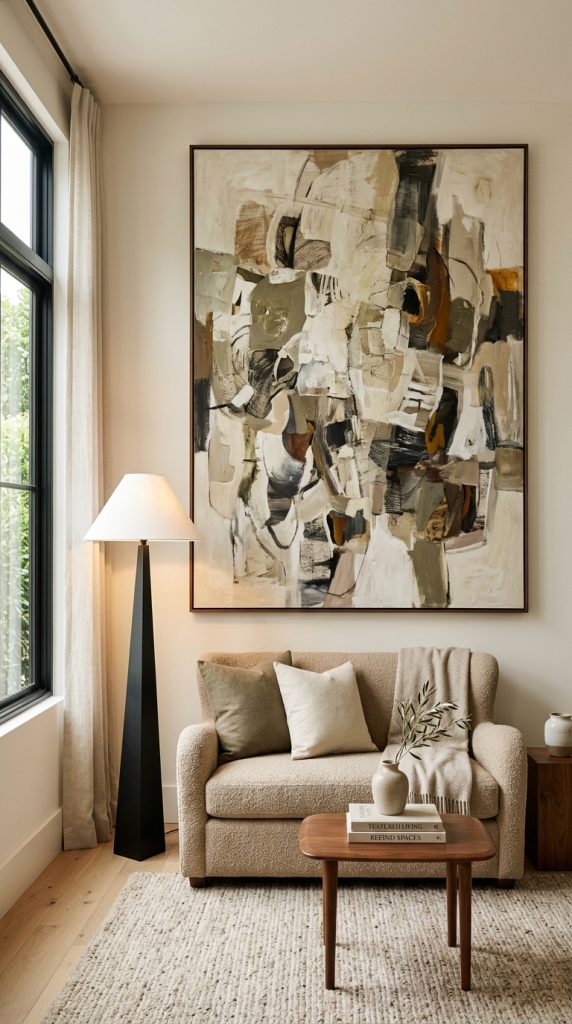
In fact, one large artwork can sometimes make a compact room feel more sophisticated than a collection of tiny pieces.
Architectural Digest’s recent small-space guidance specifically highlights oversized artwork as a way to draw the eye through a room and create a more immersive effect. (Architectural Digest)
Why one large piece works
A single artwork creates a clear visual focal point.
Instead of the eye jumping between multiple small objects, it immediately understands where to look.
This can make the room feel more organized.
Choose artwork with depth
You do not have to choose a completely neutral painting.
Consider:
- Abstract artwork
- Oversized botanical artwork
- Landscape photography
- Vintage-inspired paintings
- Monochrome photography
- Textured canvas
- Soft geometric artwork
For a small neutral room, artwork can introduce a controlled accent color.
For example, an otherwise cream and beige room could feature artwork containing muted olive, rust, charcoal, or dusty blue.
Match the scale to the wall
Large artwork should still be proportionate to the furniture beneath it.
Above a sofa, the artwork should visually connect to the sofa rather than appearing like a tiny isolated rectangle.
Above a bed, choose a piece wide enough to create a substantial focal point.
Above a small console, a vertical artwork can work beautifully.
Keep everything else quiet
When using oversized artwork, you do not need five additional decorations on the same wall.
Let the artwork breathe.
That empty space around it is part of the composition.
4. Install Floating Shelves for Style and Practical Storage
Floating shelves are one of the most useful solutions when floor space is limited.
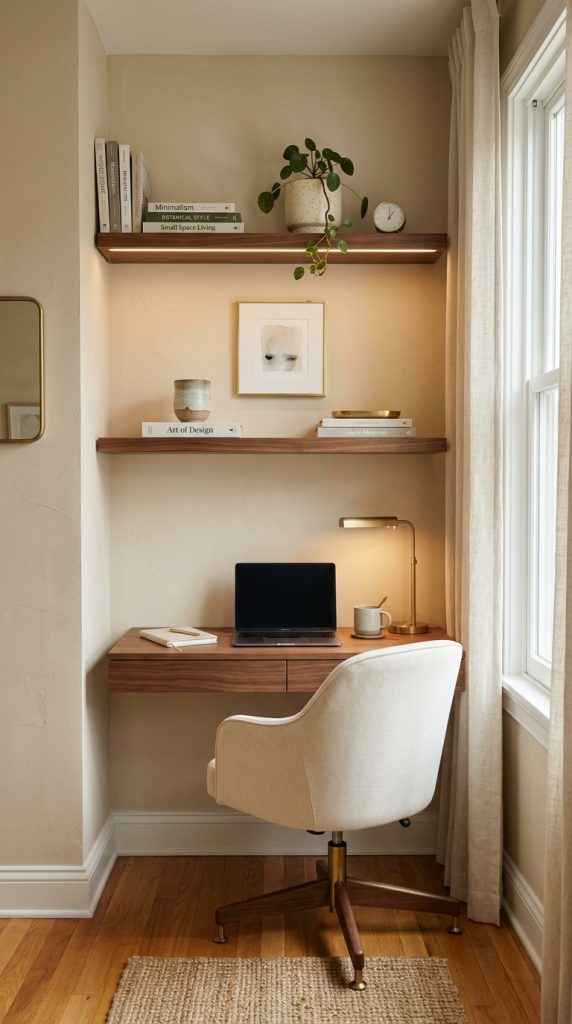
They allow you to move storage and display upward while keeping the area beneath open.
Current 2026 small-space coverage continues to highlight floating shelving because it provides storage and display without the visual weight of a bulky floor-standing unit. (Architectural Digest)
Use fewer shelves
Instead of covering an entire wall with shelves, start with two or three.
A pair of long shelves can create a clean horizontal composition.
Three narrow shelves stacked vertically can emphasize height.
Style shelves with restraint
Use a combination of practical and decorative items.
For example:
Top shelf:
- One framed artwork
- One ceramic vase
- One small object
Middle shelf:
- A few books
- One sculptural piece
- One plant
Bottom shelf:
- A basket
- A small stack of books
- One decorative object
Avoid filling every inch.
Choose materials carefully
Natural wood shelves work beautifully in warm interiors.
White shelves can disappear into a light wall.
Dark walnut shelves create a sophisticated contrast.
Stone or marble-look shelves can create a more luxurious appearance.
Use shelves where furniture would be too bulky
Floating shelves work particularly well in:
- Small kitchens
- Home offices
- Bedrooms
- Narrow living rooms
- Bathrooms
- Entryways
They can provide useful storage without reducing walking space.
5. Use Vertical Wall Decor to Draw the Eye Upward
When floor space is limited, take advantage of the room’s height.
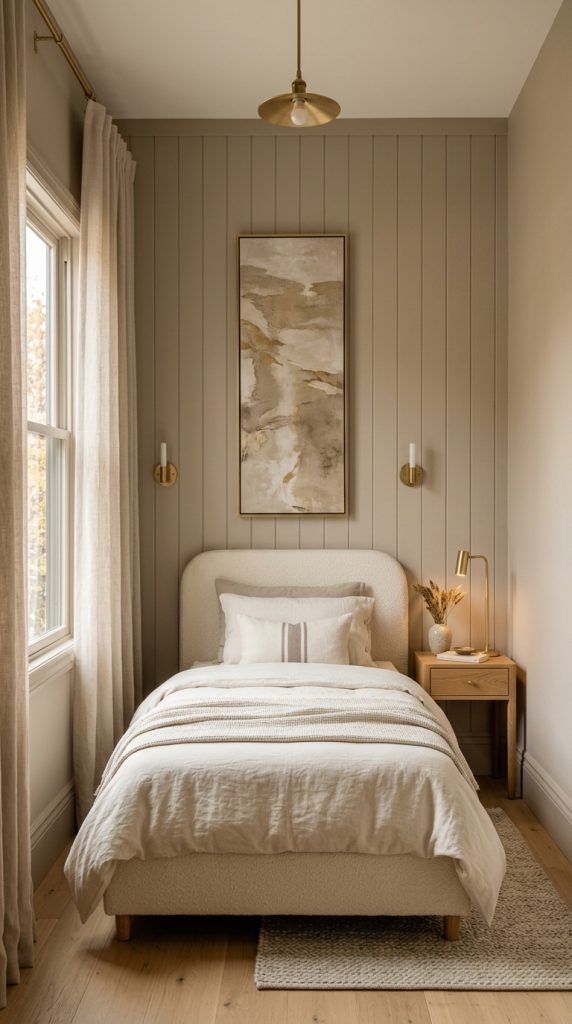
Vertical decorating can make walls appear taller and encourage the eye to move upward. Designers frequently recommend using vertical shelving, artwork, stripes, and tall decorative elements to maximize small spaces. (Architectural Digest)
Try tall artwork
Instead of a wide horizontal print, choose a vertical piece.
This works particularly well beside:
- A doorway
- A narrow dresser
- A reading chair
- A small console
- A compact desk
Use vertical paneling
Wood slats or narrow wall molding can emphasize height.
Paint the treatment in a color close to the wall for a subtle appearance.
For a dramatic effect, use a warm wood finish against a lighter wall.
Consider vertical wallpaper
Subtle stripes can visually elongate the wall.
A narrow botanical pattern can achieve a similar effect without looking overly formal.
Hang curtains high
Although curtains are not traditional wall decor, they strongly influence how the wall is perceived.
Mounting curtain hardware higher can visually extend the wall upward.
Choose full-length panels that fall close to the floor.
Keep the lower wall open
The more visual weight you place at floor level, the smaller the room can feel.
Use the upper wall strategically while allowing the lower portion to breathe.
6. Add a Sculptural Wall Sconce for Beauty and Function
Wall lighting is one of the smartest ways to combine decoration with functionality.
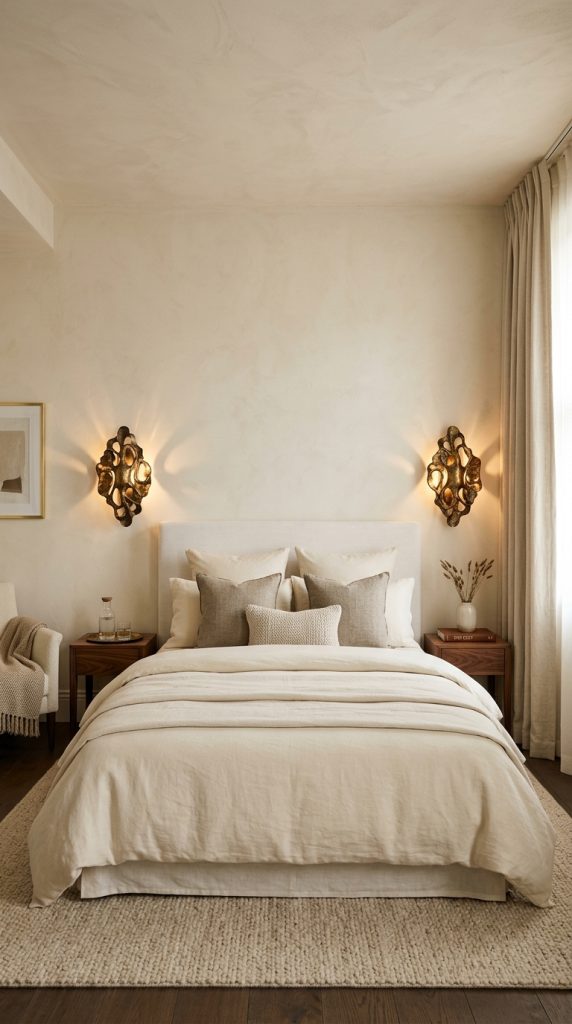
A beautiful sconce can become artwork while providing useful illumination.
This is particularly helpful in small spaces because it eliminates the need for a bulky floor lamp or large table lamp.
Architectural Digest’s 2026 vertical-design guidance notes that sconces, particularly those that direct light upward, can help draw attention toward the height of a room. (Architectural Digest)
Place sconces strategically
Use them:
- Beside a bed
- Above a desk
- On either side of artwork
- Beside a bathroom mirror
- Along a narrow hallway
- Above a small reading chair
Choose sculptural designs
Look for:
- Aged brass
- Bronze
- Ceramic
- Ribbed glass
- Opal glass
- Matte black
- Natural stone
- Sculptural metal
The fixture should complement your room’s existing finishes.
Make lighting part of the artwork
Instead of thinking of the sconce as merely functional, select one with a distinctive silhouette.
A sculptural fixture can become the focal point of an otherwise simple wall.
Use warm light
Warm lighting helps prevent small rooms from feeling stark.
Use dimmable fixtures where possible so you can adjust the atmosphere.
A soft evening glow can make a compact room feel considerably more intimate.
7. Try a Small-Scale Gallery Wall With a Cohesive Color Palette
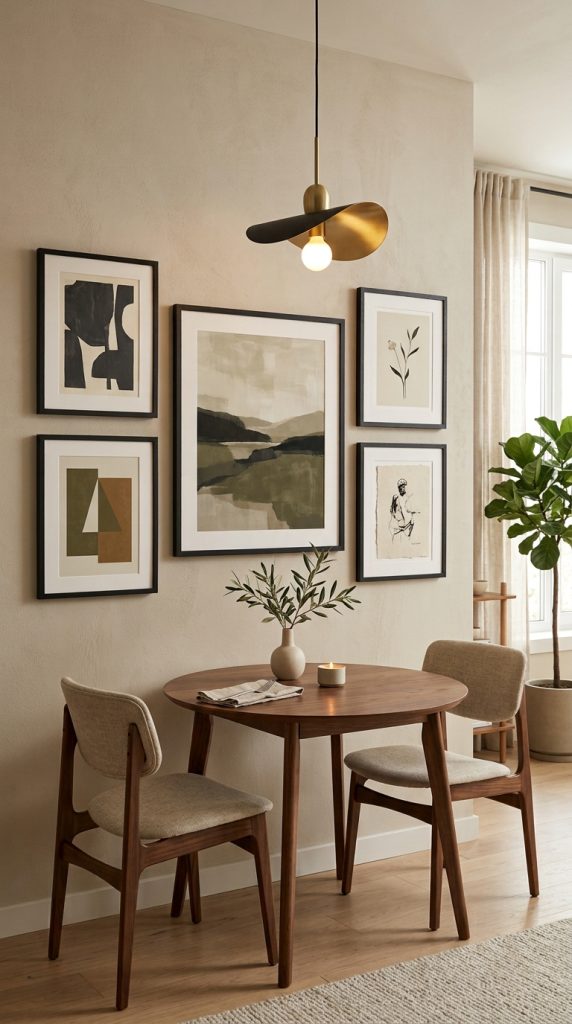
Although oversized artwork and picture ledges can be excellent alternatives to gallery walls, a gallery wall can still work beautifully in a small space when it is carefully edited.
The problem is not necessarily the number of frames. The problem is visual inconsistency.
Choose one theme
You could create a gallery around:
- Black-and-white photography
- Botanical prints
- Vintage landscapes
- Family photographs
- Abstract artwork
- Travel memories
A clear theme immediately creates cohesion.
Repeat the frame style
Matching frames are an easy way to make multiple pieces feel intentional.
Alternatively, mix frames while keeping one common element such as color, material, or width.
For example:
Black + walnut frames.
Or:
Natural wood + cream mats.
Keep the arrangement compact
Do not spread tiny pieces across an enormous wall.
Instead, create one concentrated composition.
Leave generous negative space around the gallery.
Use a consistent color palette
If every artwork contains different bright colors, the wall can become visually overwhelming.
Muted tones are especially effective in small spaces.
Try cream, black, taupe, brown, olive, dusty blue, or muted terracotta.
Add one unexpected element
A small mirror, woven object, or sculptural piece can break the repetitive quality of framed artwork.
Keep it to one or two unusual elements rather than turning the wall into a collection of everything you own.
8. Create a Textured Accent Wall With Wallpaper or Limewash
A small room can benefit from a dramatic wall treatment.
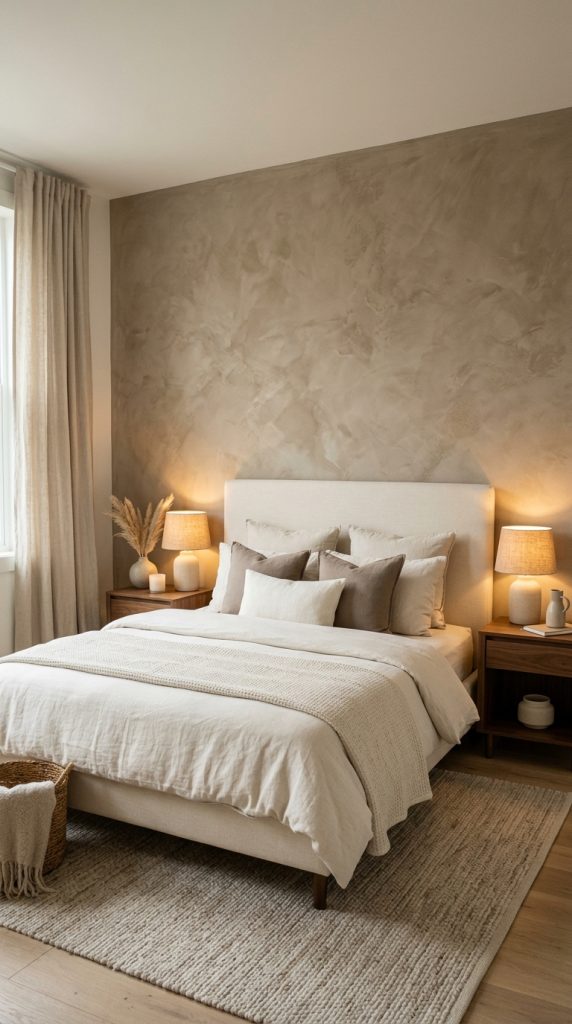
You do not necessarily need to leave small spaces completely plain.
Current small-space design commentary has pushed back against the idea that compact rooms must always use conservative decorating. Designers are increasingly using bold wallpaper, pattern, and richer treatments to give small rooms personality. (Architectural Digest)
Try subtle textured wallpaper
Consider:
- Linen-look wallpaper
- Grasscloth-inspired texture
- Fine stripes
- Small-scale botanical patterns
- Tonal geometric patterns
- Soft plaster-effect wallpaper
The pattern should support the room rather than compete with everything else.
Consider limewash
A softly mottled limewash-style finish can create depth without adding physical objects.
It works especially well in:
- Bedrooms
- Reading corners
- Small dining rooms
- Home offices
Use one feature wall
If the room already contains plenty of furniture, treat one wall as the focal point.
The remaining walls can stay quieter.
Match the treatment to your furniture
A textured beige wall pairs beautifully with warm wood.
A muted olive wall can work with cream upholstery.
A soft clay wall can complement walnut and brass.
A charcoal wall can provide a sophisticated backdrop for light artwork.
9. Hang a Large Textile or Woven Wall Art Piece
Wall textiles are an excellent way to introduce warmth and texture without adding bulky furniture.
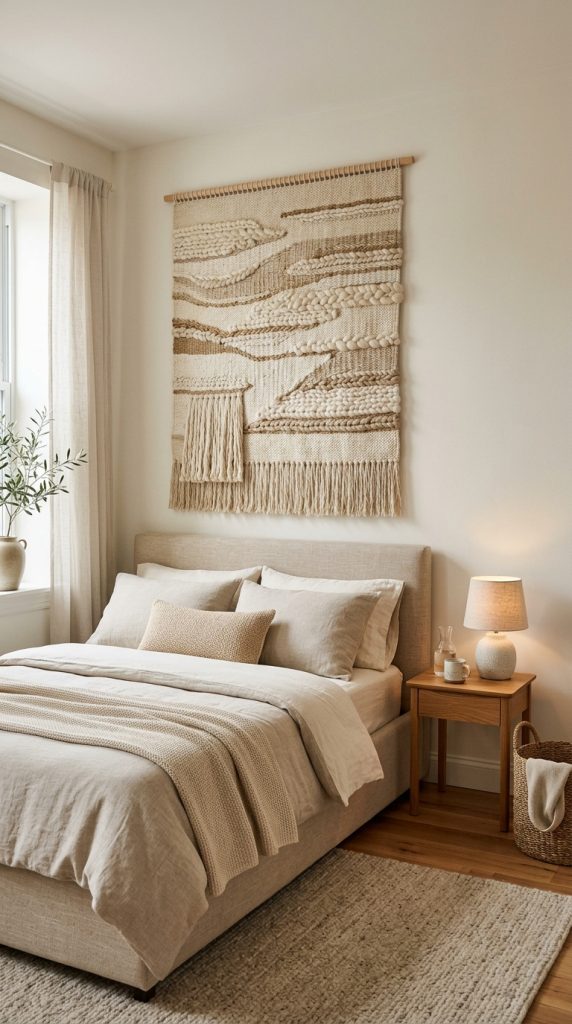
A woven wall hanging, textile artwork, vintage tapestry, or fabric panel can soften an otherwise hard wall.
Recent design coverage has highlighted the renewed popularity of woven wall art and tapestries because they add warmth, texture, character, and even acoustic benefits. (Homes and Gardens)
Choose one substantial textile
Rather than hanging multiple small woven pieces, select one that has enough visual presence to anchor the wall.
A large neutral textile can work beautifully in a minimalist bedroom.
A colorful woven piece can become the focal point in a neutral living room.
Consider the material
Options include:
- Wool
- Cotton
- Linen
- Jute
- Handwoven fibers
- Macramé
- Vintage textiles
Use textiles to soften modern rooms
If your room contains a lot of glass, metal, or polished surfaces, woven wall decor introduces softness.
It can also make minimalist rooms feel warmer and more lived-in.
Keep surrounding decor simple
A large textile already provides significant visual texture.
Avoid placing several busy artworks around it.
Let the material become the feature.
10. Use Narrow Wall-Mounted Cabinets in Tight Spaces
Wall-mounted cabinets are ideal when you need storage but do not have room for another piece of floor furniture.
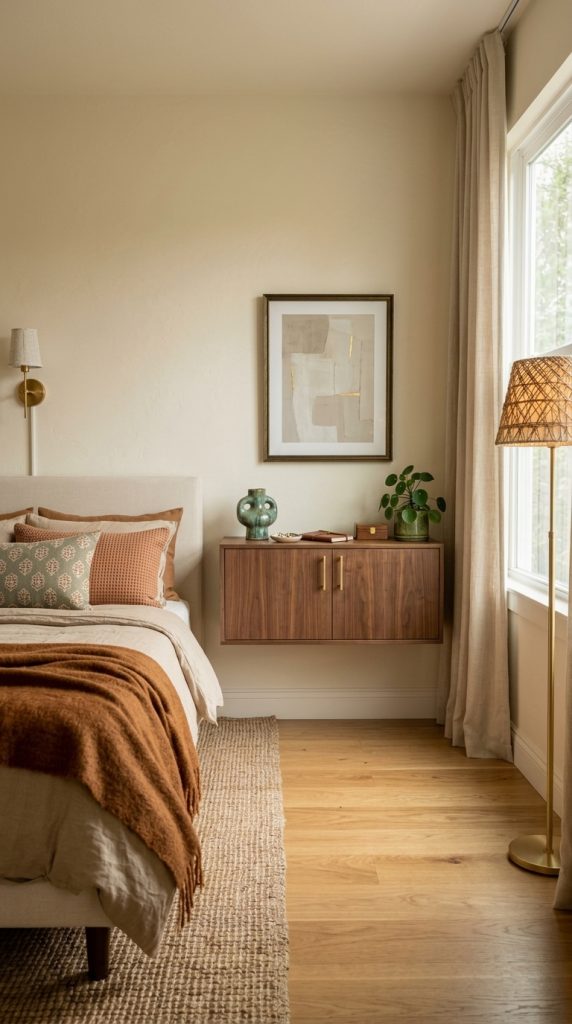
A shallow cabinet can store everyday objects while keeping them hidden.
This is especially useful in compact bedrooms, bathrooms, kitchens, and entryways.
Choose a shallow profile
The cabinet should not project too far into the room.
Measure the available wall carefully before purchasing or installing anything.
Hide visual clutter
Use the cabinet for items that would otherwise remain visible.
For example:
Bedroom:
- Accessories
- Small electronics
- Personal items
Entryway:
- Keys
- Small bags
Bathroom:
- Toiletries
- Towels
- Beauty products
Kitchen:
- Small serving items
- Pantry accessories
- Everyday supplies
Make the cabinet decorative
The cabinet itself can become part of the design.
Choose fluted wood, warm oak, walnut, painted cabinetry, cane, or a simple modern finish.
Add attractive hardware in brass, bronze, or black.
Keep the top lightly styled
If the cabinet has a visible top, place only one or two objects there.
A small vase or artwork is enough.
The goal is concealed organization, not another cluttered display surface.
11. Create a Slim Entryway Wall With Hooks and Decorative Art
Small entryways often become cluttered because they have no obvious place for everyday belongings.
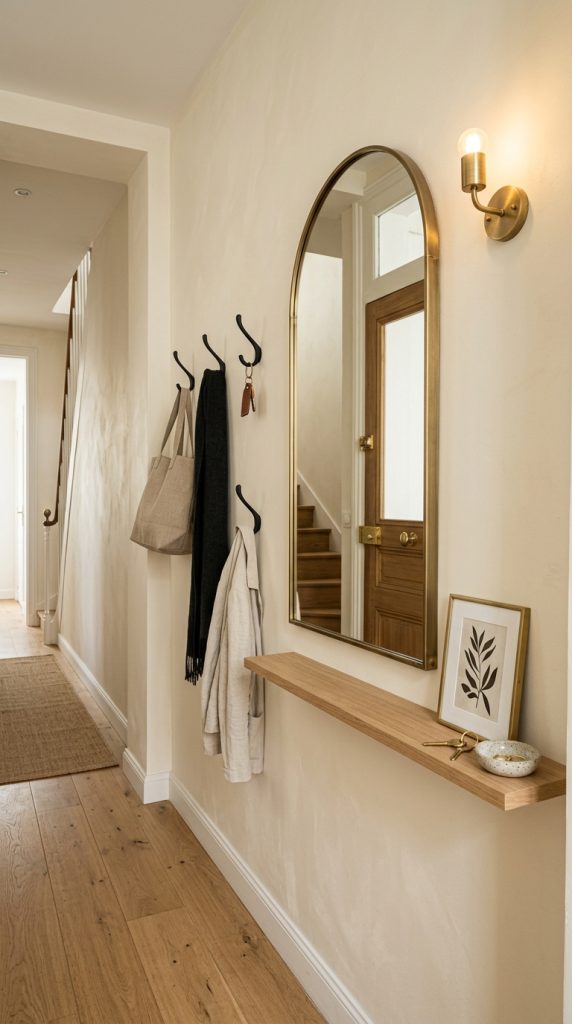
A wall can solve this problem.
Instead of adding a large console table, create a slim wall-mounted entry station.
Build the composition
Start with:
- One mirror
- Three or four hooks
- One narrow shelf
- One small artwork
This creates a complete entryway without requiring much floor space.
Choose attractive hooks
Hooks do not have to look purely functional.
Consider brass, black metal, natural wood, ceramic, or sculptural hooks.
Add a narrow ledge
A shallow ledge can hold:
- Keys
- Small tray
- Candle
- Tiny vase
- Mail organizer
Use the mirror as the focal point
The mirror provides practical functionality while also reflecting light.
This combination of mirror, hooks, ledge, and artwork is especially useful when there is no room for a traditional entry console. Architectural Digest has highlighted similar layered wall compositions as small-space solutions. (Architectural Digest)
Keep the floor clear
This is the biggest advantage.
The wall performs several functions without creating another obstacle in the walking path.
12. Decorate Around a Doorway or Window With Vertical Artwork
Awkward wall areas around doors and windows are often ignored.
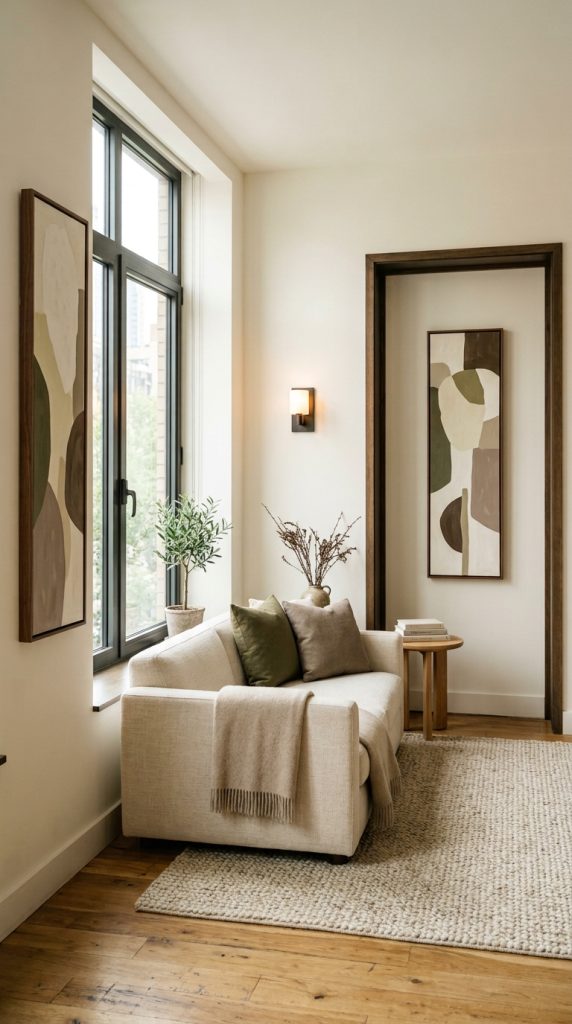
Instead of leaving these narrow spaces blank, use them for tall, slim artwork.
Use narrow proportions
Choose artwork that fits the wall without crowding the doorway or window.
A vertical botanical print, abstract painting, vintage poster, or framed textile can work beautifully.
Create visual rhythm
If you have two similar narrow wall spaces on either side of a doorway, consider placing related artwork on both sides.
They do not have to be identical.
The common color palette creates the connection.
Use height strategically
Position the artwork so that it guides the eye upward.
This can make the room feel taller while also giving purpose to otherwise awkward wall space.
Avoid overcrowding
Leave breathing room around door frames, windows, and trim.
Architectural features should remain visible.
The artwork should enhance the architecture rather than compete with it.
13. Use Architectural Molding for Elegant Wall Detail
If you want your small space to look expensive without adding lots of objects, architectural wall detail can be a powerful solution.
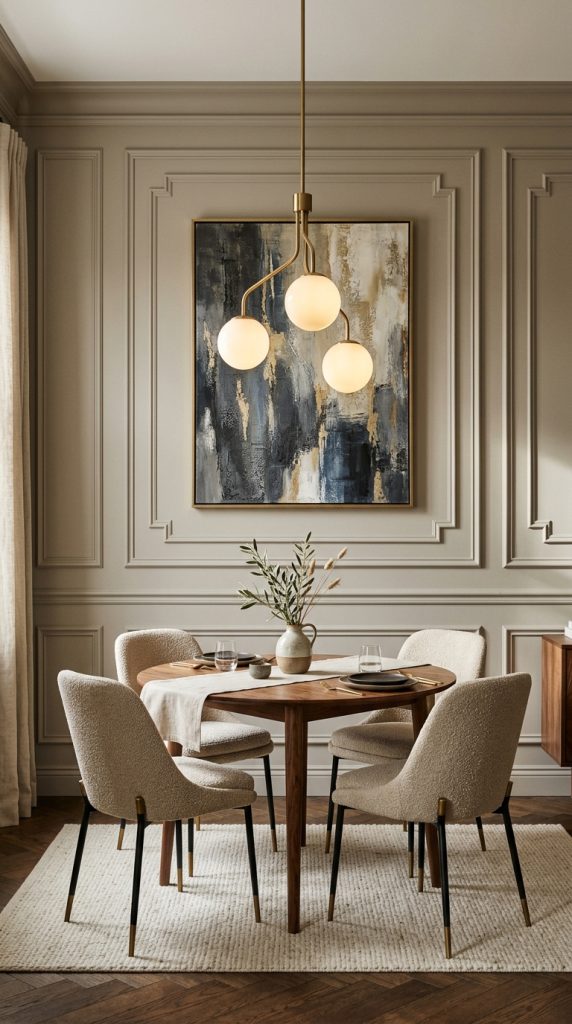
Panel molding, box molding, vertical trim, or simple wall battens can create depth without physically taking up room.
Keep the color subtle
One of the most sophisticated approaches is to paint the molding and wall the same color.
The design becomes visible through shadows and texture rather than strong contrast.
For example:
- Cream wall + cream molding
- Taupe wall + taupe molding
- Soft gray + soft gray
- Deep olive + deep olive
- Warm white + warm white
Use molding behind a bed
A bedroom wall can instantly look more custom with simple panel molding around the headboard.
Use it in a dining area
A small dining wall can feel architectural with a few large rectangular panels.
Add one artwork or mirror inside the central section.
Use vertical battens
Vertical wall battens can emphasize height.
They work particularly well in compact rooms with low ceilings.
Avoid overly complicated patterns
Small spaces usually benefit from clean geometry.
A simple panel design can feel more luxurious than an elaborate pattern covering every wall.
14. Create a Personalized Memento Wall Without Visual Clutter
Your home should not look like a showroom.
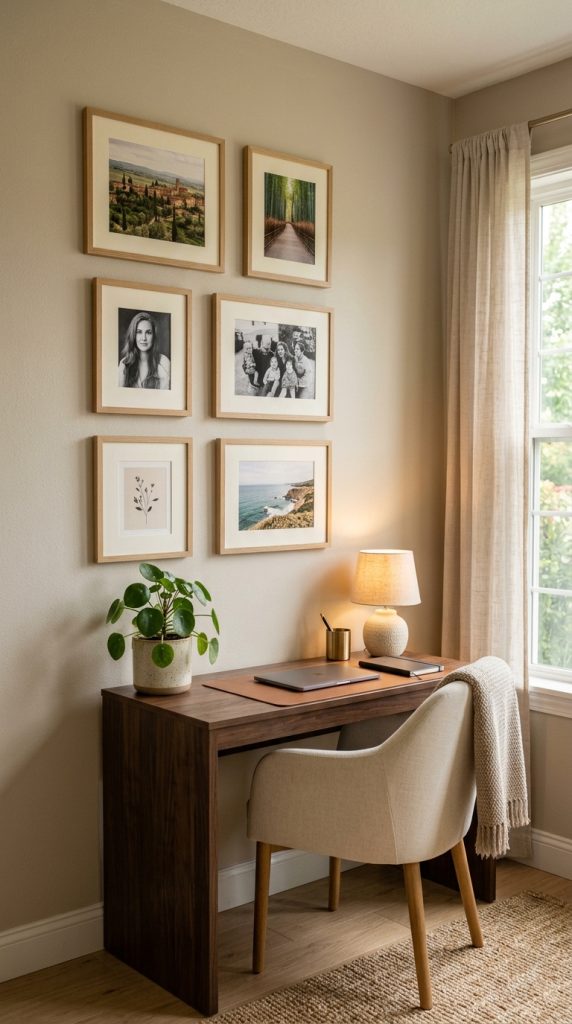
Personal objects make a space feel meaningful, but displaying too many can create visual chaos.
The solution is to create a deliberately edited memento wall.
Choose a category
Instead of displaying everything, choose one type of memory.
For example:
- Family photographs
- Travel photographs
- Children’s artwork
- Vintage postcards
- Collected botanical prints
- Small inherited artwork
Use consistent framing
Matching frames create structure even when the contents are different.
Black frames create a modern appearance.
Natural wood frames feel warmer.
Brass frames can create a more traditional look.
Limit the number of pieces
Choose the items that genuinely mean something.
A wall containing six favorite photographs will usually feel more sophisticated than one containing twenty-five random pictures.
Create breathing room
Do not fill every available inch.
Negative space gives personal collections a gallery-like quality.
Rotate the display
You do not have to display everything simultaneously.
Store some pieces and rotate them seasonally or when your taste changes.
This keeps the room fresh without adding more permanent wall clutter.
15. Use One Beautiful Wall Composition Instead of Many Small Decorations
Sometimes the best small-space wall decor idea is simply to create one complete composition.
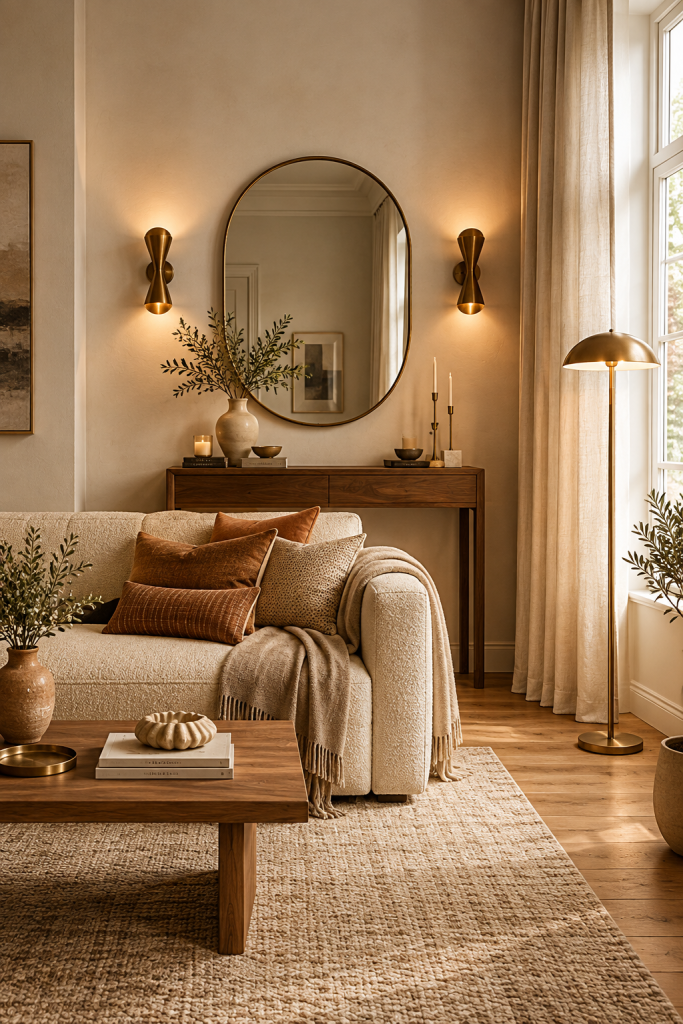
Instead of buying individual decorations for every empty section, design the entire wall as one visual arrangement.
Combine complementary elements
For example, a small living room could feature:
- One large round mirror
- One slim picture ledge
- One sculptural wall sconce
- Two framed artworks
The pieces work together as a single composition.
A bedroom could feature:
- Oversized headboard
- Two wall sconces
- One large artwork
- Minimal decorative accents
An entryway could feature:
- Tall mirror
- Narrow ledge
- Three hooks
- One small artwork
Repeat materials
The easiest way to make a mixed wall composition feel intentional is to repeat materials.
Use brass in the lighting and mirror frame.
Use walnut in the shelf and furniture.
Use cream and taupe in the artwork and textiles.
Establish one focal point
Not every element needs equal visual weight.
Choose the main feature first.
Everything else should support it.
Leave negative space
This is the most important rule.
A sophisticated wall does not need to be completely filled.
The empty areas allow the main pieces to stand out.
How to Choose Wall Decor for a Small Room
Before buying anything, consider five questions.
What does the room need?
Does the wall need decoration, storage, lighting, or a combination?
If you need storage, a floating shelf or wall-mounted cabinet may be more useful than artwork.
If the room feels dark, consider a mirror.
If the wall feels plain, choose artwork or texture.
What is the room’s focal point?
Do not allow wall decor to compete with an existing focal point.
If you already have a dramatic sofa, fireplace, or bed, choose wall decor that supports it.
What colors already exist?
Repeat colors that are already present.
This makes even inexpensive wall decor feel more coordinated.
How much visual weight can the room handle?
A small room does not necessarily need tiny decor, but it does need balance.
One large artwork can work beautifully.
Five large artworks may not.
Is the wall helping the room?
Every piece should either add beauty, function, or both.
If it does neither, it may not deserve the space.
How to Decorate Small Walls Without Making Them Look Cluttered
The secret is editing.
Start by choosing one focal point.
Then add one or two supporting elements.
For example:
Large mirror + small sconce
Large artwork + picture light
Floating shelf + three decorative objects
Wall cabinet + one artwork
Picture ledge + edited collection
This creates a visual hierarchy.
The eye knows what to look at first, second, and third.
Avoid giving every object the same visual importance.
Best Wall Decor Colors for Small Spaces
Color can either calm a small room or make it feel busy.
For a sophisticated small space, consider:
Warm neutrals
Cream, beige, taupe, oatmeal, and warm gray create a soft foundation.
Natural wood
Oak, walnut, and medium wood tones add warmth.
Soft black
Black frames, sconces, and hardware can create definition without requiring bright color.
Muted green
Olive and sage can bring an organic feeling.
Dusty blue
Soft blue works particularly well in bedrooms and bathrooms.
Warm metallics
Brass and aged bronze can provide a subtle luxury effect.
Rather than introducing many unrelated colors, repeat two or three shades throughout the room.
Wall Decor Ideas for Small Apartments
Apartment walls can be especially challenging because floor space is limited and some renters cannot make permanent changes.
If drilling is restricted, consider removable or lightweight solutions where appropriate and follow your lease requirements.
Useful apartment-friendly approaches include:
- Large lightweight mirrors
- Removable wallpaper
- Picture ledges where permitted
- Leaning artwork when floor space allows
- Slim floating-style shelves with appropriate installation
- Framed textiles
- Decorative removable hooks
- Large artwork as a focal point
If the apartment has plain white walls, warm wood frames, woven textures, and soft artwork can make it feel much more personal.
Wall Decor Ideas for Small Bedrooms
A small bedroom benefits from wall decor that performs more than one job.
Wall sconces can provide bedside lighting.
A picture ledge can replace multiple framed pieces.
An oversized mirror can provide dressing functionality.
A wall-mounted cabinet can provide storage.
An upholstered or wood-paneled headboard can become the primary decorative wall.
Keep the area around the bed particularly calm because excessive visual activity can make the room feel less restful.
Wall Decor Ideas for Small Living Rooms
In a small living room, the wall behind the sofa is often the most important decorative area.
Consider:
- One oversized artwork
- A large mirror
- Two picture ledges
- A slim gallery wall
- Wall sconces
- A combination of artwork and lighting
Do not automatically choose several tiny frames simply because the room is small.
A substantial focal piece can actually make the room feel more intentional.
Wall Decor Ideas for Small Entryways
Entryways need to be both attractive and functional.
If there is no room for a console, use the wall.
A large mirror can sit above a narrow shelf.
Hooks can hold everyday bags.
A tiny ledge can collect keys.
One small artwork can add personality.
This creates an entryway moment without requiring a bulky piece of furniture.
How to Make Small-Space Wall Decor Look Expensive
Luxury is often about restraint.
Choose fewer pieces with stronger visual impact.
Use quality-looking materials such as:
- Natural wood
- Linen
- Ceramic
- Stone
- Aged brass
- Bronze
- Glass
- Textured paper
- Woven fibers
Repeat finishes throughout the room.
Avoid covering every surface.
Use large-scale artwork where appropriate.
Choose frames with substantial-looking profiles.
Most importantly, keep everything intentional.
A $30 artwork displayed beautifully can look more sophisticated than an expensive artwork surrounded by clutter.
Common Wall Decor Mistakes in Small Spaces
Filling every wall
A room needs empty space.
Blank walls can help decorative features stand out.
Using too many tiny objects
Small objects often create visual noise.
Try grouping fewer, larger pieces.
Ignoring scale
Tiny artwork above a large sofa can look disconnected.
Large furniture often requires larger wall decor.
Blocking natural light
Do not position bulky wall storage where it interferes with windows or natural light.
Hanging everything too high
Vertical decorating does not mean every artwork should touch the ceiling.
Use the furniture below it to determine appropriate placement.
Mixing too many frame finishes
A carefully mixed collection can work, but too many unrelated frames can look chaotic.
Ignoring functionality
Wall decor should not interfere with doors, windows, switches, outlets, or walking paths.
Decorating without a focal point
If everything demands attention, nothing becomes the focal point.
Choose one main feature.
A Simple Formula for Clutter-Free Small-Space Walls
If you are unsure where to begin, use this simple formula:
1 major focal point + 1 functional element + plenty of negative space.
For example:
Bedroom:
Large artwork + wall sconce + empty space
Living room:
Oversized mirror + picture ledge + open wall area
Entryway:
Mirror + hooks + narrow shelf
Home office:
Large artwork + floating shelf + organized accessories
Dining area:
Statement artwork + sculptural sconce + clean surrounding wall
This formula creates enough visual interest without turning the wall into a storage dump.
Final Thoughts
Decorating a small space does not mean sacrificing personality, elegance, or creativity. In fact, limited square footage can encourage better design decisions because every element has to earn its place.
The most successful wall decor ideas for small spaces combine beauty with intention. A mirror can make the room feel brighter and more open. A picture ledge can display artwork while remaining flexible. Floating shelves can provide storage without consuming floor space. Vertical artwork can emphasize height. Wall sconces can provide both lighting and decoration. A textured wall can create character without adding physical clutter.
The biggest lesson is that small rooms do not necessarily need smaller decoration. They need better-proportioned decoration.
One oversized artwork can create more impact than ten tiny prints. One sculptural mirror can do more for a room than several small decorative objects. One carefully styled shelf can provide both storage and personality.
Current 2026 small-space design thinking increasingly supports this approach, with designers encouraging homeowners to use vertical space, reflective surfaces, large-scale artwork, flexible picture ledges, and wall-mounted storage rather than allowing valuable floor space to become crowded. (Homes and Gardens)
The key is to create visual hierarchy.
Choose one focal point.
Support it with one or two complementary elements.
Repeat a few colors or materials.
Leave room around everything.
And always consider what the wall can contribute beyond decoration.
When you approach wall decor this way, even a compact apartment or small room can feel sophisticated, spacious, organized, and highly personal.
Your goal is not to decorate every inch.
Your goal is to make every chosen inch count.
Leave a Reply