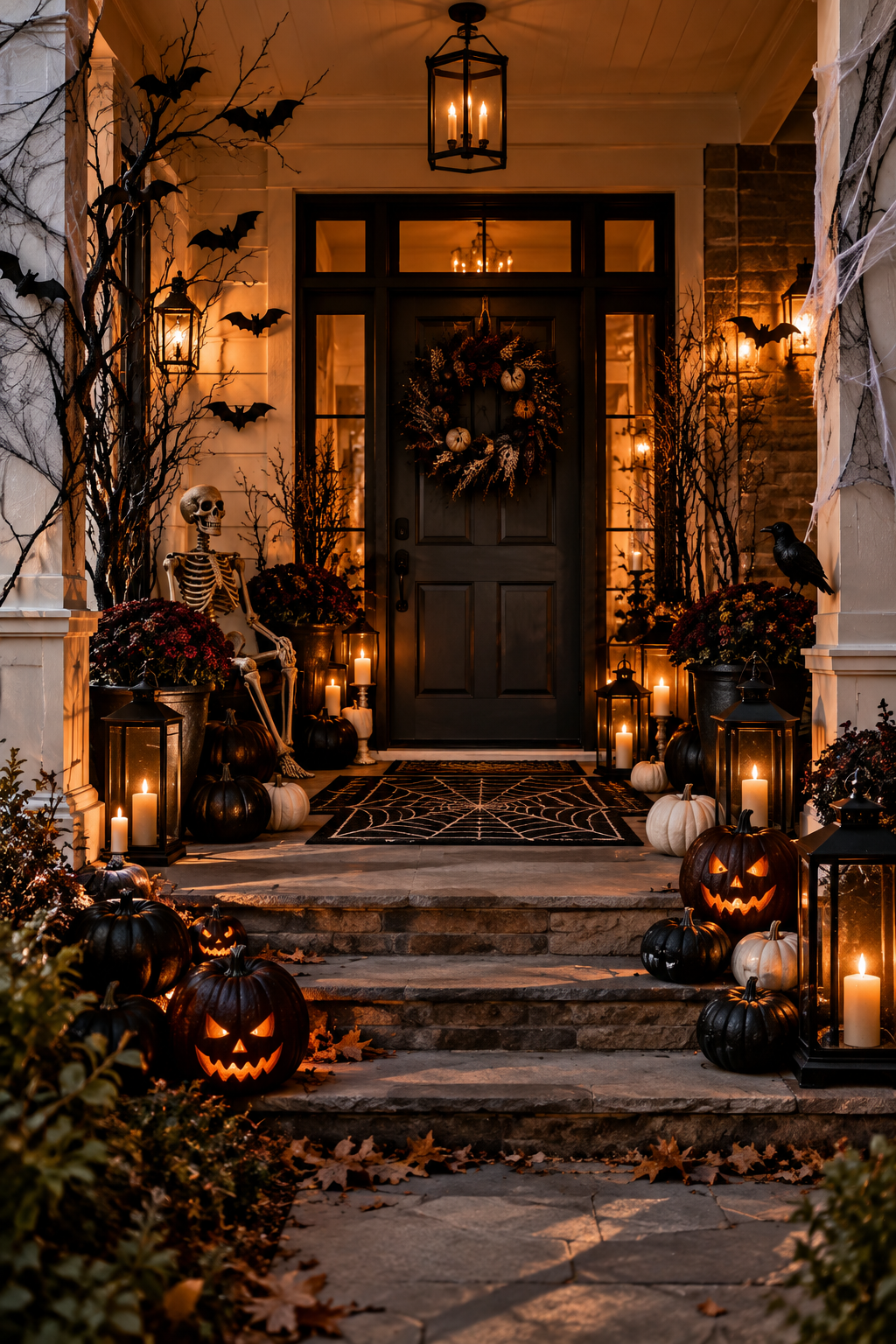
Halloween is the perfect time to transform an ordinary front porch into a dramatic entrance that immediately sets the mood for the rest of the home. Scary Halloween porch ideas can range from eerie and mysterious to genuinely frightening, depending on how intense you want the atmosphere to feel. A well-designed Halloween porch does not need to be filled with random decorations. Instead, the most effective spooky displays use lighting, shadows, texture, sound, height, and carefully positioned props to create a scene that feels intentional.
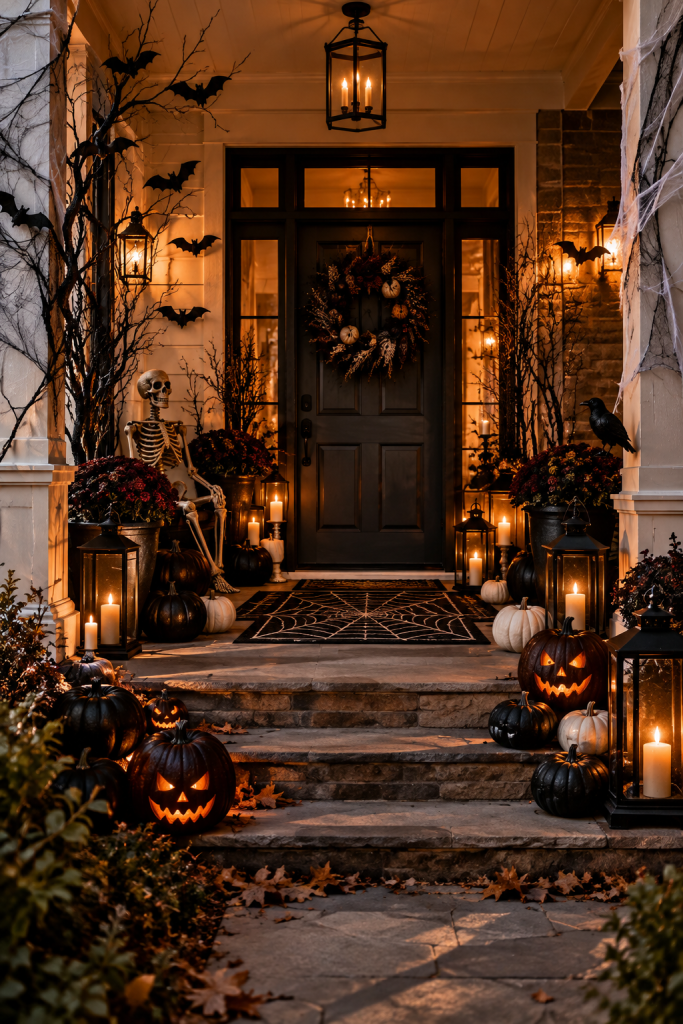
The front porch is especially important because it is the first part of the home guests, neighbors, trick-or-treaters, and visitors see. Unlike indoor Halloween decorating, porch decorating has the advantage of natural darkness, outdoor shadows, changing weather, and architectural features that can all contribute to the atmosphere. A staircase can become part of a haunted entrance. A doorway can look like the entrance to an abandoned house. A porch railing can disappear beneath artificial cobwebs. A simple pathway can become an eerie passage surrounded by ghostly silhouettes.
The key to creating a genuinely scary Halloween porch is not simply adding more decorations. Too many props competing for attention can actually make the display less frightening because the eye has nowhere specific to focus. A better approach is to create a visual story.
Imagine walking toward a dark porch after sunset.
The pathway is barely illuminated.
A few twisted branches cast long shadows across the ground.
An old lantern flickers beside the front door.
A weathered chair sits beneath a dark window.
A life-size figure stands quietly in the corner.
Above the entrance, something moves slightly in the wind.
Nothing is completely obvious.
That uncertainty is what creates suspense.
A spooky porch can be much more effective when some areas are left dark rather than illuminated. Shadows allow the imagination to fill in what cannot be seen. Instead of lighting every decoration equally, use light selectively to highlight certain objects while allowing others to remain partially hidden.
Color also has an important role.
Traditional orange and black can create a recognizable Halloween appearance, but a more frightening porch can use charcoal, deep burgundy, aged brown, gray, muted orange, and dark green alongside black. These colors can make the display feel more atmospheric and less like a collection of brightly colored holiday decorations.
Lighting deserves particular attention.
Warm amber lights can create an old haunted-house feeling. Cool white or pale blue lighting can create a colder, ghostly atmosphere. Red lighting can be dramatic when used sparingly. Flickering lights can suggest an abandoned or unstable environment.
However, the most effective lighting is often a combination rather than a single color.
A warm lantern near the door can provide a welcoming but eerie glow while a dim cooler light illuminates a shadowy figure farther away.
Texture can make a porch feel much more convincing.
Weathered wood, burlap, aged metal, artificial moss, rough rope, dried branches, gauze, distressed fabric, and tangled vines can all contribute to a haunted atmosphere. These materials create visual depth even when the colors remain dark.
The porch architecture should also be considered.
If you have columns, wrap them with subtle vines or cobwebs.
If you have railings, use them to create depth with hanging fabric or skeletal decorations.
If your porch has steps, use each level to create a gradual transition from the yard to the doorway.
If you have a covered porch, take advantage of the ceiling and upper areas.
Hanging ghosts, bats, branches, lanterns, and suspended props can make the entire space feel immersive.
Safety should always remain part of the design.
Keep stairs and walking paths clear.
Secure decorations against wind.
Keep electrical cords protected and away from standing water.
Use outdoor-rated lighting where appropriate.
Keep open flames away from fabric, dried vegetation, paper, and other flammable decorations.
Battery-operated candles and outdoor-rated LED lighting can create atmospheric effects without requiring open flames.
The following ten ideas are designed to create different types of scary Halloween porches. You can choose one complete theme or combine elements carefully to create a personalized haunted entrance.
1. Create a Haunted House Entrance With Dark Lighting
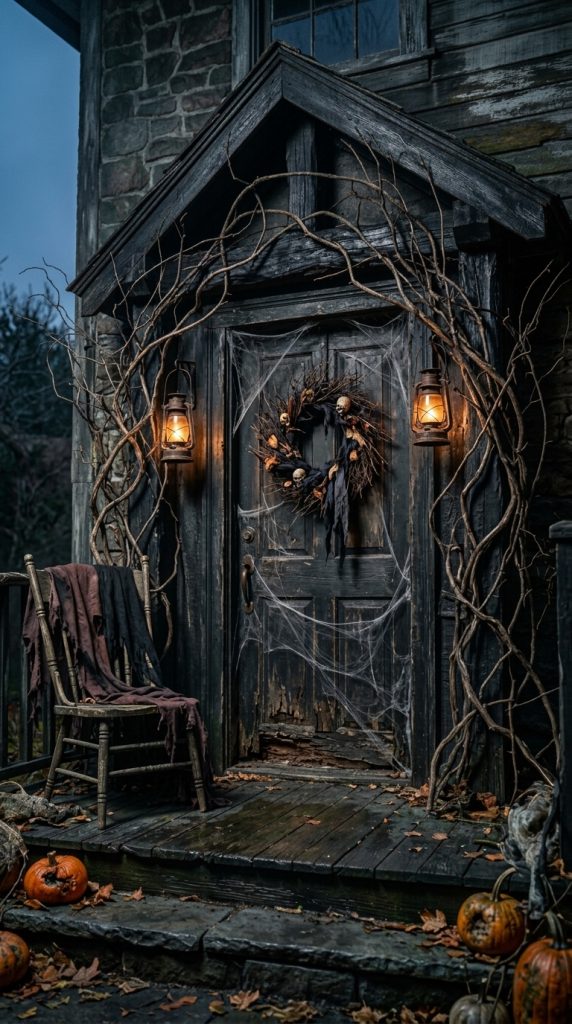
One of the most effective ways to make a porch look genuinely frightening is to transform the entire entrance into a haunted-house scene.
Instead of concentrating on individual decorations, focus on changing the atmosphere of the porch itself.
Start with the front door.
A dark or weathered-looking door provides an excellent foundation. If your door is already black, charcoal, dark brown, or deep green, you have an ideal starting point. If it is a lighter color, you can create contrast by surrounding it with darker decorations rather than trying to change the door permanently.
Add an old-looking wreath.
Instead of using a cheerful autumn wreath, choose one made from dark branches, dried foliage, black leaves, or twisted vines. Add a few subtle elements such as small ravens, dark flowers, or distressed ribbon.
Keep the wreath relatively simple.
The doorway should feel mysterious rather than covered in decorations.
Next, create darkness around the entrance.
Place warm lanterns or dim outdoor lights on either side of the door. The lighting should illuminate the doorway without making every decoration completely visible.
The areas outside the light should remain darker.
This creates a natural transition between visibility and shadow.
Add weathered wooden elements around the entrance.
Old-looking crates, distressed boards, or vintage-style signs can create the impression that the house has been abandoned.
You can use a few carefully selected pieces rather than covering the porch with props.
One of the strongest additions is an old chair.
Place it slightly away from the center of the doorway.
The chair can hold a dark fabric, an artificial crow, or a weathered lantern.
The object becomes more mysterious because it looks like something that might actually belong in an abandoned home.
Artificial cobwebs can be used around the doorframe, but apply them selectively.
Stretch them across corners, railings, and architectural details rather than covering every surface.
Natural-looking irregularity is more convincing than a thick layer of white material.
You can also add black branches.
Place tall twisted branches in a large outdoor planter beside the entrance.
Their silhouettes will become dramatic after sunset.
If the branches are positioned near a light source, they can cast shadows onto the wall.
Those shadows become part of the decoration.
The final element should be sound.
A low-volume outdoor speaker can play subtle environmental sounds such as distant wind, creaking wood, or quiet atmospheric effects.
Avoid making the sound constant and overwhelming.
A subtle soundscape can create more suspense.
The result should feel like a house with a story.
Guests should feel as though they are approaching somewhere they are not completely sure they want to enter.
2. Build a Creepy Cemetery on the Front Porch
A miniature cemetery is a classic Halloween theme, but it can become much more sophisticated and frightening when the arrangement is carefully designed.
The first step is deciding how much of the porch and yard you want to use.
If you have a small porch, create a compact cemetery scene around the entrance.
If you have a larger front yard, extend the cemetery outward so that the porch becomes the center of the scene.
Use artificial tombstones with different heights and shapes.
Avoid arranging them in a perfectly straight line.
Instead, create an irregular pattern.
Some tombstones can appear slightly tilted.
Others can be partially hidden behind artificial fog, plants, or fabric.
This irregularity makes the scene feel older.
Place the tallest tombstone toward the back.
Use medium-sized stones around it.
Keep shorter pieces toward the front.
This creates depth.
You can also add small ground-level props.
Artificial bones, skeletal hands, old lanterns, and weathered signs can be placed near the tombstones.
Use these pieces sparingly.
A few strategically positioned objects can be more effective than covering every inch of the ground.
Lighting is particularly important for a cemetery.
Instead of brightly illuminating every tombstone, place small lights near the ground.
A dim amber light can illuminate one stone.
Another cool-toned light can highlight a different section.
This creates visual separation.
Artificial fog can add another layer.
If you use a fog machine, position it so the fog remains low and does not obscure stairs or walking paths.
The fog should move through the scene rather than creating a thick cloud everywhere.
Add dead-looking vegetation.
Dark grasses, bare branches, artificial moss, and dried foliage can soften the edges of the cemetery props.
This helps the tombstones feel integrated into the landscape.
You can also create a pathway through the cemetery.
Use lanterns to mark the edges.
Keep the walkway completely clear.
The pathway itself becomes part of the story because visitors have to move through the scene.
For an extra eerie detail, add a shadowy figure behind the cemetery.
It does not need to be immediately obvious.
A partially concealed silhouette can create suspense.
The goal is to make visitors look twice.
A cemetery display works especially well with older homes, traditional porches, brick houses, and homes with mature landscaping.
The architectural character provides a natural backdrop for the haunted scene.
3. Create a Ghostly Porch With Hanging Spirits
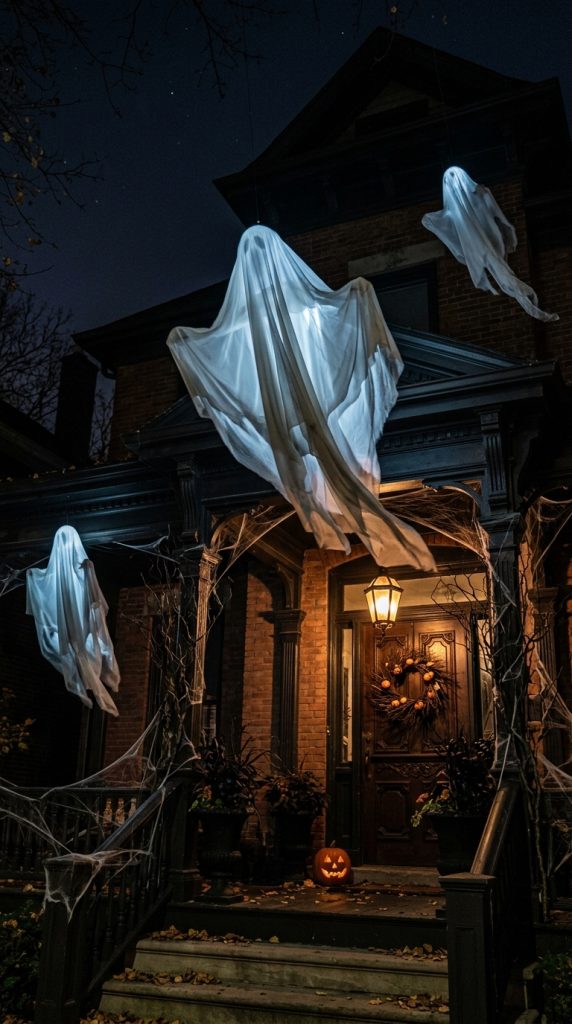
For a more supernatural Halloween porch, create an environment filled with ghostly figures.
The main advantage of hanging ghosts is that they use vertical space.
Instead of occupying the floor, they float above it.
This can make a porch feel much more immersive.
Begin with one large central ghost.
Place it above or slightly beside the entrance.
The figure should be high enough that it does not interfere with anyone walking beneath it.
Then add smaller ghostly forms at different heights.
Do not place them all at the same level.
Varying heights create movement.
Some ghosts can hang near the ceiling.
Others can appear farther out toward the porch edge.
One or two can be positioned closer to the yard.
Use lightweight outdoor-safe materials appropriate for the weather conditions.
Flowing white or pale gray fabric can create the appearance of floating figures.
The fabric should move naturally in the wind.
Avoid making every ghost identical.
Different sizes create a more believable scene.
Lighting should come from below or behind.
A small light positioned beneath a ghost can illuminate the fabric and create dramatic shadows.
Another option is placing a dim light behind the figure so it becomes a silhouette.
The second technique can be particularly effective because it hides details.
You can also use pale blue or cool white illumination for a colder atmosphere.
Keep warmer lights near the doorway so the entrance remains visible.
Add a few dark elements around the ghosts.
Black branches, dark lanterns, or shadowy planters can create contrast.
The combination of pale ghostly forms and dark surroundings creates a strong visual effect.
Avoid filling the entire porch with white fabric.
Too much fabric can make the display look messy.
Instead, create a few distinct floating figures with plenty of dark space between them.
You can also add subtle movement.
Lightweight hanging elements that sway in the wind can create an unsettling effect.
If you use electronic moving props, choose outdoor-rated equipment and secure everything carefully.
A ghostly porch works particularly well for homes with covered entrances because the overhead structure provides natural attachment points for hanging decorations.
The final scene should look as though the porch has become occupied by things that do not belong there.
4. Turn the Porch Into a Dark Spider-Web Tunnel
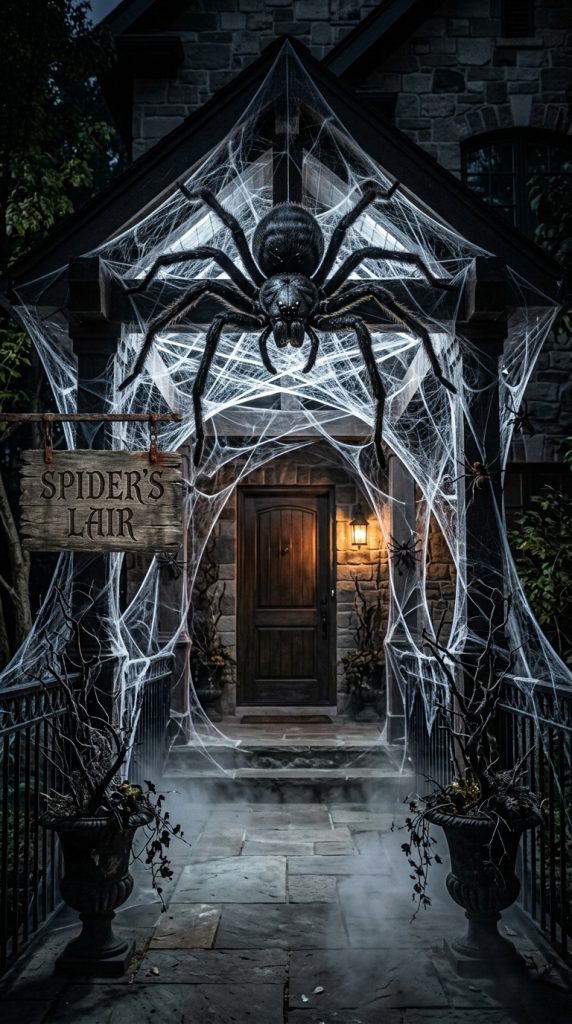
For a dramatic Halloween entrance, transform the walkway or porch into a giant spider-web passage.
This theme works particularly well if your porch has columns, railings, or a covered walkway.
Begin at the outer edge of the porch.
Stretch artificial web material across selected areas.
Do not make the web perfectly symmetrical.
Pull it unevenly across railings and corners.
Allow sections to hang slightly lower.
Then add oversized artificial spiders.
Use different sizes.
One large spider can become the primary focal point.
Smaller spiders can be positioned farther away.
Place the largest spider somewhere that visitors will notice immediately, but keep it away from the actual walking path.
You can also position one spider above the doorway.
The contrast between the dark spider and the lighter web creates a strong visual focal point.
Lighting can make the web dramatically more visible.
Use a light positioned behind or beneath the web so the strands catch the illumination.
A warm amber light can create an old haunted-house feeling.
A cool white light can make the web feel colder and more unnatural.
Avoid illuminating the entire porch evenly.
Allow some areas of web to disappear into darkness.
This creates depth.
Add black branches around the entrance.
They can look like the spider web has spread into surrounding vegetation.
A weathered sign can add storytelling.
For example, a simple distressed sign could suggest that visitors are entering a forbidden area.
Keep the lettering limited.
The visual scene should remain the main attraction.
The spider-web theme can also extend to planters.
Place dark artificial vines around the base of a planter.
Allow some strands to trail naturally.
Do not cover every plant.
The contrast between ordinary landscaping and the web creates a more believable effect.
For safety, make sure web material does not obstruct handrails, steps, door handles, lighting fixtures, or pathways.
Secure loose material against wind.
The result should feel like visitors are walking into a giant hidden spider lair.
5. Create a Sinister Witch’s Porch
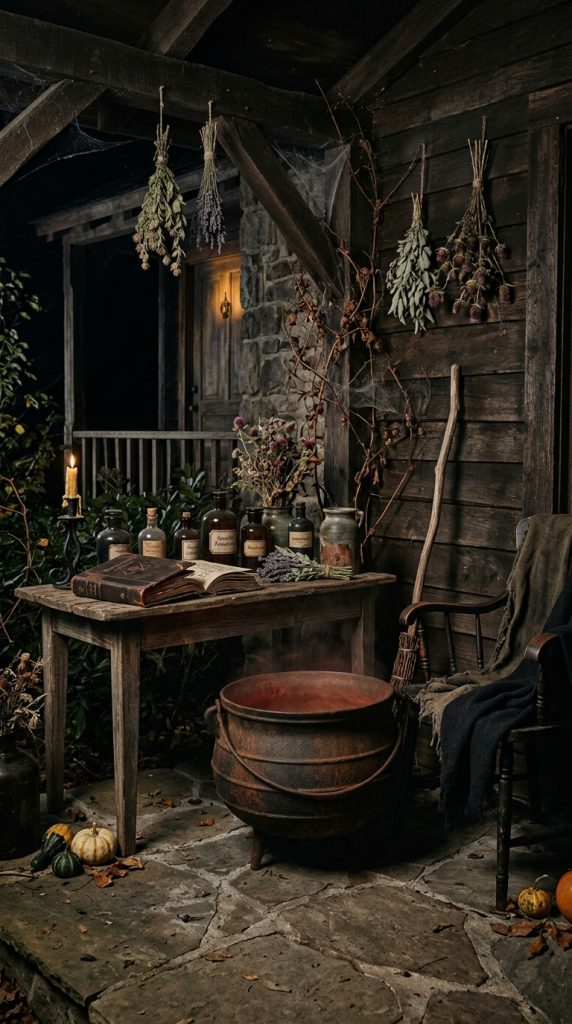
A witch-themed porch can be spooky without relying on an overwhelming collection of cartoon-style Halloween decorations.
The key is to create the impression that a mysterious witch lives inside the house.
Start with an old-looking wooden table or small console.
Place it against one side of the porch.
On the table, arrange dark bottles, an old-looking book, a black candle holder, dried herbs, and a dark ceramic vessel.
Keep the objects arranged like a working collection rather than a random Halloween display.
A large black cauldron can become another focal point.
Place it safely away from the walkway.
If you want to create a glowing effect inside the cauldron, use battery-operated lighting rather than an exposed flame.
A low red or amber glow can create a mysterious atmosphere.
Add a broom.
Lean it against a wall or place it beside the table.
A pointed witch hat can be positioned nearby, but keep the styling restrained.
The scene should feel atmospheric rather than humorous.
Lighting can transform the display.
Use one warm lantern near the table.
Add a dim colored light behind the cauldron.
Keep the rest of the porch darker.
You can also add hanging herbs or dried branches.
Tie small bundles together and hang them from a protected area.
Use natural-looking materials and avoid placing anything that could easily fall onto a walkway.
A vintage-style mirror can add another layer.
Position it against the wall where it can reflect a dim light or another part of the porch.
The reflection can create an unsettling visual effect.
A dark chair can complete the scene.
Place it slightly away from the main arrangement.
Add a dark shawl or distressed fabric.
Avoid placing a person inside the chair.
The empty chair itself can feel more mysterious.
You can also use a shadowy witch silhouette behind a window.
This creates the impression that something is moving inside the house.
The silhouette should remain subtle.
The goal is suspense rather than a fully explained scene.
A witch’s porch works particularly well with dark green, black, brown, burgundy, and antique brass.
These colors create an old-world atmosphere that feels more sophisticated than bright Halloween colors.
6. Design a Sinister Scarecrow and Harvest Porch
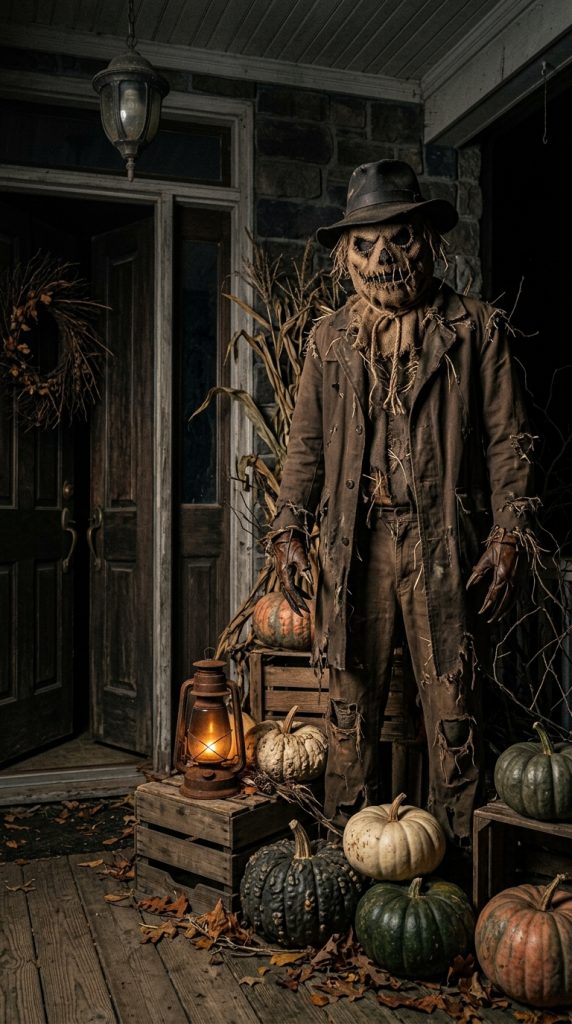
For a frightening fall porch that still incorporates seasonal autumn elements, create a sinister scarecrow display.
Instead of a cheerful harvest arrangement, use weathered textures and darker colors.
Begin with the scarecrow.
Choose a figure with worn clothing, distressed fabric, and an aged appearance.
Position it slightly to the side rather than directly in front of the door.
This creates an element of surprise.
The scarecrow can stand beside a stack of wooden crates or old barrels.
Add muted pumpkins around the base.
Choose colors such as:
- Charcoal
- Dark green
- Muted orange
- Cream
- Brown
Avoid making every pumpkin bright orange.
The darker palette creates a more ominous appearance.
Add dried cornstalks or tall grasses behind the scarecrow.
Their height creates a strong vertical background.
At night, these plants can cast long shadows.
Lighting should be low and directional.
Place a warm light near the ground so it illuminates the scarecrow from below.
This creates dramatic shadows across the face.
Avoid a bright overhead light.
The upward lighting technique makes the figure appear much more unsettling.
You can add an old lantern beside the scarecrow.
If using a real lantern with a flame, ensure it is positioned safely away from dry vegetation and fabric. Battery-operated lanterns are often easier for a decorative display.
A wooden sign can add atmosphere.
Use a weathered finish and simple lettering.
The sign should support the scene without becoming the focal point.
Add a few crows.
One artificial crow perched on a crate or branch can be enough.
Multiple birds may make the display feel overly themed.
The scarecrow should remain the main character.
This idea is especially useful if you want a porch that transitions naturally from autumn to Halloween.
After Halloween, remove the frightening details and keep the pumpkins, dried plants, wooden crates, and lanterns for the rest of the fall season.
7. Create a Victorian Haunted Porch
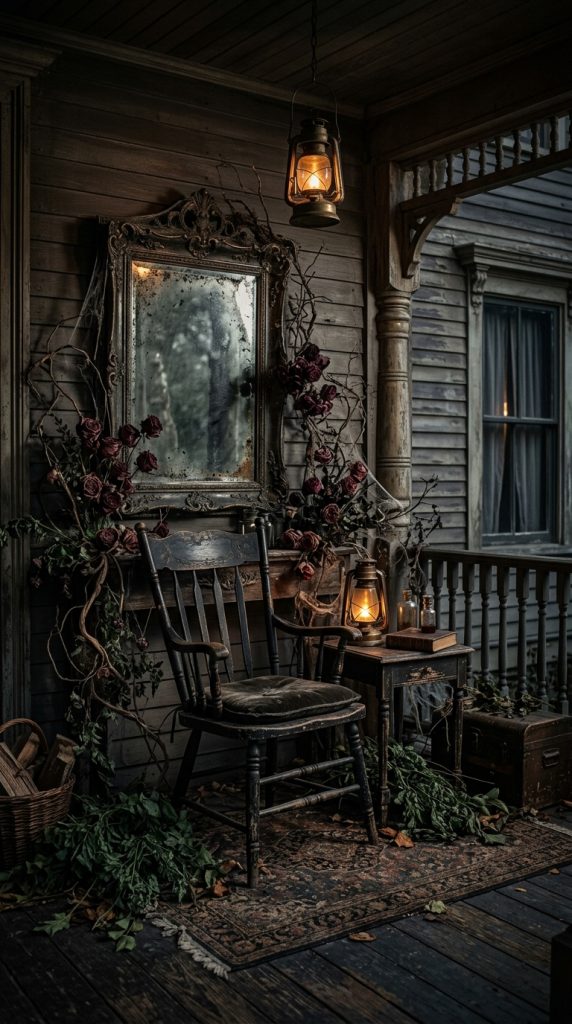
For a more sophisticated scary Halloween look, use Victorian-inspired styling.
This theme works particularly well with older homes, traditional architecture, dark wood, brick, ornate railings, or covered porches.
Start with the lighting.
Use vintage-style lanterns with warm amber bulbs.
The glow should be soft rather than extremely bright.
Next, add dark furniture.
A weathered wooden chair or antique-style bench can become the foundation of the display.
Place it against one wall.
Add a dark cushion or distressed textile.
A large vintage-style mirror can create another focal point.
Position it so that it reflects the porch rather than directly reflecting the street.
The reflection can add visual depth.
Black or deep burgundy flowers can be arranged in a dark vase.
Dried roses, branches, or deep-colored foliage can create an old-world atmosphere.
Add an antique-style picture frame.
The frame can contain a dark botanical print, an old-fashioned portrait-style artwork, or another suitably mysterious image.
Keep the artwork tasteful.
The goal is to create a haunted historical atmosphere rather than a crowded Halloween store.
Architectural details can be enhanced with artificial vines.
Allow them to grow around one column or along one section of railing.
Do not cover the entire porch.
Use aged brass accessories where appropriate.
A brass candle holder, lantern, or tray can add warmth against the dark colors.
Black and antique brass create a particularly sophisticated combination.
Add subtle cobwebs around corners.
The cobwebs should look old and neglected.
The lighting can cast shadows across the wall and furniture.
For additional atmosphere, use quiet sound effects such as distant wind, an old clock, or soft creaking sounds.
The Victorian porch should feel as though it has been untouched for decades.
Its strength comes from atmosphere, age, and restraint.
8. Build a Skeleton-Filled Haunted Entry
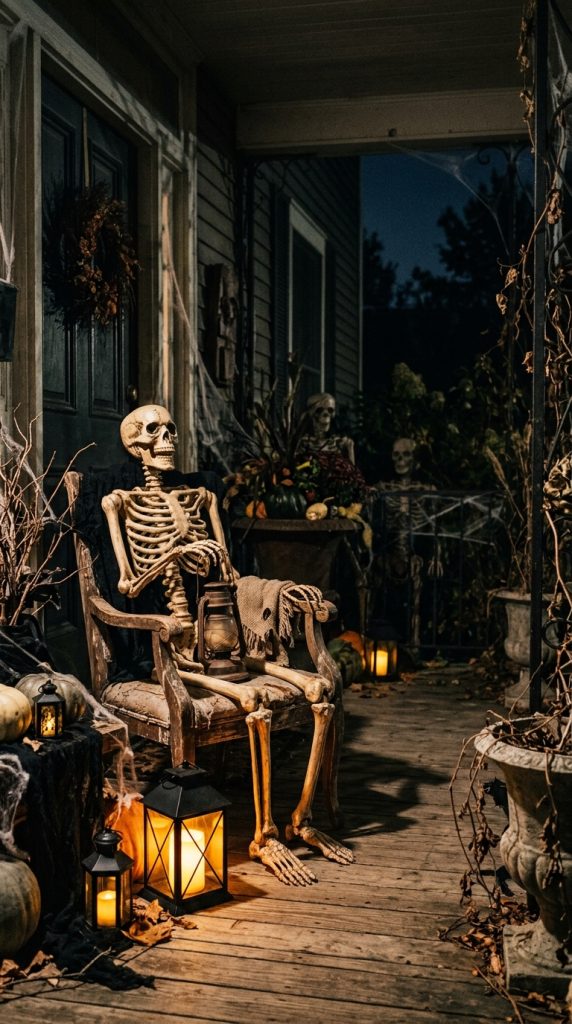
A skeleton display can be dramatic when the figures are arranged as part of a scene instead of simply standing around the porch.
Choose one main skeleton as the focal character.
Place it in a chair near the entrance.
Another can stand near the railing.
A third can appear to be climbing the steps or leaning against a wall.
Vary their positions.
The figures should interact with the environment.
For example, one skeleton could hold an old lantern.
Another could sit beside a small table.
Another could be positioned behind a planter.
This creates a narrative.
Avoid placing all the skeletons upright facing forward.
That arrangement quickly becomes repetitive.
Use different poses and heights.
You can also create a skeleton family or group, but keep the number appropriate to the size of the porch.
The surrounding decorations should support the skeletons.
Use black lanterns, weathered wood, dark fabric, dried branches, and muted pumpkins.
Avoid introducing too many unrelated Halloween characters.
Lighting should highlight one skeleton more strongly than the others.
A dim spotlight can illuminate the main figure.
Secondary figures can remain partially hidden.
This creates a sense of depth.
You can also use shadows.
Position a skeleton near a wall so that lighting creates a large shadow behind it.
The shadow becomes a second visual element.
Add a few cobwebs to the railing and furniture.
Use dark fabric on the chair.
Place an old-looking book on the table.
These details create the feeling that the skeletons are part of a larger story.
For a particularly dramatic effect, place one skeleton near the doorway but slightly off to the side.
Visitors may notice it only as they approach.
This can create a small surprise without obstructing the entrance.
The skeleton theme is highly adaptable.
It can be frightening, gothic, humorous, or theatrical depending on the styling.
For a genuinely spooky home, keep the colors dark and the lighting dramatic.
9. Create a Foggy, Abandoned Porch
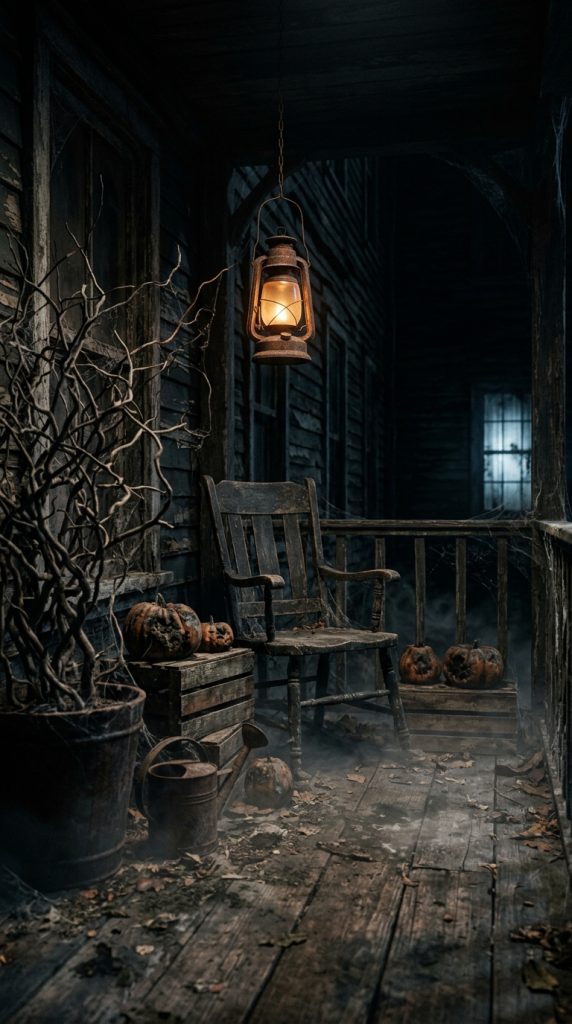
Fog can instantly change the atmosphere of a Halloween porch.
When combined with dark architecture, low lighting, and weathered props, it can make an ordinary entrance feel abandoned.
Start by reducing visual brightness.
You do not want the porch flooded with light.
Instead, use a few focused sources.
Place one warm lantern near the entrance.
Add a dim cool light farther away.
Then introduce low-lying fog.
If using a fog machine, position it carefully so the fog does not create a slipping hazard or obscure stairs.
Keep pathways visible.
The fog should drift around objects rather than completely hide them.
Add weathered furniture.
A distressed chair, old wooden crate, or vintage bench can create the impression that the porch has been neglected.
Add dried branches.
Place them in large dark planters.
Allow the branches to extend into the fog.
Their silhouettes can look particularly dramatic.
A few muted pumpkins can add seasonal context.
Choose dark green, gray, cream, or aged orange.
Add a distressed lantern.
A flickering LED light inside can create movement.
One of the most important elements is negative space.
Do not fill every part of the porch with props.
Allow empty dark areas where the fog can move.
This makes the porch feel larger and more mysterious.
You can also use a partially open-looking door effect if it can be done safely and securely.
A narrow gap of darkness can be more unsettling than a fully decorated doorway.
Do not compromise home security for decoration.
Sound can enhance the scene.
Low wind, distant thunder, or quiet creaking sounds can accompany the visual atmosphere.
Keep the volume low enough that the effect remains subtle.
The abandoned porch theme works particularly well at night because the darkness becomes part of the design.
During daylight, the weathered props provide visual interest.
After sunset, lighting and fog transform the same arrangement into something much more dramatic.
10. Create an Ultimate Haunted Porch With Layered Scary Details
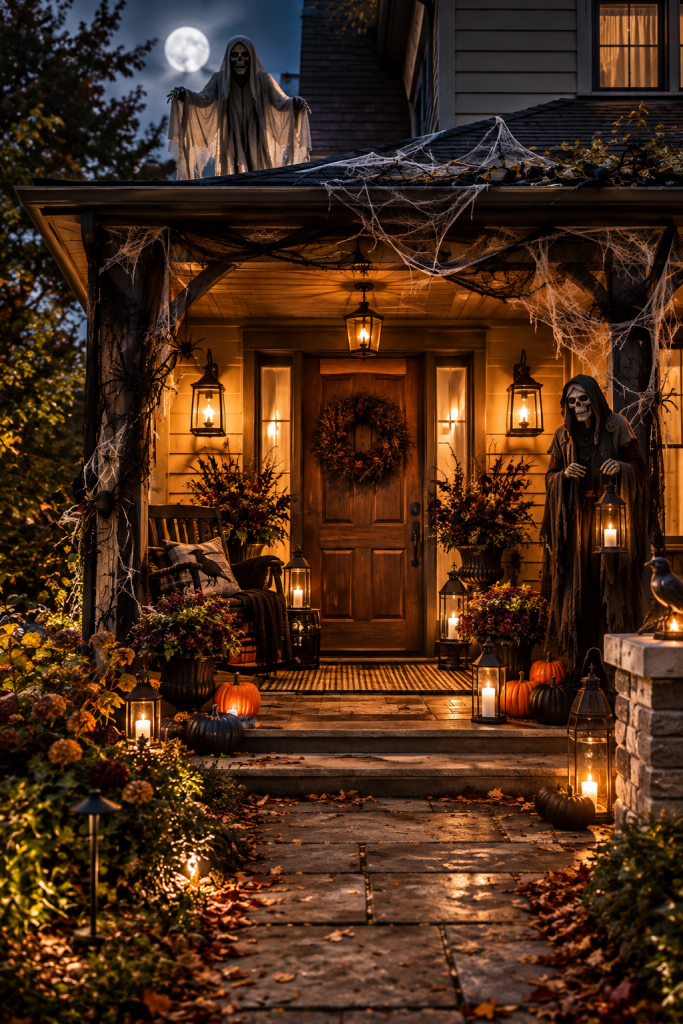
If you want the most immersive Halloween porch possible, combine several elements into one carefully planned scene.
The key is not to use every decoration you own.
Instead, build the porch in layers.
Start with the background.
Use dark fabric, weathered boards, branches, vines, or architectural shadows to create depth.
Next, establish one main focal point.
This could be a life-size haunted figure, a large cemetery gate, a sinister doorway, or an oversized skeleton.
Then create secondary focal points.
A chair can occupy one corner.
A cemetery stone can sit near the steps.
A dark planter can hold twisted branches.
A hanging ghost can occupy the upper area.
These elements should support the central scene.
Do not make every object equally dramatic.
The main focal point should receive the strongest visual emphasis.
Lighting is the final layer.
Use different levels of brightness.
A warm lantern can illuminate the doorway.
A cool light can highlight a distant figure.
A small ground light can illuminate a tombstone.
Another light can create dramatic branch shadows on the wall.
The result is a porch with multiple visual zones.
As visitors approach, they notice different details at different distances.
From far away, they see the overall silhouette.
Closer to the house, they notice the central figure.
At the entrance, smaller details become visible.
This creates an experience rather than a static decoration display.
Add texture throughout the scene.
Use distressed wood, artificial moss, dried branches, rough fabric, dark metal, and aged-looking props.
Keep the color palette coordinated.
A strong combination might include:
Black + charcoal + aged brown + muted orange + deep burgundy.
Another option is:
Black + gray + cream + dark green.
You can also use small amounts of red for dramatic contrast.
Do not overuse it.
The porch should remain visually coherent.
Sound can complete the experience.
Use subtle atmospheric audio rather than loud continuous effects.
Distant wind.
Low creaking.
Soft footsteps.
Occasional eerie sounds.
These can create suspense without becoming annoying to neighbors or guests.
Most importantly, keep the actual entrance functional.
The front door should open easily.
Steps should remain visible.
Handrails should remain accessible.
Electrical cables should be secured.
Decorations should not create trip hazards.
Fog should not obscure walking areas.
Outdoor lighting should provide enough visibility for safe movement.
The best scary porch is one that looks frightening while remaining comfortable and practical to navigate.
How to Make a Halloween Porch Look Scarier at Night
Daylight and darkness create completely different visual experiences.
During the day, visitors can see every decoration clearly.
At night, you can control what they see.
This is where lighting becomes one of your most powerful tools.
Avoid lighting everything equally.
Instead, choose a few focal points.
Light the face of a figure.
Illuminate one tombstone.
Highlight a hanging ghost.
Allow the rest to disappear into shadow.
This creates suspense.
Warm amber light creates an old haunted-house atmosphere.
Cool blue-white light can create a ghostly feeling.
Deep red can be used for a dramatic accent.
You can combine them carefully rather than using only one color.
Shadows are equally important.
Place lights behind branches or objects so they cast silhouettes across walls.
A simple branch can become visually dramatic when its shadow moves across the porch.
How to Decorate a Small Porch for Halloween
A small porch does not require fewer ideas.
It simply requires better editing.
Choose one major focal point.
This could be:
- A life-size skeleton
- A haunted wreath
- A large lantern
- A creepy chair
- A hanging ghost
Then use vertical space.
Hang bats, ghosts, branches, or fabric overhead.
Use the doorway and walls rather than covering the floor.
Keep the stairs clear.
Use a few smaller accessories around the main focal point.
A compact porch can actually feel scarier because the decorations are closer together and the available darkness creates stronger contrast.
How to Create a Scary Halloween Porch Without Spending Too Much
You do not need to purchase expensive animatronic props.
Atmosphere can be created using relatively simple materials.
Start with black fabric.
Use it to create dark backgrounds or draped areas.
Add inexpensive artificial branches.
Use them in planters or around doorways.
Battery-operated lanterns can provide atmospheric lighting.
Old wooden crates can become display platforms.
Secondhand chairs can become haunted furniture.
Black spray paint can transform suitable decorative objects.
Thrift stores can be useful sources for old-looking frames, baskets, furniture, vases, and trays.
The key is not the price of the object.
It is how the object is used.
An inexpensive old chair placed under dramatic lighting can feel more frightening than an expensive novelty decoration placed randomly.
Safety Tips for Scary Halloween Porch Decorating
A dramatic Halloween porch should never create unnecessary safety risks.
Keep stairs completely clear.
Do not cover handrails with materials that make them difficult to grip.
Secure hanging decorations.
Outdoor decorations can move significantly in wind.
Protect electrical connections from moisture.
Use lighting rated for outdoor conditions when required.
Keep candles away from fabric, dried plants, paper, and other combustible materials.
Battery-operated candles are a practical alternative.
Do not use fog machines where visibility becomes dangerously limited.
Keep decorations away from heaters, outdoor fireplaces, and other heat sources.
Check the porch after dark before guests arrive.
Make sure visitors can clearly see the walking path.
The goal is to create fear through atmosphere, not actual hazards.
Final Thoughts
A scary Halloween porch can completely change the way your home feels during the Halloween season.
The most memorable displays are rarely the ones with the greatest number of decorations.
They are the ones with the strongest atmosphere.
A dark entrance can feel more frightening than a brightly lit collection of props.
A single shadowy figure can create more suspense than ten characters standing together.
A weathered chair beneath a dim lantern can suggest an entire story.
A few tombstones surrounded by fog can make an ordinary yard feel abandoned.
A hanging ghost can transform an otherwise simple covered porch.
The secret is to create a scene that makes people curious about what they are seeing.
Use darkness strategically.
Use lighting to direct attention.
Use texture to create age.
Use different heights to build depth.
Use sound sparingly.
And leave enough empty space for the imagination to work.
Your porch does not have to look like a commercial haunted attraction.
It can feel more personal and atmospheric.
Maybe your theme is an abandoned Victorian house.
Maybe it is a forgotten cemetery.
Maybe the porch belongs to a mysterious witch.
Maybe the entire entrance has been taken over by enormous spiders.
Maybe ghostly figures are quietly floating above the walkway.
Maybe an old scarecrow is waiting beside the door.
The important thing is consistency.
Choose a theme and allow the colors, props, lighting, and textures to support it.
If you want a truly frightening look, keep bright colors limited.
Black, charcoal, dark brown, gray, deep green, muted orange, and burgundy create a strong foundation.
Then use small amounts of brighter color as accents.
Lighting can bring the entire composition together.
A warm lantern beside the door can make the entrance feel old and mysterious.
A cool light behind a ghost can make the figure appear almost weightless.
A low light beneath a skeleton can create dramatic shadows.
A dim light behind branches can turn ordinary vegetation into something unsettling.
Do not underestimate the power of sound either.
A porch that looks frightening during the day can become much more immersive after sunset when combined with subtle environmental sounds.
Keep the audio controlled.
Halloween should be fun for the people living in the neighborhood as well as the visitors experiencing the decoration.
Another important consideration is the transition from daytime to nighttime.
A good porch should still look intentional in daylight.
Weathered wood, dark plants, pumpkins, lanterns, and architectural details can create an attractive autumn composition during the day.
After sunset, lighting and shadows take over.
This creates two different experiences without requiring two different decorations.
If you want your porch to feel sophisticated rather than overly commercial, focus on materials.
Use wood.
Use metal.
Use ceramic.
Use natural branches.
Use aged-looking fabric.
Use glass lanterns.
Use muted colors.
These materials create a more believable haunted environment.
You can still include traditional Halloween props, but surround them with realistic textures so they feel integrated.
The same principle applies to skeletons and ghosts.
Instead of placing a skeleton alone on a porch, give it a setting.
Put it in a chair.
Place a lantern beside it.
Add a weathered table.
Create shadows behind it.
Suddenly the skeleton becomes part of a story.
The same is true for a ghost.
Hang it in a dark corner.
Give it movement.
Illuminate it from behind.
Leave empty darkness around it.
The visual result becomes much more atmospheric.
Remember that the front porch is an architectural space.
Use its existing features.
Columns can become part of the haunted scene.
Railings can support vines and webs.
Steps can become a transition into the cemetery.
Windows can become locations for silhouettes.
Doorways can become dramatic focal points.
Ceilings can hold hanging figures.
Walls can receive shadows.
When decorations interact with architecture, they feel much more intentional.
Ultimately, the best scary Halloween porch ideas are the ones that create an emotional reaction before visitors even reach the front door.
A little uncertainty.
A little darkness.
A strange shadow.
A quiet sound.
A figure that seems to be watching.
A doorway that looks different after sunset.
Those small details create suspense.
You do not need to reveal everything immediately.
Let some decorations remain hidden.
Let some areas stay dark.
Let shadows create questions.
That is where the real Halloween atmosphere comes from.
Whether you have a tiny apartment entrance, a traditional front porch, a large covered veranda, or a spacious suburban entryway, the same principles can be adapted to your space.
Start with one focal point.
Build the background.
Add supporting details.
Introduce texture.
Layer the lighting.
Create shadows.
Then stop before the porch becomes overcrowded.
A frightening Halloween porch should still allow people to move safely and comfortably.
Keep pathways clear.
Secure every decoration.
Protect electrical equipment.
Use safe lighting.
Keep open flames away from flammable materials.
Check the display after dark.
These practical details allow you to enjoy the atmosphere without unnecessary problems.
When everything comes together, your porch can become more than a collection of Halloween decorations.
It can become a small theatrical scene.
A place where autumn darkness, architecture, lighting, texture, and imagination meet.
And when Halloween arrives, visitors will not simply notice that your home is decorated.
They will feel that they have stepped into a different world before they even reach the front door.
Leave a Reply