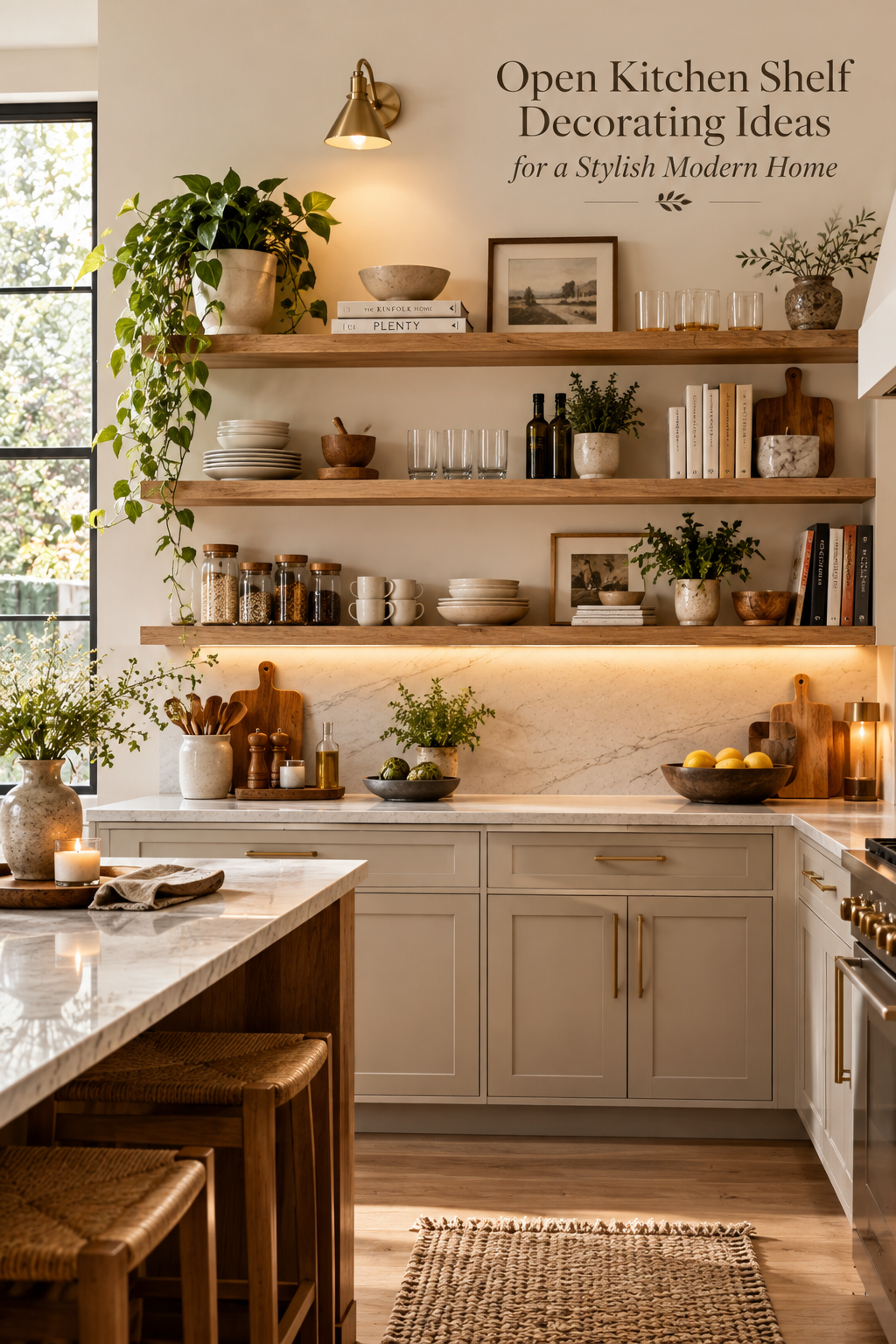
Open kitchen shelf decorating ideas can completely transform the personality of a modern kitchen. Instead of keeping every attractive plate, bowl, glass, cookbook, vase, and serving piece behind closed cabinet doors, open shelving allows carefully chosen objects to become part of the interior design. When styled correctly, open shelves can make a kitchen feel warmer, more personal, organized, and sophisticated without sacrificing its practical purpose.
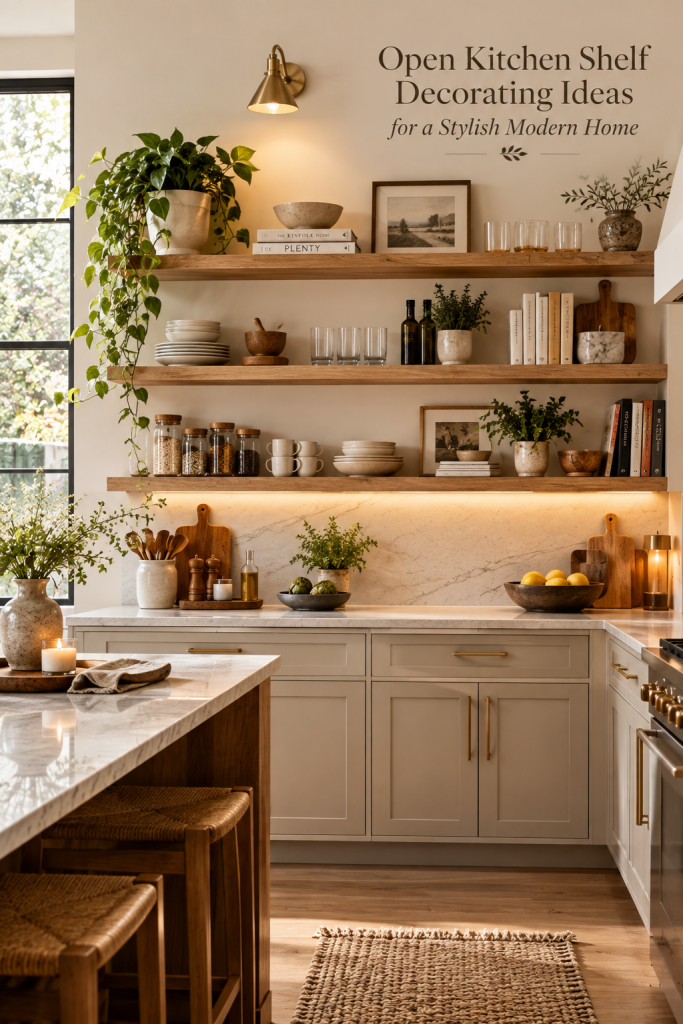
The biggest challenge with open shelving is that everything becomes visible. A closed cabinet can hide mismatched dishes, colorful packaging, rarely used appliances, and everyday kitchen clutter. An open shelf cannot. Every object contributes to the overall appearance of the room, which means successful shelf styling depends on thoughtful selection, proportion, spacing, color, and texture.
This does not mean your shelves need to look perfectly staged or almost empty. A modern kitchen should still feel like a real kitchen. Plates should be accessible. Mugs should be easy to reach. Cookbooks should look used rather than untouched. Wooden cutting boards can lean against the backsplash. Glassware can remain within reach. The goal is to make useful objects attractive rather than filling the shelves with unnecessary decorations.
One of the easiest ways to achieve this is to create a controlled visual palette. If your kitchen has white or cream cabinets, warm oak shelves, beige countertops, and black hardware, you can repeat those same tones through the objects you display. Cream ceramics, natural wood, clear glass, and a few black accessories can create a cohesive arrangement without requiring everything to match.
Color repetition is particularly powerful because it visually connects the shelves with the rest of the room. A black mug can echo a black faucet. A wooden bowl can repeat the tone of oak cabinetry. A cream vase can relate to the backsplash. A small brass object can complement cabinet hardware or pendant lights.
Materials matter just as much as color. Modern kitchens often contain smooth and hard surfaces such as stone countertops, glossy cabinets, metal appliances, glass, and tile. Open shelves provide an opportunity to introduce materials that make the room feel softer and more layered.
Natural wood brings warmth.
Ceramic adds handcrafted character.
Glass creates lightness.
Woven baskets introduce texture.
Linen adds softness.
Stone brings an organic quality.
Greenery adds life.
Combining a few of these materials can make even a very neutral kitchen feel interesting without adding bright colors or excessive decoration.
The shelf itself is also part of the design. Natural oak shelves can create a warm Scandinavian-inspired appearance. Walnut shelving gives a richer, more sophisticated impression. Black shelves can add architectural contrast. White floating shelves can blend seamlessly into a pale kitchen. Thick wood shelves can add character to a modern farmhouse interior, while slim shelves can create a lighter contemporary appearance.
Before decorating, consider what the shelf is actually being used for. If it is positioned near the coffee maker, coffee mugs and attractive containers may be more useful than decorative objects. If it is beside the dining area, glassware and serving dishes may make more sense. If it is close to food preparation, wooden boards, bowls, and frequently used cooking pieces can be practical choices.
This functional approach prevents the shelves from becoming purely decorative.
Open shelving is also an excellent way to personalize a modern kitchen. Contemporary kitchens can sometimes feel too uniform because of large expanses of cabinetry and stone. A few handmade ceramics, vintage cookbooks, meaningful serving pieces, or collected objects can give the space personality.
The items do not need to be expensive.
A handmade ceramic bowl from a local market can be more visually interesting than an expensive mass-produced accessory. An old wooden cutting board can add character to a newly renovated kitchen. A favorite cookbook can introduce personality and color. A simple vase filled with a few branches can make an otherwise clean shelf feel alive.
The important thing is that the pieces relate to each other.
You can mix styles without creating chaos when there is some consistency in color, material, shape, or scale.
Another important consideration is negative space. Empty shelf space is not wasted space. It allows the objects around it to stand out and prevents the kitchen from feeling overloaded.
If every shelf is packed from one end to the other, individual objects lose their visual importance. A beautiful vase may disappear among dozens of smaller accessories. A stack of handmade plates may look ordinary if surrounded by too many decorative items.
Leaving some breathing room gives the display a more sophisticated appearance.
Height is another major part of successful styling. If every object is approximately the same size, the shelf can look flat. Instead, combine tall, medium, and low objects.
A tall vase can provide vertical height.
A stack of plates can create a low horizontal form.
A bowl can fill the middle.
A leaning cutting board can create another vertical element.
This creates visual movement while keeping the arrangement simple.
Depth can also be used to make shelves look more interesting. Objects do not have to sit in one perfectly straight row. A wooden board can lean against the backsplash while a bowl sits slightly in front of it. Plates can be positioned behind a vase. A small object can sit closer to the edge.
This layering gives the shelf dimension.
However, there is an important difference between layered and cluttered.
Layering means objects have a clear relationship.
Clutter means there are too many unrelated objects competing for attention.
If you are unsure whether a shelf feels crowded, remove one or two pieces and look again.
Often, editing creates a bigger improvement than adding more decoration.
Open kitchen shelves can also change with the seasons. You do not need to redecorate completely every few months. A neutral foundation can remain in place while a few accents change.
In autumn, you might add muted brown ceramics or dried branches. In spring, fresh greenery can bring softness. During the holiday season, a few understated seasonal objects can be introduced. This keeps the kitchen fresh without creating unnecessary storage problems.
Another benefit is that open shelving encourages you to be selective about what you own. Because everything is visible, you become more aware of which pieces actually contribute to the kitchen.
This can lead to a cleaner, more intentional home.
The most beautiful modern shelves are rarely filled with dozens of unrelated decorative pieces. Instead, they contain a carefully edited collection of useful objects and a few accessories that add personality.
The following ten ideas offer different approaches to styling open kitchen shelves. You do not need to use all ten. Choose the direction that best fits your kitchen, your storage needs, and your personal style.
1. Create a Warm Neutral Ceramic Display
A warm neutral ceramic display is one of the easiest ways to make open kitchen shelves look elegant and modern.
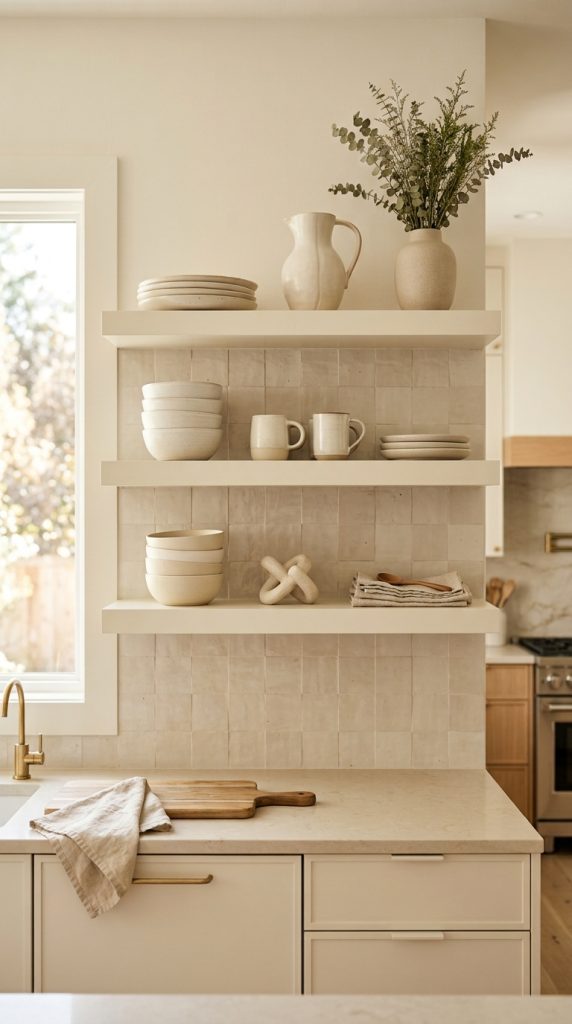
The concept is simple: use everyday plates, bowls, mugs, pitchers, and decorative ceramics in a restrained family of neutral colors.
Think about shades such as ivory, cream, oatmeal, beige, taupe, warm white, and soft gray.
The goal is not to make every piece identical.
In fact, slightly different ceramic shapes often make the arrangement more interesting. A handmade bowl with an irregular edge can sit beside simple modern plates. A softly curved pitcher can provide height next to a stack of dishes. A small matte vase can fill a gap without making the shelf feel decorated for decoration’s sake.
Begin with the largest pieces.
Place dinner plates in a neat vertical arrangement toward the back of the shelf. If necessary, use a discreet plate stand designed for secure display.
Next, add a small stack of bowls.
Then place a taller ceramic object toward one side.
The arrangement should have a clear visual hierarchy.
You want the eye to move naturally from the tallest piece to the middle-sized objects and then toward the lower items.
A small amount of greenery can also work beautifully with neutral ceramics. Place one simple branch in a narrow vase rather than adding several plants.
If your kitchen has warm wood cabinets, the neutral ceramics will create a soft contrast.
If the kitchen has white cabinets and pale countertops, they can create a seamless, calm appearance.
For a darker kitchen, cream and ivory pieces can provide brightness.
The finish of the ceramics is important as well. Matte and softly glazed surfaces tend to create a more contemporary appearance than highly glossy pieces with elaborate patterns.
However, a small amount of shine can add variety. A glossy ceramic bowl beside several matte pieces can catch the light and create a subtle highlight.
Try not to place all the same shapes together.
Instead, mix round bowls with flat plates, tall pitchers, and small cups.
This creates variation without requiring additional colors.
One useful technique is to create a visual group of three.
For example, place a tall ceramic pitcher, a medium stack of bowls, and a low cup together.
Then leave some empty space before the next group.
This prevents the shelf from becoming one continuous block of objects.
You can also use the shelf as functional storage.
If the dishes are used regularly, place them where they can be reached easily. The most frequently used pieces should not be hidden behind the most decorative items.
The result should feel like a beautiful kitchen that happens to have excellent styling rather than a showroom that no one is allowed to touch.
A neutral ceramic shelf is especially effective in modern, minimalist, Scandinavian, organic modern, and transitional kitchens because the palette remains quiet while the different shapes and textures provide visual interest.
2. Combine Natural Wood With Contemporary Accessories
Natural wood is one of the most effective materials for adding warmth to a modern kitchen.
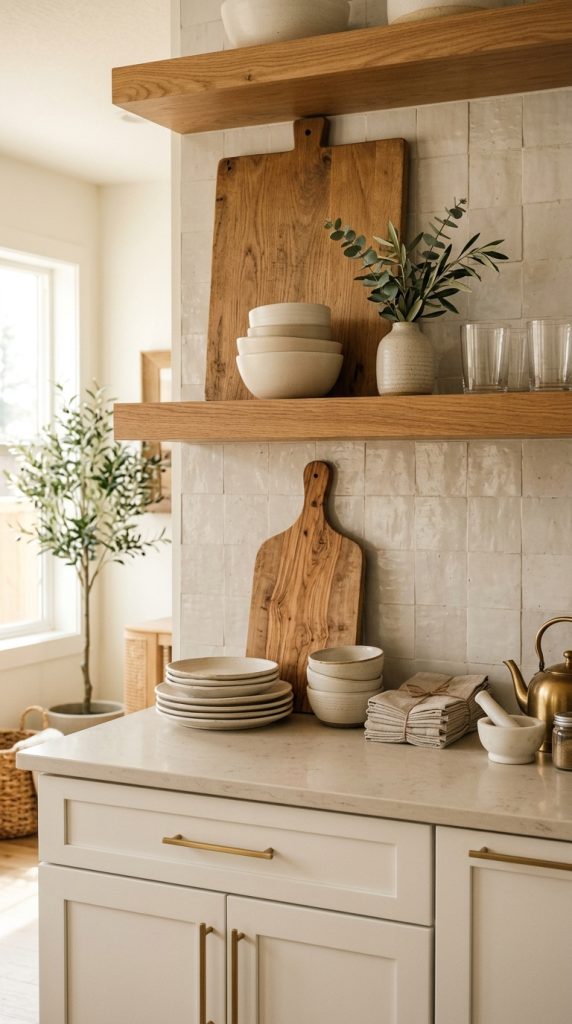
Contemporary kitchens often contain large areas of stone, metal, glass, and smooth cabinetry. These materials can look beautiful but sometimes feel visually cold.
Wood immediately changes that atmosphere.
Use wooden cutting boards, serving boards, bowls, trays, utensils, or small vessels on the shelves.
A large cutting board can lean vertically against the backsplash.
Place a stack of cream plates slightly in front of it.
Add a ceramic bowl toward one side.
On another shelf, position a wooden serving bowl next to clear glasses.
This combination creates a balance between organic warmth and modern simplicity.
The wood tone should relate to the rest of the kitchen.
Light oak works beautifully with white, cream, pale gray, and beige.
Walnut can create a sophisticated look when paired with black, charcoal, cream, or brass.
Medium-toned wood can work well with warm neutrals and earthy colors.
You do not have to use exactly the same wood throughout the shelf, but avoiding too many unrelated wood colors will help the display feel cohesive.
The natural grain should remain visible.
Avoid covering beautiful wooden boards with too many decorative pieces.
A single large board can be more effective than several small wooden objects.
You can also vary the orientation.
One board can stand vertically while a smaller board lies flat beneath a bowl.
This creates a combination of horizontal and vertical lines.
Ceramics are especially useful for balancing wood.
The smooth surface of pottery contrasts with the natural grain of timber.
Clear glass adds another layer by providing transparency.
A small plant or branch can connect the natural materials together.
The finished display might include a walnut cutting board, cream bowl, clear glasses, a small olive branch, and a simple ceramic vase.
There are enough differences in texture to make the shelf interesting without making it busy.
Wooden accessories also make the display practical.
A serving board can be taken down when needed.
A bowl can be used for food.
A tray can organize the coffee station.
This means your styling does not have to sacrifice functionality.
Natural wood is particularly effective in kitchens that need warmth.
If your kitchen already has wood cabinetry, repeat the tone lightly through accessories.
If your kitchen is mostly white, wood can become the main warmth-producing element.
If your kitchen has darker cabinetry, lighter wood can provide contrast.
3. Turn Everyday Dinnerware Into the Main Display
Open shelves do not need to be decorated with objects that were purchased specifically for styling.
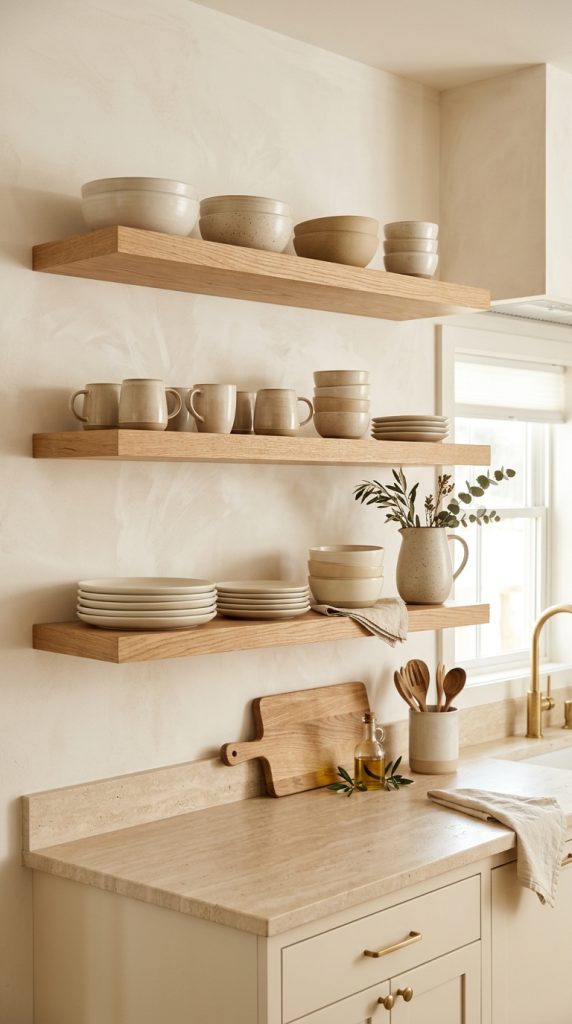
Your everyday dinnerware can become the decoration.
This approach is especially useful when you want your kitchen to remain highly functional.
Choose the plates, bowls, mugs, and serving pieces that are attractive enough to display.
Arrange them in organized groups.
Place dinner plates into one stack.
Create another stack with smaller plates.
Group bowls together.
Keep mugs in a row or small cluster.
The arrangement should look organized without appearing rigid.
One way to make the display more interesting is to vary the height of each group.
For example, the dinner plate stack can be taller than the bowl stack.
The mugs can form another low group.
Then place one taller pitcher or vase beside them.
This creates visual movement.
Color is particularly important when displaying everyday dishes.
If your dinnerware is white or cream, you can introduce a little contrast through wood, black, or muted greenery.
If your dinnerware is colorful, keep the other shelf accessories relatively neutral.
This prevents the arrangement from becoming overwhelming.
You can also create a subtle gradient.
For example, use cream plates beside beige bowls and warm brown wooden pieces.
The colors transition naturally.
If you own patterned dishes, do not necessarily display every pattern at once.
Choose the most visually compatible pieces.
Open shelves are highly visible, so editing matters.
Frequently used pieces should remain accessible.
If you use your breakfast bowls every morning, place them where they can be reached easily.
If a decorative serving plate is rarely used, it can occupy a less accessible position.
This creates a practical hierarchy.
Another advantage of displaying dinnerware is that it makes the kitchen feel lived-in.
A shelf filled entirely with decorative objects can sometimes feel staged.
A shelf containing the plates you actually use feels authentic.
You can still add a few decorative elements.
A small vase, plant, or wooden object can provide personality.
Just make sure the decoration does not interfere with access to the dishes.
This style works particularly well for modern farmhouse, Scandinavian, minimalist, transitional, and contemporary kitchens.
4. Design a Stylish Coffee and Tea Shelf
A coffee and tea shelf can become one of the most charming areas of a modern kitchen.
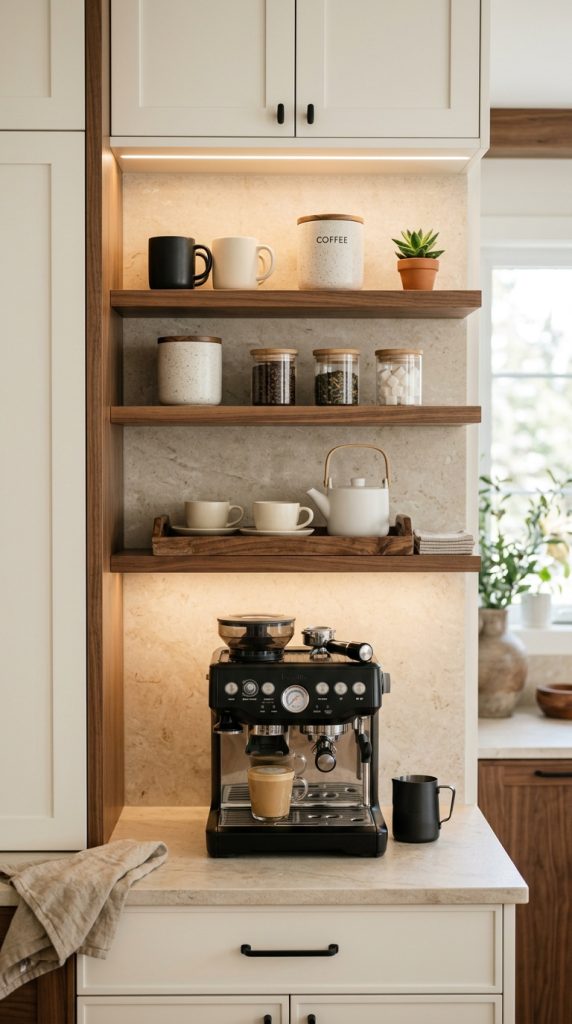
Because the objects already belong together functionally, it is easy to create a cohesive display.
Start with the mugs.
Choose a small collection of mugs in complementary colors.
Black, cream, white, beige, or muted brown work particularly well.
Arrange them together rather than scattering them across the kitchen.
Add a coffee container.
If you store coffee beans or ground coffee in an attractive container, it can remain visible.
The same applies to tea.
A simple glass or ceramic container can look much more cohesive than brightly colored packaging.
You can add a small wooden tray to organize the smaller items.
A tray visually connects separate objects and gives the coffee area a defined boundary.
If the shelf is above or near your coffee machine, make sure the arrangement does not interfere with appliance use.
Keep electrical cords, steam outlets, and hot surfaces clear.
The decorative pieces should support the coffee station rather than obstruct it.
A small ceramic vase can provide a vertical element.
A compact plant can add freshness.
A stack of two small cups can create another level.
The palette should remain controlled.
Try cream, walnut, and matte black for a modern look.
Try beige, oak, and white for a softer appearance.
Try charcoal, brass, and cream for a more dramatic sophisticated palette.
If you enjoy entertaining, you could also display a beautiful serving tray, glass carafe, or small teapot.
Keep the arrangement relatively compact.
Coffee stations naturally contain equipment and supplies, so adding too many accessories can quickly make the area look crowded.
One useful principle is to leave one clear working zone.
The coffee machine and frequently used items should remain easy to access.
The shelf should make your morning routine more pleasant rather than requiring constant rearranging.
This idea is especially effective when open shelving is positioned near a breakfast nook or kitchen island.
5. Use Glassware to Create a Light and Airy Arrangement
Glassware is one of the best choices for open shelves when you want the kitchen to feel visually light.
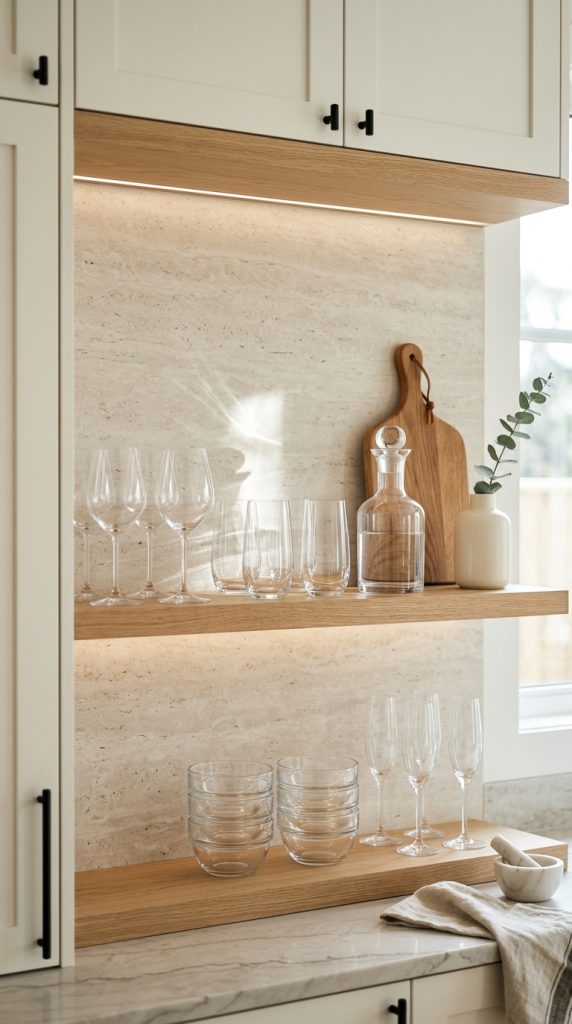
Unlike solid ceramics, transparent glasses allow the background to remain visible.
This is particularly useful in smaller kitchens.
Arrange clear drinking glasses in small groups.
If you regularly use wine glasses, add a few.
A glass carafe can provide a larger shape.
You can also introduce subtle amber, smoky, or lightly tinted glass for additional character.
Avoid filling the shelf completely with glassware.
Instead, allow the pieces to breathe.
For example, place four clear tumblers together.
Leave some space.
Then add a simple ceramic vase.
On another shelf, display a small collection of wine glasses beside a wooden serving board.
The contrast between transparent glass and solid wood creates visual depth.
Glass also responds beautifully to natural light.
If the shelf is near a window, the glassware can catch daylight and create delicate reflections.
In the evening, warm kitchen lighting can make the display glow subtly.
The shelf material affects the appearance too.
Clear glassware looks beautiful against natural oak.
It also looks sophisticated against dark walnut.
Against black shelves, transparent glass creates a crisp contrast.
Against white shelves, combine glass with darker ceramics or wood so the display does not become too pale.
Practicality is important.
Make sure the shelf is strong enough for the glassware.
Place heavier glass pieces toward more secure areas.
Keep fragile objects away from places where they can easily be bumped.
If children frequently use the kitchen, consider whether delicate pieces are appropriate for lower shelves.
Glassware can also make a kitchen feel more elegant without adding unnecessary decoration.
A few beautiful glasses are both functional and visually refined.
6. Add Cookbooks and Personal Objects for Character
A modern kitchen should not feel like a showroom.
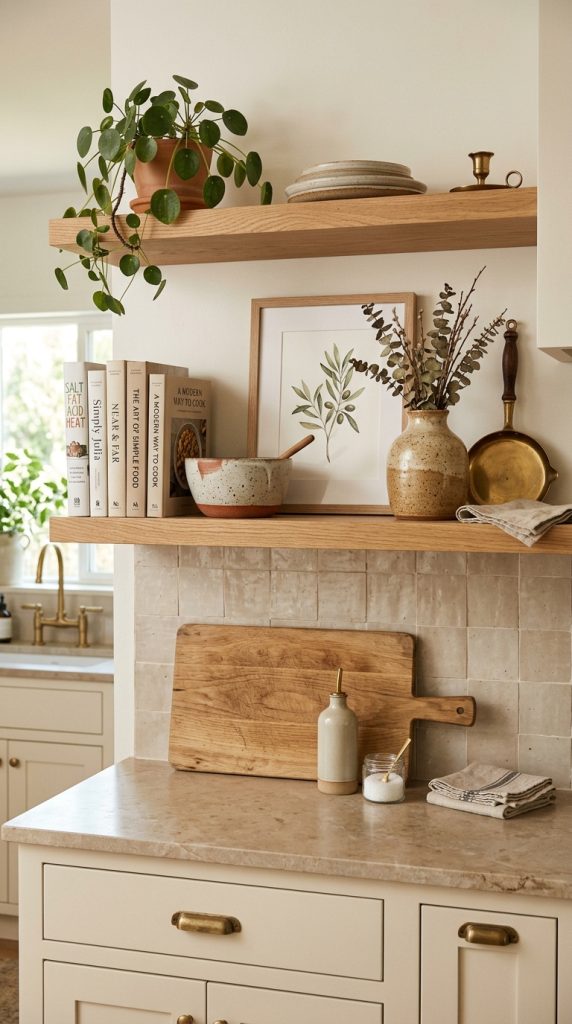
One of the easiest ways to make open shelves more personal is to include cookbooks and meaningful objects.
Cookbooks naturally belong in the kitchen, so they add personality without feeling random.
Create a small stack of two or three books.
Place a simple ceramic bowl or decorative object on top.
Beside the stack, position a vase or small framed print.
You can also arrange several books vertically.
The important thing is to avoid turning the shelf into a library.
A few books create personality.
Too many can make the shelves feel visually heavy.
Book colors can also influence the kitchen palette.
Neutral covers are ideal for a calm minimalist interior.
Muted olive, brown, terracotta, burgundy, or dusty blue can introduce controlled color.
If your kitchen already has strong colors, choose quieter book covers.
Personal objects can be even more meaningful.
Perhaps you have a handmade ceramic bowl.
Maybe you own a vintage serving platter.
Perhaps there is a small object from a memorable trip.
These pieces can become part of the kitchen story.
You do not need to display every sentimental object.
Choose a few.
This makes them more noticeable.
Small artwork can also work well.
A botanical print, abstract sketch, or simple black-and-white illustration can lean against the backsplash.
Keep the frame simple.
The kitchen should remain the dominant environment.
A personal shelf arrangement can be especially useful in a very modern kitchen because it introduces warmth and individuality.
The goal is not to make the shelves look perfectly coordinated.
A little variation makes the display feel collected.
The colors should still relate to the room.
A vintage wooden piece can work beautifully with contemporary ceramics.
An old cookbook can sit beside modern glassware.
A handmade vase can contrast with minimalist plates.
These combinations create depth.
7. Use Black and Cream for a Sophisticated Modern Contrast
Black and cream create one of the most timeless combinations for modern kitchen shelving.
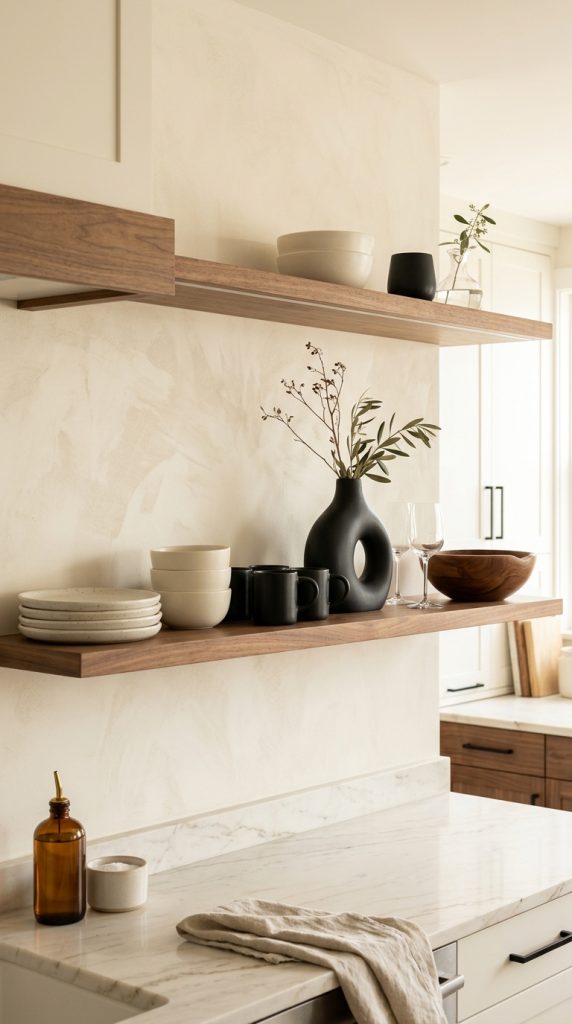
The contrast is strong enough to create visual interest but simple enough to remain elegant.
Start with cream or ivory ceramics.
Add several matte-black accessories.
These could include mugs, bowls, a vase, or a small serving piece.
Then introduce natural wood to soften the contrast.
For example, a shelf could contain cream plates, a black ceramic vase, a walnut bowl, and clear glasses.
The black pieces should act as accents rather than dominating the entire display.
This is especially effective if your kitchen already has black hardware.
A black faucet, cabinet handles, pendant lights, or appliances can be echoed through the shelf accessories.
This repetition creates visual continuity.
Matte black works particularly well because it has a quiet, sophisticated surface.
Glossy black can also work, but too much shine may make the display feel more dramatic.
The cream pieces create visual brightness.
Wood provides warmth.
Glass provides transparency.
Together, the four materials create a balanced composition.
You can also use a small amount of brass if the kitchen already contains brass hardware.
One brass object is enough.
Avoid turning the shelf into a collection of black, cream, wood, and brass accessories without a clear hierarchy.
The cream ceramics should remain the foundation.
Black creates contrast.
Wood introduces warmth.
Brass provides a subtle highlight.
This type of arrangement works particularly well in contemporary, modern farmhouse, transitional, and luxury-inspired kitchens.
8. Add Woven Baskets for Warmth and Practical Storage
Woven baskets are useful when your kitchen needs additional storage but you do not want the shelves to look purely functional.
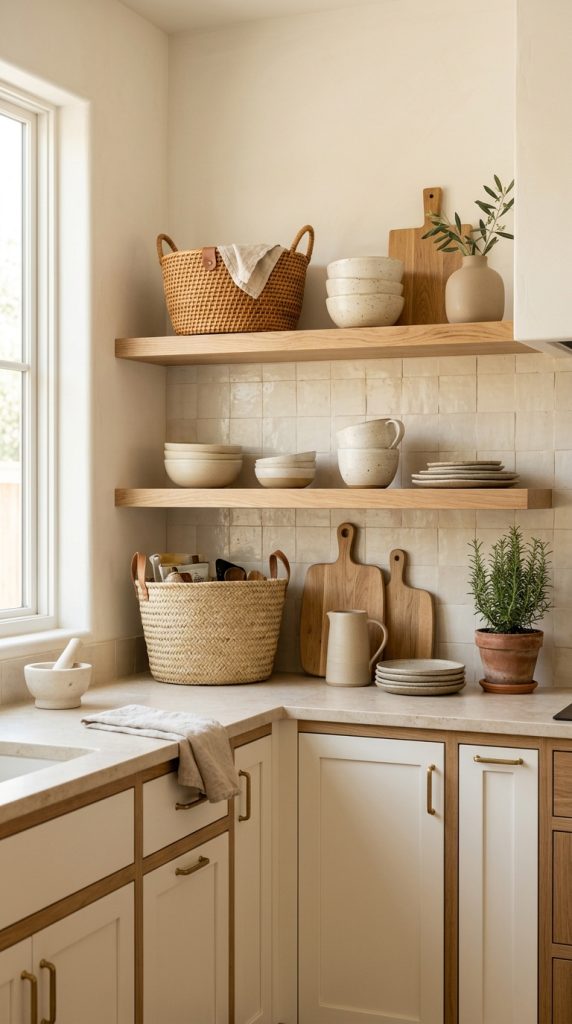
Choose a small basket made from rattan, cane, seagrass, or another natural fiber.
Use it to contain smaller items that would otherwise create visual clutter.
You might store:
- Tea towels
- Napkins
- Small kitchen tools
- Coffee supplies
- Reusable bags
- Baking accessories
Because the contents are contained, the shelf remains visually calm.
Place the basket beside ceramic bowls or plates.
The contrast between woven texture and smooth pottery creates depth.
A natural-fiber basket also works beautifully with wood.
You can create a warm arrangement using:
Woven basket + oak board + cream ceramic bowl + small green plant.
The palette remains neutral, but the different textures prevent it from looking boring.
Do not use baskets on every shelf.
One or two are generally enough.
Too many can make the kitchen feel like a storage room.
Choose baskets that fit the shelf proportions.
A basket that is too large can overwhelm the arrangement.
A very small basket may look insignificant.
The weave should also complement the kitchen.
Fine, structured cane can look sophisticated in a contemporary kitchen.
Rougher woven fibers can create a more relaxed organic appearance.
Baskets are especially useful when open shelves are part of a small kitchen.
They help hide less attractive small items while keeping them accessible.
This makes the shelves both beautiful and practical.
9. Create an Organic Modern Shelf With Greenery
An organic modern kitchen combines contemporary simplicity with natural materials, earthy colors, and living elements.
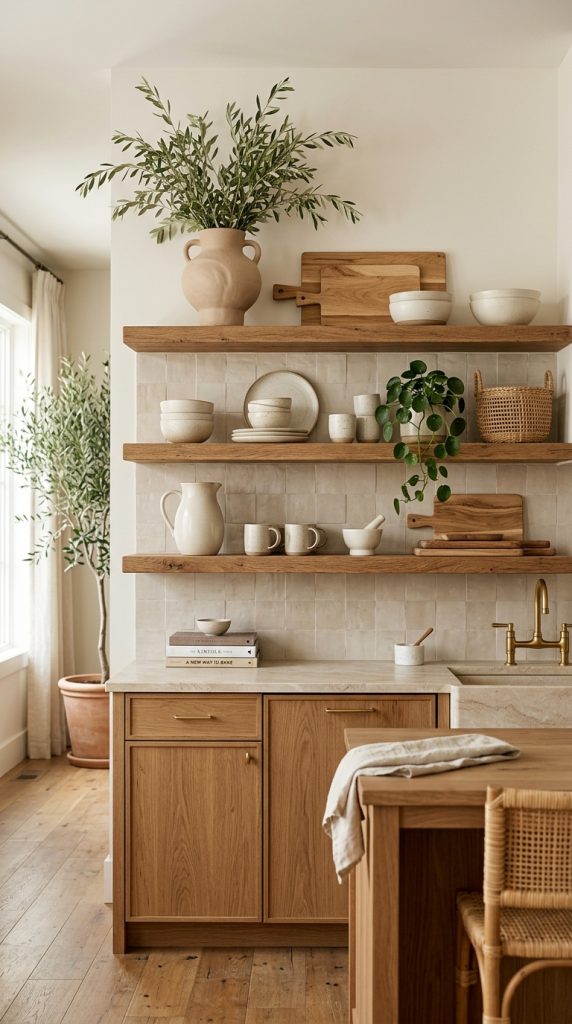
Open shelves are perfect for this style.
Start with warm wood.
Add cream, beige, sand, or taupe ceramics.
Then introduce a carefully chosen plant or botanical arrangement.
You might use a small olive tree, trailing plant, eucalyptus, herbs, or a few sculptural branches.
The greenery should be intentional.
One beautiful plant can have more impact than five small plants scattered across the shelves.
Choose a planter that works with the palette.
Matte cream ceramic is an easy option.
Natural stone can create a more earthy look.
Dark charcoal can add contrast.
You can also use handmade vessels with irregular shapes.
Organic modern interiors benefit from imperfect forms.
A rounded bowl, uneven ceramic vase, or naturally shaped wooden object can soften the straight lines of modern cabinetry.
Muted colors are ideal.
Think:
- Warm beige
- Cream
- Olive
- Sand
- Walnut
- Soft brown
Avoid introducing too many strong colors.
The beauty of organic modern styling comes from material and texture rather than bright decoration.
You can create a layered shelf using wood, ceramic, stone, greenery, and woven material.
For example, place a tall olive branch in a cream vase.
Beside it, stack two neutral bowls.
Behind them, lean a wooden cutting board.
On the next shelf, add a small woven basket and a stone-colored serving dish.
The display feels natural without looking rustic.
This style works especially well in kitchens with oak cabinetry, natural stone, warm flooring, neutral walls, or large windows.
10. Create a Curated Designer-Style Shelf
If you want your open shelves to look professionally styled, treat them as a composition rather than simply arranging objects wherever there is space.
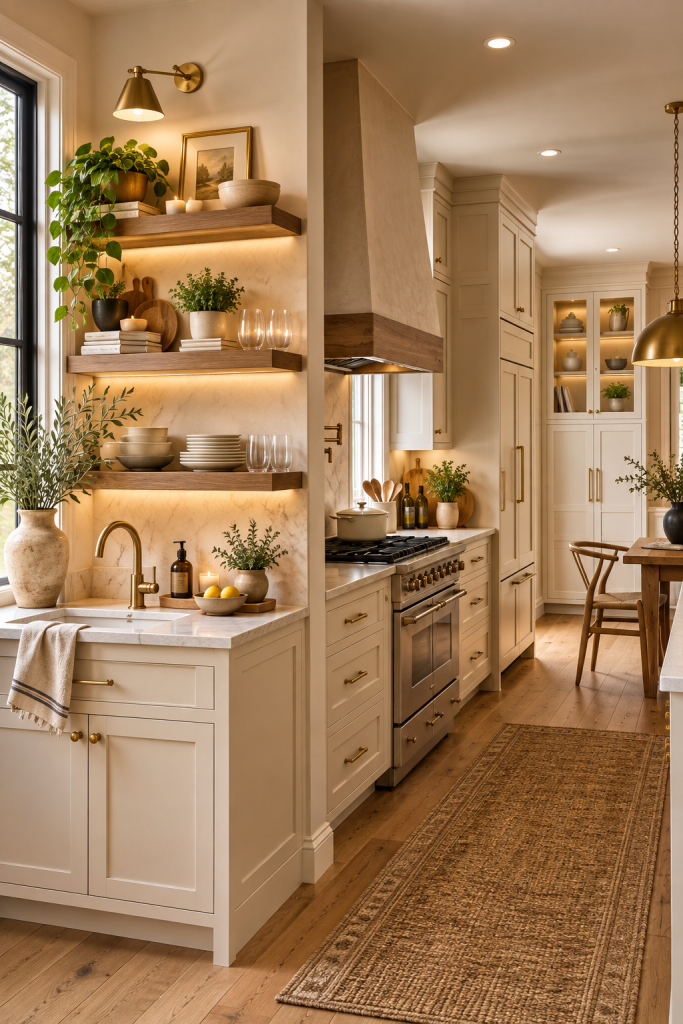
Start with one focal piece.
This could be a large ceramic vase, sculptural pitcher, distinctive serving bowl, or beautiful wooden board.
Position it where it can be noticed immediately.
Then build around it.
Add a medium-sized object.
Then add something low.
This creates a clear hierarchy.
For example:
Tall ceramic vase + medium wooden bowl + low stack of plates.
On the next shelf, change the arrangement.
You might use:
Leaning cutting board + handmade bowl + clear glasses.
The compositions should relate to each other without being identical.
This avoids a repetitive showroom effect.
Depth is important.
Lean larger flat pieces such as cutting boards or artwork against the backsplash.
Place smaller objects slightly forward.
Use the back of the shelf for visual height.
Use the front for low functional pieces.
This creates dimension.
You should also consider the negative space around your focal piece.
A statement vase cannot stand out if it is surrounded by ten other decorative objects.
Give it room.
The same applies to handmade pottery or unusual serving pieces.
The less competition they have, the more important they appear.
A designer-style arrangement also uses repetition.
If you introduce black on one shelf, repeat a small amount of black elsewhere.
If you use walnut, repeat walnut.
If your main ceramics are cream, allow that color to appear throughout the display.
This creates continuity.
But repetition should not become duplication.
You do not need three identical vases.
You need a relationship between the objects.
The final step is editing.
Look at the shelf from across the room.
Ask whether one object feels unnecessary.
Remove it.
Then look again.
Often the shelf becomes more sophisticated immediately.
This approach is particularly useful when you want your kitchen to feel luxurious without spending a large amount on accessories.
How to Keep Open Kitchen Shelves From Looking Cluttered
The biggest secret to attractive open shelving is not adding more.
It is editing.
Before styling, remove everything from the shelves.
Clean the surface.
Then select only the items that deserve to remain visible.
Start with functional pieces.
Add a few decorative objects.
Then step back.
If there are too many small objects, group them.
If the colors are competing, remove some.
If every object is the same height, introduce a taller piece.
If the shelf feels heavy, remove something and create more empty space.
You can also use a simple visual rule: avoid putting similarly sized objects directly beside each other throughout the entire shelf.
Mix tall and short pieces.
Mix round and straight forms.
Mix solid and transparent materials.
This creates variety without clutter.
How to Choose Colors for Modern Open Shelves
A simple palette is easier to maintain.
For a warm modern kitchen, try:
Cream + oak + beige + black.
For an organic modern kitchen:
Sand + olive + walnut + ivory.
For a sophisticated contemporary kitchen:
Charcoal + cream + walnut + brass.
For a bright minimalist kitchen:
White + pale wood + clear glass + greenery.
You do not need to use every color equally.
One should dominate.
One or two should support it.
Another can become a small accent.
This creates visual hierarchy.
How to Make Open Shelving Look Expensive
Expensive-looking styling usually comes from restraint rather than price.
Choose natural materials.
Prioritize ceramics, wood, glass, stone, linen, and woven fibers.
Avoid excessive plastic.
Choose fewer larger pieces rather than many tiny objects.
Create negative space.
Keep the colors coordinated.
Use warm lighting.
And most importantly, avoid overcrowding.
A simple shelf with one beautiful ceramic vase, a few cream plates, a wooden board, and clear glasses can look far more sophisticated than a shelf packed with inexpensive decorations.
Open Shelving in a Small Kitchen
A small kitchen benefits from visual lightness.
Use clear glass, pale ceramics, slim accessories, and small amounts of greenery.
Avoid oversized vases.
Keep the shelves relatively open.
If storage is limited, prioritize items you actually use.
A shelf filled with everyday plates and glasses may be more useful than a shelf filled entirely with decorative objects.
You can also use baskets to contain smaller items.
This keeps the visual field calm.
Another useful technique is to keep the upper shelf lighter than the lower one.
Place taller or heavier objects lower down.
Use lighter glassware and small ceramics higher up.
This can make the entire arrangement feel more balanced.
Open Shelves in a Large Modern Kitchen
A larger kitchen can support stronger focal points.
You can use larger ceramic vessels, substantial wooden boards, bigger plants, or more extensive dinnerware collections.
However, a large shelf does not need to be completely filled.
In fact, empty sections can make a large kitchen feel more luxurious.
Use the additional space to create separate visual zones.
One area can focus on dinnerware.
Another can feature glassware.
Another can contain cookbooks and a statement object.
The zones should still share a color palette.
This prevents the shelves from looking like unrelated displays.
Final Thoughts
Open kitchen shelves can be one of the most beautiful design features in a modern home when they are styled with intention.
They can make everyday kitchen objects feel special.
They can introduce warmth into a sleek contemporary space.
They can provide practical storage.
They can showcase your favorite ceramics.
They can bring greenery into the room.
And they can make a kitchen feel more personal without requiring a major renovation.
The most important thing is to avoid treating the shelf as an empty space that needs to be filled.
Instead, think of it as a visual composition.
Start with your kitchen’s existing architecture.
Look at the cabinets.
Look at the countertops.
Look at the backsplash.
Look at the flooring.
Look at the hardware and lighting.
Then choose objects that complement those elements.
If your kitchen is mostly white, natural wood and warm ceramics can create contrast.
If it is already rich in wood, pale ceramics and glass can provide balance.
If the kitchen has black hardware, a few black shelf accessories can connect the design.
If the space feels cold, woven baskets and greenery can add softness.
If the kitchen already has plenty of visual activity, keep the shelves quiet.
There is no requirement to use every styling idea at once.
Choose one direction and develop it consistently.
A neutral ceramic display can create a peaceful minimalist look.
Natural wood can make a contemporary kitchen feel warmer.
Everyday dinnerware can turn storage into decoration.
A coffee shelf can create a beautiful functional station.
Glassware can make the room feel lighter.
Cookbooks can add personality.
Black and cream can create sophisticated contrast.
Woven baskets can provide texture and practical storage.
Greenery can bring an organic quality.
A curated designer-style arrangement can create a polished focal point.
Each approach can work independently.
The strongest results usually come from choosing one primary idea and supporting it with two or three complementary materials.
For example, if natural wood is the main feature, use ceramic and greenery as supporting elements.
If black and cream are the main colors, add wood to soften them.
If glassware is the focus, use ceramic and wood to create contrast.
This prevents the shelves from becoming visually confused.
Remember that open shelving is highly visible.
That is both its advantage and its challenge.
Because the shelves are exposed, they can make the kitchen look beautifully styled.
But because they are exposed, they also require more editing than closed storage.
Use the shelves to display things you genuinely enjoy seeing.
Store the things that create visual noise elsewhere.
Bright packaging, mismatched containers, cleaning products, and rarely used objects do not need to become part of the kitchen’s visual identity.
Your shelves should show the best version of your everyday kitchen.
At the same time, do not make them so perfect that they become inconvenient.
If you use a mug every morning, you should be able to pick it up easily.
If you cook frequently, your bowls and serving pieces should remain accessible.
If you entertain regularly, your glasses should be positioned where they make sense.
The best shelf styling combines beauty with real life.
It is also worth remembering that modern does not have to mean cold.
Modern kitchen design can include handmade ceramics, natural wood, woven baskets, vintage cookbooks, soft greenery, warm lighting, and collected objects.
These details can make clean architecture feel inviting.
The most successful modern interiors often combine precise lines with organic materials.
Open shelves are an ideal place to create that balance.
A straight wooden shelf can hold an irregular ceramic vase.
Smooth stone countertops can sit below woven baskets.
Modern cabinets can be softened by natural greenery.
Clear glass can reflect warm lighting.
The contrast is what creates character.
Do not be afraid of small imperfections.
A handmade bowl that is slightly uneven can make the shelf feel more authentic.
A wooden board with visible grain can add warmth.
A vintage book can introduce history.
A slightly irregular vase can soften a perfectly modern kitchen.
These details give the space a collected appearance.
At the same time, restraint remains important.
One handmade piece can be beautiful.
Ten unrelated handmade pieces may become overwhelming.
The goal is not to create a museum collection.
It is to create a kitchen that feels intentional and comfortable.
When styling your shelves, take your time.
Try one arrangement.
Step back.
Take a photo of the kitchen from across the room.
Look at the image rather than only looking closely at the shelf.
You will often notice things in a photograph that you do not notice while standing directly in front of the arrangement.
Maybe one side looks heavier.
Maybe there are too many small objects.
Maybe the colors are not balanced.
Maybe one beautiful object is being hidden.
Make small adjustments.
You do not need to completely redo the shelf every time.
Sometimes moving one vase or removing one bowl is enough.
The final result should feel effortless.
It should look as though the beautiful objects naturally belong there.
That is the difference between a shelf that is decorated and a shelf that is well styled.
Whether your kitchen is large or small, bright or dark, minimalist or layered, open shelving can become a defining feature.
Use it to display what is beautiful.
Use it to store what is useful.
Use it to add warmth where the kitchen feels cold.
Use it to introduce personality where the architecture feels too uniform.
And always leave enough space for the kitchen to breathe.
Ultimately, the best open kitchen shelf decorating ideas are not about following a strict formula.
They are about understanding your space and making thoughtful choices.
Choose a cohesive palette.
Mix materials.
Vary heights.
Create depth.
Repeat a few colors.
Leave negative space.
Display useful pieces.
Add personality.
Remove anything unnecessary.
When these principles come together, open shelves can make a modern kitchen feel polished, warm, functional, and genuinely lived in.
The result is not a kitchen filled with decorations.
It is a kitchen where the everyday objects become part of the beauty of the room.
Leave a Reply