A beautiful kitchen does not have to come with a luxury-sized renovation budget. In fact, some of the most effective modern kitchen ideas are not about replacing everything in the room. They are about knowing which details create the strongest visual impact and spending money selectively on those areas.
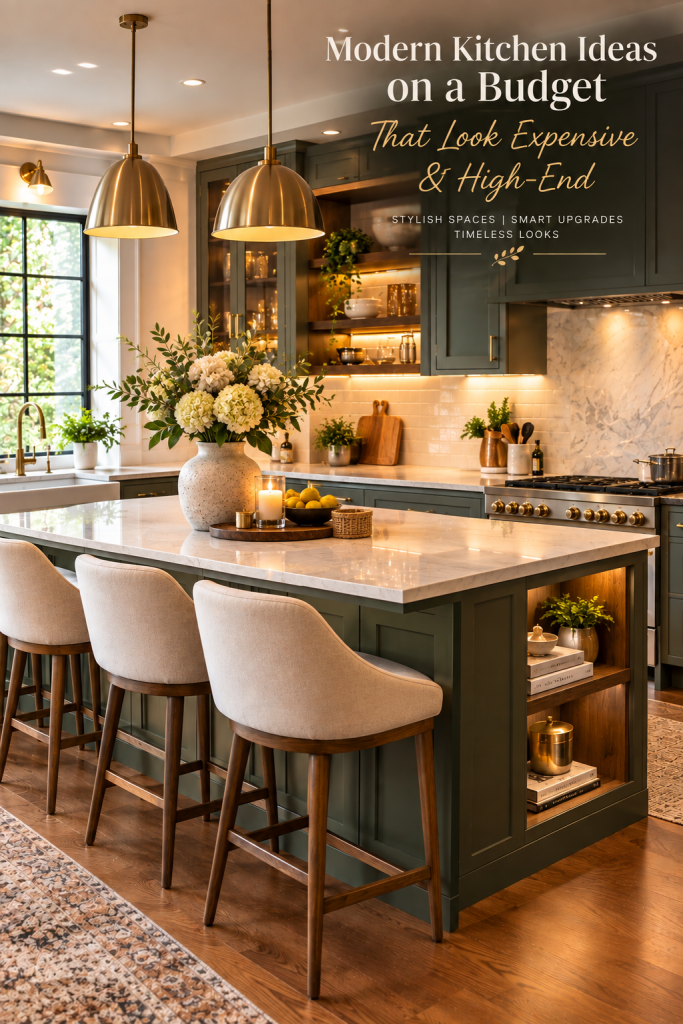
The modern kitchen has evolved beyond the cold, ultra-minimal spaces that once dominated interior design. Today, high-end kitchens are becoming warmer, more personalized, functional, and visually layered. Natural wood, soft neutrals, sophisticated lighting, clean cabinetry, subtle hardware, textured surfaces, and carefully chosen accessories are all contributing to this newer interpretation of modern kitchen design. Current industry research also points toward natural materials, wood cabinetry, minimalist details, and warmer palettes as important directions for kitchens in 2026. (NKBA Knowledge Base)
That is excellent news if you are decorating on a budget.
You do not necessarily need custom cabinets, expensive marble, designer appliances, or a complete kitchen renovation to make your space look expensive. A carefully painted cabinet, a beautiful faucet, upgraded lighting, organized countertops, or a simple wood accent can completely change how the kitchen feels.
The secret is visual editing.
Luxury kitchens usually look expensive because they feel intentional. There is a sense of balance between materials, colors, lighting, storage, and empty space. Nothing appears randomly placed. Countertops are not overwhelmed by appliances and miscellaneous objects. Hardware feels coordinated. Lighting highlights the areas that matter. Natural textures add depth without making the room feel busy.
This approach is particularly useful for small kitchens, apartment kitchens, rental kitchens, outdated kitchens, and homeowners who want a modern kitchen makeover without committing to a major remodel.
Another advantage of a budget-friendly kitchen makeover is that you can work in stages. You might start by painting the cabinets, then replace the hardware a few weeks later. Later, you can introduce under-cabinet lighting, update the backsplash, add a wood accent, or replace an old faucet. Instead of spending a huge amount at once, you can gradually build the look.
Current 2026 kitchen research also shows that homeowners are paying close attention to functionality and storage, with pantry cabinets and built-in storage remaining important features. (Houzz) This means that making your kitchen look high-end is not simply about decoration. A beautiful kitchen that is difficult to use will never feel truly luxurious.
The best modern kitchen ideas combine appearance with practicality.
For a budget makeover, think about your kitchen in layers. First, consider the large visual surfaces: cabinets, walls, flooring, countertops, and backsplash. Then look at functional details such as hardware, faucets, lighting, and storage. Finally, add decorative elements such as wood boards, ceramic vessels, bowls, artwork, greenery, or a carefully styled coffee station.
You also do not have to copy a single design style. Modern kitchens can be warm modern, contemporary, organic modern, minimalist, modern farmhouse, transitional, Scandinavian-inspired, or even slightly vintage while still looking sophisticated.
The goal is not to make your kitchen look expensive because it contains expensive objects.
The goal is to make inexpensive choices look intentional.
Here are 10 modern kitchen ideas on a budget that can help create a polished, high-end appearance without requiring a complete luxury renovation.
1. Give Your Kitchen Cabinets a Sophisticated Modern Paint Makeover
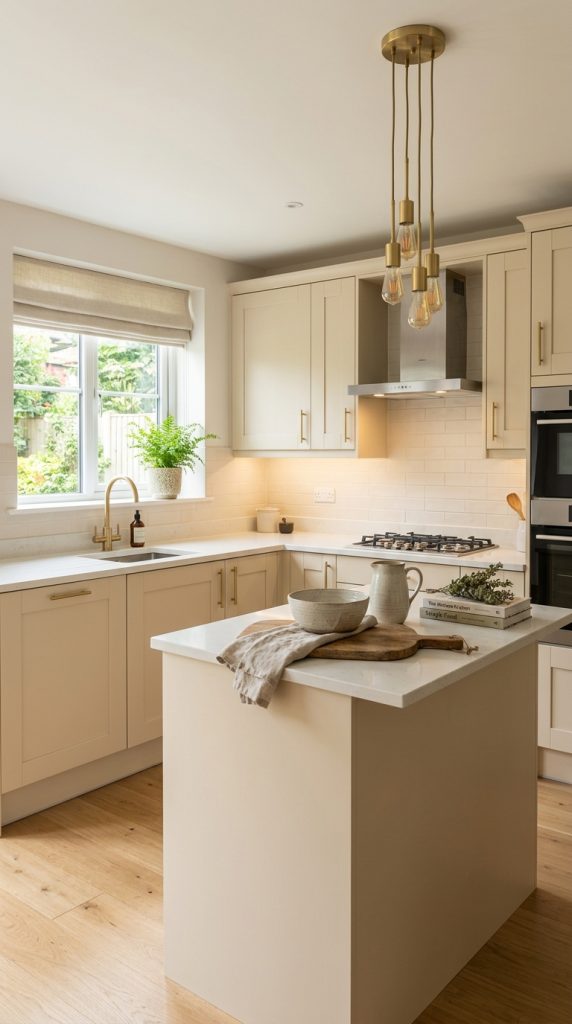
Cabinets occupy one of the largest visual areas in a kitchen, which makes them one of the best places to focus your budget.
Replacing an entire set of kitchen cabinets can become extremely expensive, especially when installation, hardware, countertops, and related work are included. If the existing cabinet boxes are in good condition, painting the doors and drawer fronts can create a dramatically different appearance for much less money.
The key is choosing a sophisticated color rather than simply choosing whatever paint happens to be available.
For a high-end modern kitchen, consider warm white, creamy ivory, soft greige, muted taupe, deep olive, charcoal, mushroom, or a restrained blue-gray. If you want the kitchen to feel warmer and more contemporary, natural-looking colors usually work particularly well.
Wood cabinetry is also increasingly prominent in 2026 kitchen design, with medium and light wood tones receiving significant attention. (Houzz) If your cabinets are already wood, you may not need to paint them at all. Instead, consider cleaning, refinishing, or refreshing their finish so the natural grain becomes part of the design.
For painted cabinets, preparation matters more than people expect.
Remove the doors and hardware, clean the surfaces thoroughly, lightly sand where appropriate, repair visible damage, use a suitable primer, and apply thin, even coats of quality cabinet paint. Allow proper drying time between coats rather than rushing the process.
A professional-looking finish is what makes the difference.
You can also create a more customized appearance by using two related tones. For example, use warm ivory on the upper cabinets and a muted taupe or medium wood tone below. Another approach is to keep the cabinets consistent while giving the island a slightly darker color.
This creates visual structure without requiring expensive cabinetry.
If you already have attractive cabinets but they look dated, do not automatically assume replacement is necessary. Sometimes the problem is simply that the hardware, lighting, backsplash, and countertop styling no longer complement them.
After painting, add modern hardware in a consistent finish. Long bar pulls can create a streamlined appearance, while smaller knobs can soften a minimalist kitchen.
The expensive-looking effect comes from coordination.
Instead of combining several unrelated colors and finishes, choose one main cabinet color, one hardware finish, and one or two supporting materials.
For example, imagine creamy cabinets, brushed brass hardware, natural oak accessories, and a warm stone-look countertop. The result can feel considerably more luxurious than a kitchen containing many unrelated finishes.
A cabinet makeover is particularly effective because it changes the overall visual identity of the room without changing its footprint.
For renters or people who cannot paint permanent cabinetry, removable options may provide another route, although compatibility with the existing surface should always be checked before installation.
The important principle is simple: make the cabinetry look intentional, clean, and cohesive.
That alone can make a dated kitchen feel significantly more modern.
2. Replace Basic Hardware With Simple Designer-Looking Cabinet Handles
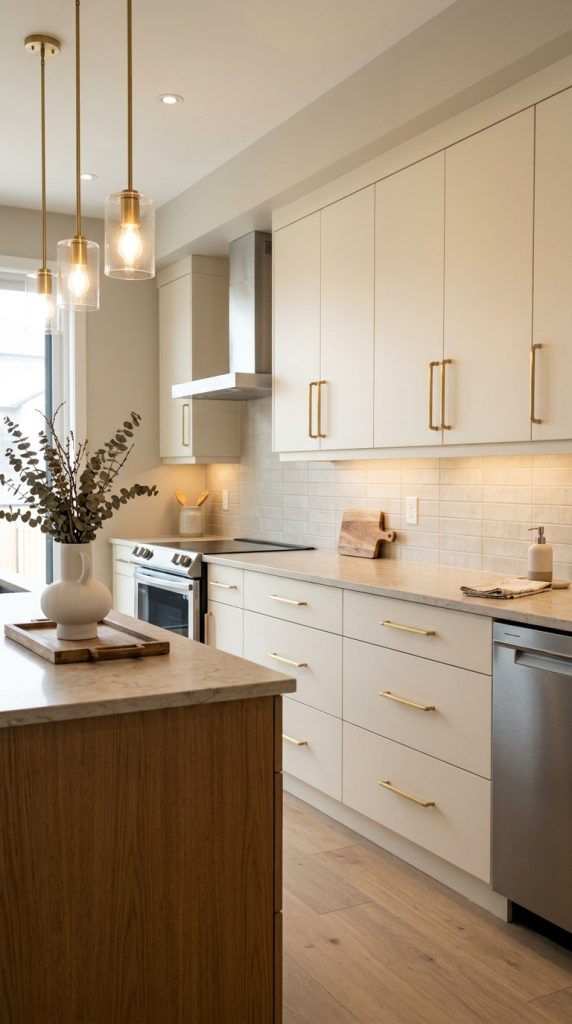
Small details can have a surprisingly large effect on kitchen design.
Cabinet hardware is one of the easiest elements to change, and it can instantly influence whether a kitchen feels dated, traditional, contemporary, or modern.
If your cabinets are structurally good but the handles look old, replacing them may be one of the smartest budget kitchen upgrades you can make.
For an expensive-looking modern kitchen, avoid hardware that is overly decorative if your goal is a clean contemporary appearance. Instead, look for simple silhouettes with good proportions.
Long linear pulls can emphasize horizontal cabinet lines and make the kitchen feel more streamlined. Rounded knobs can work beautifully in softer modern kitchens. Minimal cup pulls can introduce a subtle vintage influence without overwhelming the design.
Finish matters too.
Matte black can create a crisp architectural contrast. Brushed brass introduces warmth and works beautifully with cream, beige, white oak, and earthy colors. Brushed nickel or stainless finishes can create a cooler contemporary appearance.
Rather than mixing several metallic finishes without a plan, choose one dominant hardware finish and repeat it consistently.
This repetition creates cohesion.
For example, if you select brushed brass cabinet pulls, you might repeat the same general tone in the faucet, pendant light, or a small decorative accessory. You do not have to make every metal identical, but there should be a visual relationship between them.
Before buying new hardware, measure the existing hole spacing if you are replacing handles. Choosing replacement pulls that fit the existing holes can save you from additional drilling and repairs.
This is particularly useful when working with a tight budget.
You can also create a more expensive-looking effect by choosing hardware with substantial proportions. Very tiny handles can disappear against large cabinet doors, while excessively large hardware can dominate the room. Look at the scale of the cabinetry before deciding.
One modern approach is to use longer pulls on wide drawers and proportionally smaller pulls on narrower doors. This creates a custom appearance.
Another inexpensive trick is to coordinate hardware with the kitchen’s architectural lines.
If your kitchen has black window frames, black hardware can reinforce that visual detail. If the room features warm wood, brass or bronze can complement it. If the countertop has cool gray tones, brushed nickel can create a unified appearance.
The goal is not simply to buy expensive-looking handles.
It is to make every hardware choice feel connected to the rest of the room.
When the cabinets are freshly painted or beautifully maintained and the hardware is carefully selected, the entire kitchen can look more customized.
That is exactly the kind of detail that makes a budget modern kitchen feel high-end.
3. Use Warm Under-Cabinet Lighting to Create a Luxury Kitchen Atmosphere
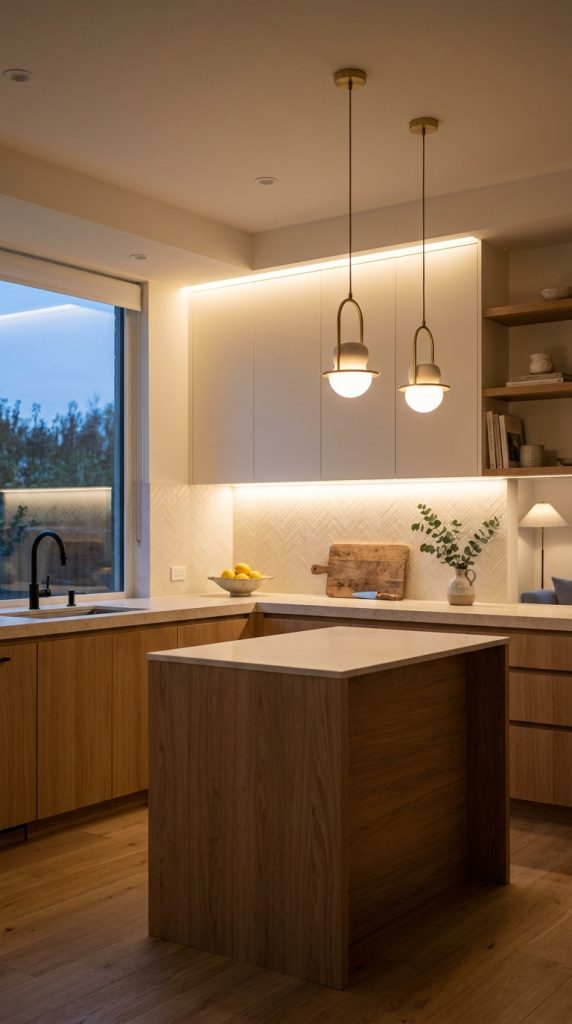
Lighting is one of the most powerful tools for changing a kitchen without dramatically changing its structure.
A kitchen may contain beautiful cabinets and countertops, yet still look ordinary if the lighting is flat or overly harsh.
Modern high-end kitchens typically benefit from several layers of illumination rather than relying on one central ceiling fixture.
Under-cabinet lighting is especially useful because it provides practical task lighting while creating a soft visual glow.
It can illuminate countertops, highlight backsplash materials, and make the kitchen feel warmer in the evening.
For a budget makeover, LED strip lighting or compact under-cabinet fixtures can provide a relatively affordable way to introduce this effect.
Choose a warm or warm-neutral light temperature that complements the finishes in your kitchen. Extremely cool lighting can make warm wood and cream finishes appear harsh, while overly yellow lighting can distort colors.
If you have glass-front cabinets, interior lighting can also turn them into a subtle display feature.
Place attractive ceramics, glasses, or dishes inside and use gentle lighting to create depth.
You can also use lighting above cabinets if there is enough architectural space. A subtle glow can visually lift the ceiling and make the room feel more layered.
Pendant lighting is another opportunity.
You do not need an enormous designer fixture. A simple pair of well-proportioned pendants over an island or peninsula can create a sophisticated focal point.
Current kitchen design coverage also highlights both bold lighting and integrated lighting as important 2026 directions. (Good Housekeeping)
If your kitchen has a dining corner, a small pendant over the table can visually define that area.
For a kitchen without an island, consider a decorative pendant above a sink or breakfast table if the electrical arrangement allows it.
The most important principle is layering.
Think about three levels:
Ambient lighting for general illumination.
Task lighting for food preparation, washing, and cooking.
Accent lighting for atmosphere and visual interest.
Even a budget kitchen can feel dramatically more luxurious when these layers work together.
Avoid making every light equally bright. Instead, create variation. Countertops should be well illuminated for tasks, while decorative areas can remain softer.
This gives the kitchen the atmosphere of a thoughtfully designed interior rather than a brightly lit utility room.
Lighting is especially important at night because it changes how finishes are perceived.
A kitchen with warm cabinet colors, natural wood, subtle brass, and soft lighting can feel exceptionally welcoming after sunset.
That sense of atmosphere is one of the easiest ways to make a modern kitchen appear more expensive.
4. Add a Budget-Friendly Wood Accent for Warmth and Natural Texture
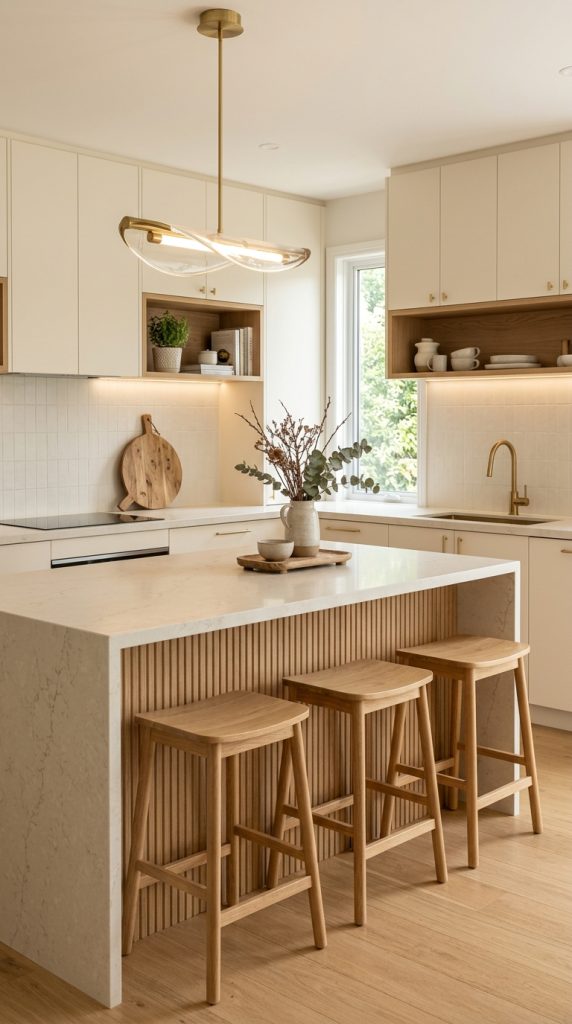
One of the easiest ways to prevent a modern kitchen from feeling cold is to introduce natural wood.
Wood adds warmth, texture, and visual character. It can also make inexpensive finishes feel more sophisticated because natural texture creates depth.
You do not need to install expensive custom wood cabinetry.
Instead, introduce wood through carefully selected accents.
A wooden cutting board can sit against the backsplash. A small oak shelf can replace an unused decorative area. Wooden counter stools can introduce warmth around a peninsula. A simple wooden tray can organize oils or coffee accessories.
If your kitchen has a small island, consider adding a wood-toned panel to one side if the existing construction allows for it.
Another possibility is a freestanding wood piece.
A narrow wood console, vintage stool, small cabinet, or open shelving unit can create the feeling of customized furniture within the kitchen.
Current kitchen research shows natural materials and wood grain continuing to gain importance, with white oak particularly prominent in industry reporting. (NKBA Knowledge Base)
This makes wood a particularly useful material if you want your budget makeover to feel current without looking overly trendy.
The key is restraint.
Do not introduce five different wood colors.
Choose one dominant wood tone and repeat it in a few places.
For example, imagine a kitchen with warm ivory cabinets, a natural oak shelf, oak counter stools, and a wooden cutting board. The wood becomes a visual thread connecting different areas of the room.
If your existing kitchen already has wood flooring, coordinate your decorative wood pieces with it rather than introducing an unrelated tone.
You can also use woven natural materials alongside wood. A small rattan basket or woven container can add texture while keeping the color palette restrained.
This approach works especially well in organic modern kitchens.
The combination of clean cabinetry, natural wood, stone-like surfaces, ceramic accessories, and warm lighting can create a sophisticated atmosphere without relying on expensive decorative objects.
Wood also photographs beautifully for Pinterest.
The visible grain provides natural texture and gives an image more visual depth, especially when paired with neutral backgrounds.
If you are creating a kitchen makeover on a tight budget, you can start with just two or three wood elements.
One cutting board.
One shelf or tray.
One pair of stools or a decorative wood accessory.
That can be enough to change the character of the room.
5. Create a High-End Look With a Simple Stone-Look Backsplash
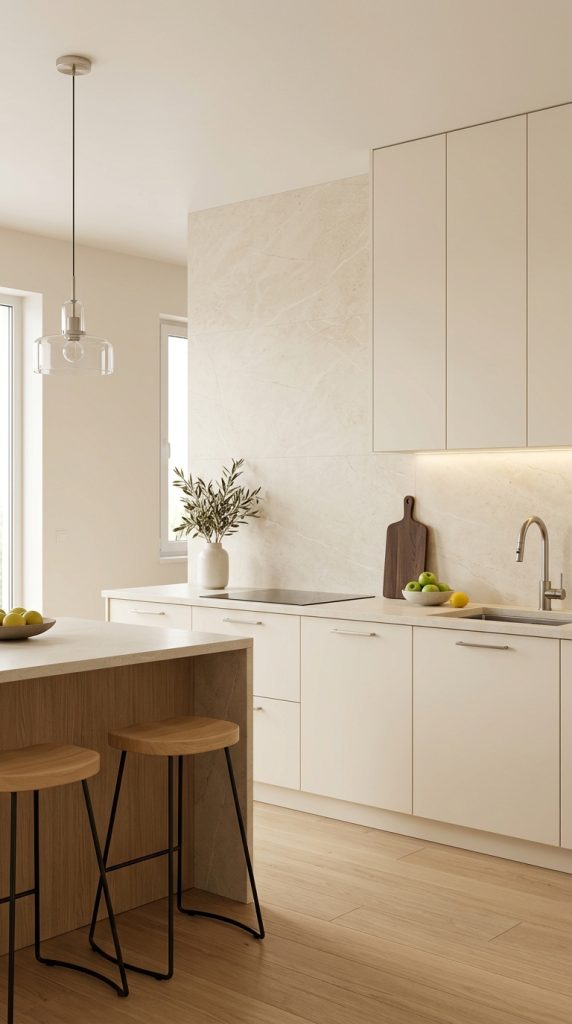
A backsplash can completely change the appearance of a kitchen, but a full custom stone installation can be expensive.
A more budget-conscious strategy is to choose a backsplash that creates the visual impression of luxury without requiring premium materials throughout the room.
Large-format, simple tile can create a clean modern appearance. Depending on your kitchen, you might consider warm white, ivory, soft beige, muted gray, or a stone-inspired finish.
If you want more character, choose a subtle veining pattern rather than an extremely dramatic print.
The goal is to make the backsplash feel architectural rather than decorative.
A simple backsplash extending across the main countertop wall can visually connect the cabinets and work surface.
For smaller kitchens, lighter backsplash colors can help maintain an open feeling.
For a more dramatic modern kitchen, a darker backsplash can create contrast against lighter cabinets.
Handmade-looking tile can also add texture. Current kitchen trend coverage notes growing interest in textured and traditional tile surfaces alongside warmer, more personalized kitchen designs. (ELLE Decor)
You do not necessarily need to cover every wall.
If your budget is limited, focus your backsplash investment on the most visible area behind the cooktop, sink, or main preparation zone.
Another strategy is to use a budget-friendly tile but make the installation look intentional.
Choose a consistent grout color. Keep lines clean. Avoid excessive decorative borders unless they genuinely complement your kitchen.
If you are considering peel-and-stick materials, carefully check their suitability for your specific wall, heat exposure, moisture conditions, and manufacturer instructions.
For homeowners who cannot make permanent changes, removable backsplash products can sometimes provide a temporary visual upgrade.
The luxury effect comes from simplicity.
Instead of combining several patterns, use one strong surface and allow it to breathe.
Imagine a kitchen with flat-panel cream cabinets, understated brushed hardware, a softly veined backsplash, and warm oak accents.
There is nothing extravagant about each individual component.
Together, however, they can create a refined appearance.
This is one of the central principles of budget-friendly luxury design: visual restraint can make ordinary materials look intentional.
6. Turn the Countertops Into a Carefully Styled Modern Display
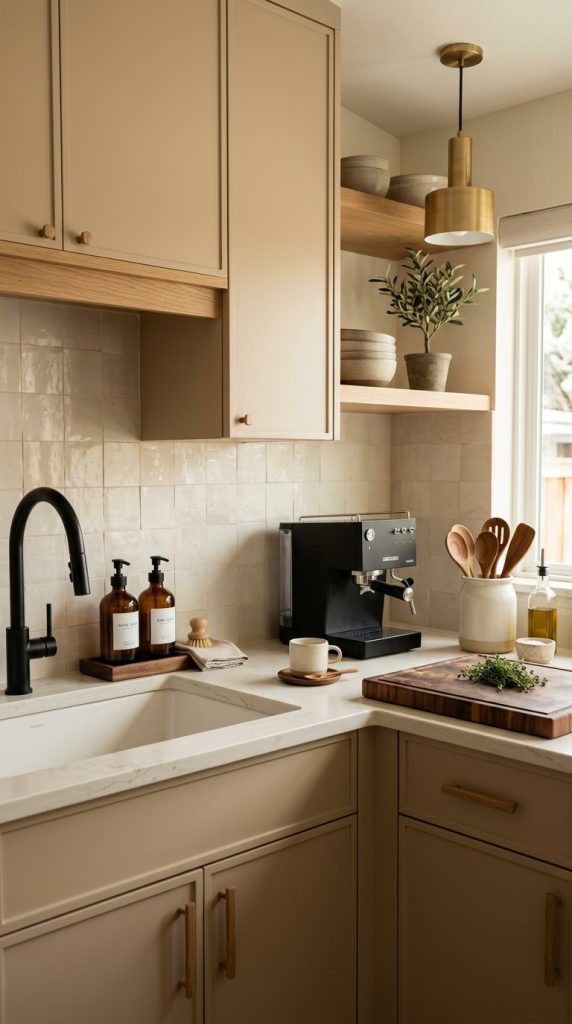
One of the easiest ways to make a kitchen look expensive costs almost nothing: remove unnecessary objects.
Countertop clutter can make even a beautiful kitchen look chaotic.
Luxury kitchens tend to have clear surfaces with a few carefully selected functional objects.
Instead of covering the countertop with every appliance, container, bottle, and utensil, decide which items genuinely deserve to remain visible.
Start by removing everything that does not need to stay out.
Then create small functional zones.
A coffee station might include a coffee machine, a ceramic cup, and one attractive container for essentials.
A cooking zone might contain a wooden cutting board, a ceramic utensil holder, and a small bottle of cooking oil.
Near the sink, a simple tray can hold hand soap and dish soap.
The tray is important because it visually groups multiple objects into one intentional composition.
This is a designer styling technique that works extremely well in budget kitchens.
Instead of five separate objects scattered across a counter, you have one defined zone.
Use materials that complement your kitchen.
A wooden tray works beautifully with warm cabinetry. A stone-look tray can complement marble-inspired surfaces. A ceramic tray can soften a minimalist kitchen.
Avoid filling every available surface.
Negative space is part of the design.
If you have an island, resist the temptation to create a giant centerpiece. A single vase, bowl, or small arrangement can often be more effective.
You can also introduce fresh produce as decoration.
A ceramic bowl filled with lemons, apples, pears, or seasonal produce can add natural color without looking artificial.
This creates the feeling of a lived-in kitchen while maintaining a curated appearance.
For open shelving, follow the same principle.
Do not fill every shelf with dishes. Leave breathing room between objects and vary heights.
Place taller pieces behind shorter ones, but avoid creating a wall of accessories.
A few beautiful ceramics often look more sophisticated than dozens of inexpensive decorations.
Current kitchen design is increasingly emphasizing personalization and lived-in character rather than sterile perfection. (ELLE Decor)
That means your kitchen does not have to look like nobody uses it.
It simply needs to look organized.
A polished countertop tells the eye that the kitchen has been intentionally designed.
That perception can make a surprisingly large difference.
7. Upgrade the Faucet for an Instant Modern Kitchen Transformation
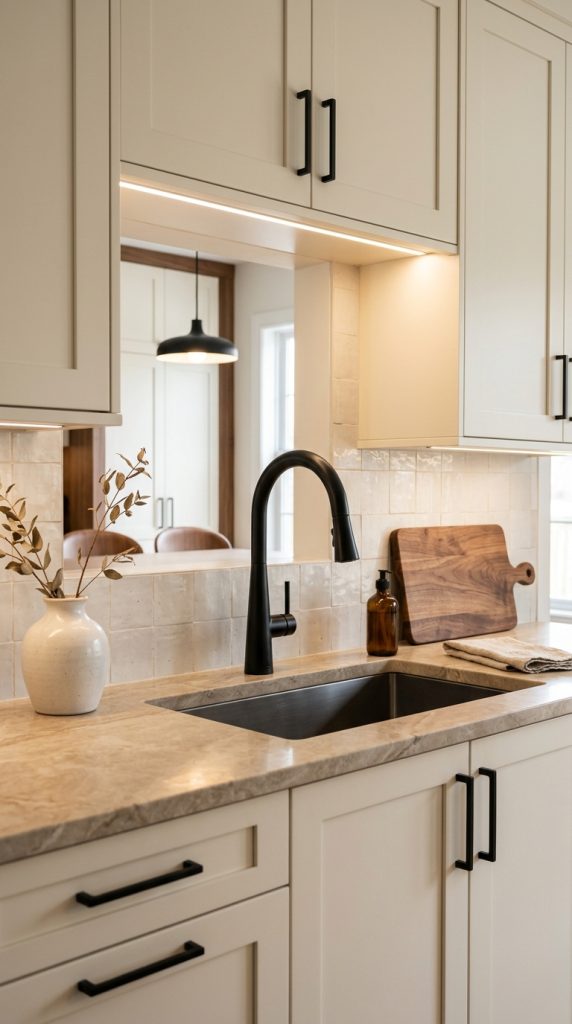
A kitchen faucet is both functional equipment and a visual feature.
Because it sits directly above one of the most frequently used areas in the kitchen, an outdated faucet can make the entire space feel old.
Replacing it with a modern, well-proportioned faucet can therefore create a noticeable transformation.
You do not need the most expensive model.
Instead, prioritize shape, finish, scale, and coordination.
A simple high-arc faucet can create a contemporary appearance. A more compact curved faucet may work better in a small kitchen.
Choose a finish that works with your cabinet hardware and other visible metals.
Matte black can create a graphic modern effect.
Brushed brass can make a neutral kitchen feel warmer and more luxurious.
Brushed stainless or nickel can provide a clean, timeless appearance.
Avoid selecting the faucet in isolation.
Look at the whole room.
If your kitchen has black cabinet pulls, black window frames, and a dark pendant, a black faucet can visually connect these elements.
If your cabinets are cream and your lighting contains warm brass, a brass faucet can reinforce the palette.
This is how inexpensive individual improvements start to look like a professionally planned renovation.
You can also choose a faucet with useful functionality such as a pull-down sprayer or convenient control design, depending on your needs.
A high-end kitchen is not simply attractive.
It works well.
That is why functional upgrades can be more valuable than purely decorative ones.
Before replacing a faucet, check compatibility with your sink configuration and plumbing. If the installation requires modifications beyond your comfort level, professional help may be appropriate.
For a renter, replacing a faucet may not be practical depending on the lease.
In that case, focus on complementary upgrades such as hardware, lighting, organization, and styling.
A faucet is particularly useful in Pinterest imagery because it sits at the intersection of several major visual elements: cabinets, countertop, sink, backsplash, and lighting.
When those elements coordinate, the kitchen immediately feels more cohesive.
8. Use Open Shelving Selectively Instead of Covering the Kitchen in Decor
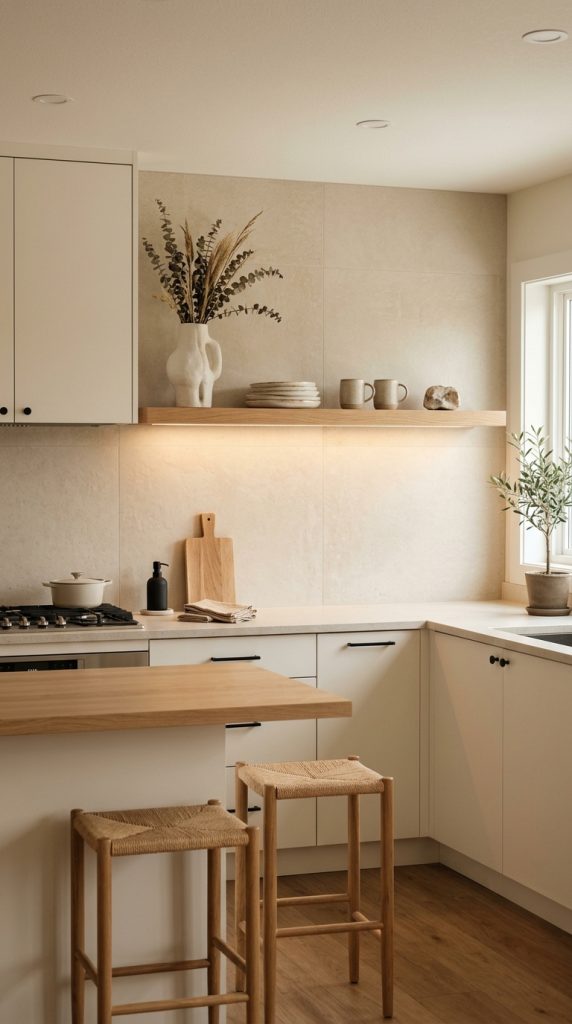
Open shelving can make a kitchen feel lighter and more contemporary, but it needs to be used carefully.
Too many open shelves can quickly become cluttered.
The expensive-looking approach is to use open shelving as a curated display rather than as a place to store everything.
One or two shelves may be enough.
Natural wood shelves can introduce warmth against a neutral wall. Black shelves can create architectural contrast. A painted shelf can blend into the surrounding cabinetry for a quieter appearance.
Once installed, style the shelf with restraint.
Start with practical pieces such as ceramic plates, bowls, glasses, or mugs.
Then introduce one or two decorative objects.
Vary height and shape.
For example, a stack of plates can sit beside a taller ceramic vase, while a small bowl or cup fills the lower visual area.
Leave some empty space.
That empty space is what prevents the shelf from looking like storage overflow.
If you have attractive cookware, a few pieces can also become part of the design. Copper pans, wooden cutting boards, ceramic pitchers, and textured serving bowls can create a warm collected appearance.
Do not feel obligated to use only brand-new items.
Vintage or thrifted ceramics can add individuality and character.
Current design commentary is increasingly highlighting kitchens that feel personal and lived-in rather than overly uniform. (ELLE Decor)
That means a carefully selected secondhand piece can actually make the room feel more sophisticated than a shelf filled with identical mass-produced accessories.
For a small kitchen, one shelf can also create useful vertical storage.
This is especially helpful when cabinets are limited.
However, make sure frequently used items remain easy to access and that the shelf does not become a collection of objects you never use.
Open shelving works best when it solves a real storage or display need.
If you have children, pets, or a kitchen with heavy daily use, enclosed storage may be more practical for certain items.
You can still achieve the visual effect through one decorative shelf.
The high-end look comes from editing, not quantity.
9. Create a Modern Coffee or Beverage Station With a Small Budget
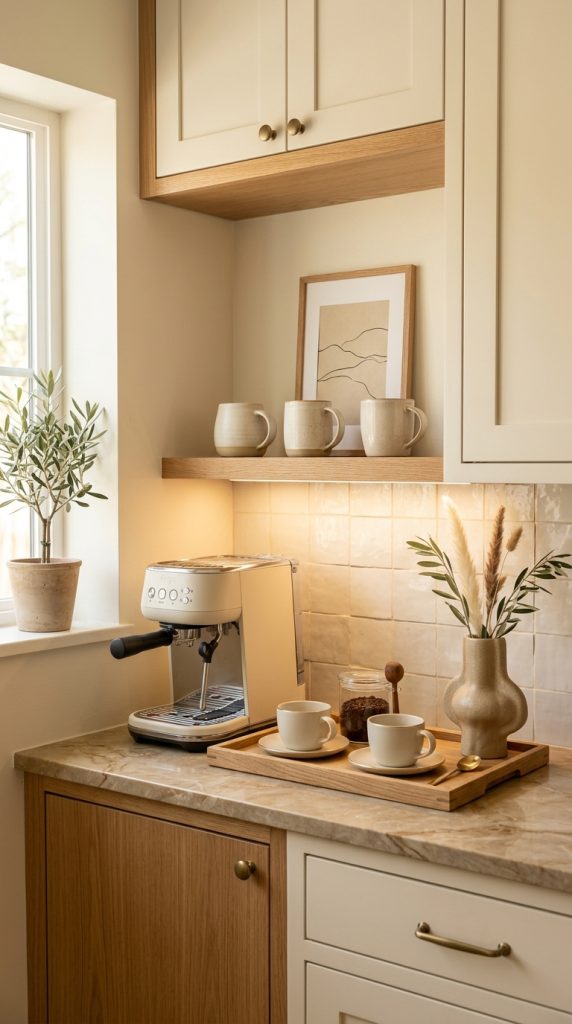
A dedicated beverage area can make an ordinary kitchen feel more customized.
You do not need a built-in coffee bar.
A small section of countertop can become a beautiful coffee or beverage station with only a few carefully selected pieces.
Choose one area that does not interfere with food preparation.
Start with the essentials: coffee machine or kettle, cups, a container for coffee or tea, and perhaps a small tray.
Use matching or complementary containers rather than displaying multiple branded packages.
Transfer frequently used ingredients into simple glass or ceramic containers if practical.
This immediately creates a cleaner visual appearance.
Add one decorative element such as a small framed print, a ceramic vase, or a wooden board.
If you have a floating shelf above the station, use it to display a few attractive mugs or glasses.
Keep the palette coordinated.
For a warm modern kitchen, combine cream ceramics, natural wood, amber glass, and brushed brass.
For a more contemporary black-and-white kitchen, use black, white, clear glass, and one warm wood accent.
For a soft organic modern kitchen, combine beige, oatmeal, light oak, stone, and muted green.
A beverage station is also a good opportunity to introduce one of the principles of luxury design: repetition.
Repeat the same material in several places.
For example, the wooden coffee tray can relate to the wooden shelf, while the brass spoon or hardware relates to the faucet.
These small connections make the space feel designed rather than randomly decorated.
If you have a small kitchen, use vertical space.
A narrow shelf above the coffee area can provide storage without consuming additional countertop area.
A peg rail can also hold a few mugs if it fits your kitchen style.
The important thing is not to create a giant coffee display.
Keep it functional.
A compact beverage station can also make a Pinterest image more interesting because it gives the kitchen a lifestyle story.
Instead of showing an empty room, the image communicates how the space is actually used.
That emotional connection can make a kitchen feel more inviting.
10. Finish the Kitchen With a Curated Mix of Modern Decor and Natural Details
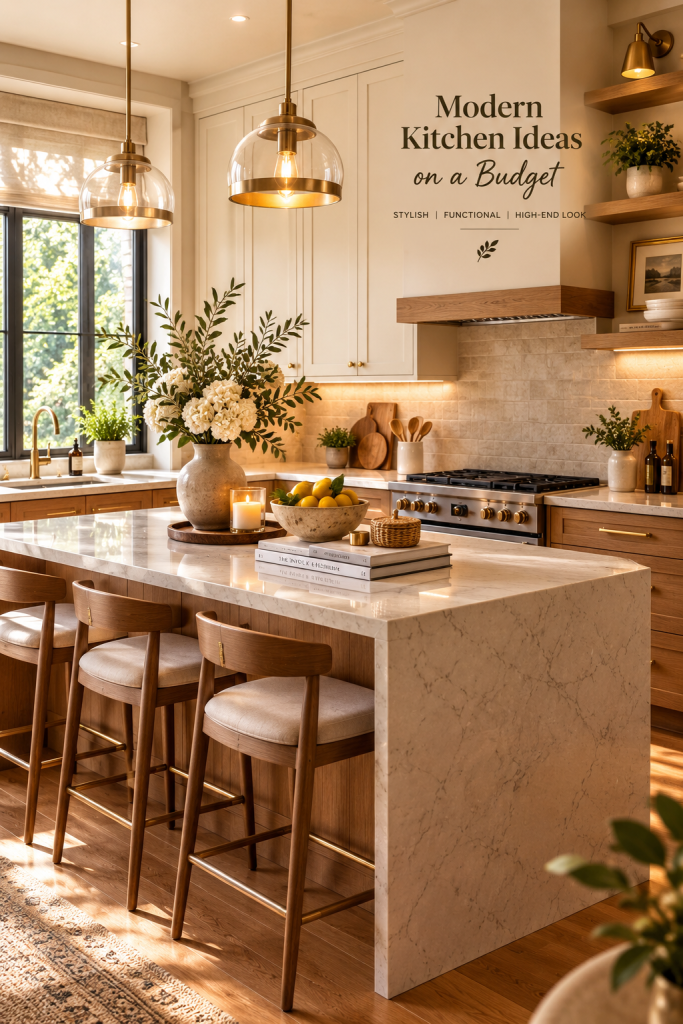
The final layer is where your kitchen begins to feel truly finished.
After the major surfaces, hardware, lighting, and organization are addressed, use a small number of decorative elements to create personality.
This does not mean filling the kitchen with accessories.
In fact, the opposite is usually more effective.
Choose several pieces with strong visual value.
A sculptural ceramic vase can sit on an island.
A wooden cutting board can lean against the backsplash.
A textured bowl can hold fresh produce.
A small framed artwork can occupy an empty wall.
A woven basket can soften an open shelf.
A small plant or branch arrangement can introduce organic texture if the location receives suitable light.
Natural materials are particularly effective because they add visual richness without requiring elaborate decoration.
Wood, stone, ceramic, glass, woven fibers, linen, and aged metal can all contribute texture.
Current 2026 kitchen research continues to emphasize natural materials, warm woods, neutral palettes, and more personalized kitchen environments. (NKBA Knowledge Base)
When combining materials, think about contrast.
Smooth cabinetry looks more interesting beside textured wood.
Matte finishes can be balanced by glass.
Stone surfaces can be softened by woven materials.
Metal hardware can be warmed by ceramics and wood.
This contrast creates depth.
You should also pay attention to scale.
One oversized ceramic vase may look more luxurious than five tiny decorative objects.
One large framed artwork can have more impact than a wall covered with small unrelated prints.
One beautiful wooden board can look more intentional than a collection of kitchen signs.
This is particularly important for Pinterest because strong compositions are easier to understand visually.
When someone sees a kitchen image while scrolling, the eye should immediately understand the main focal point.
Perhaps it is the warm wood island.
Perhaps it is the sculptural pendant.
Perhaps it is the beautiful backsplash.
Perhaps it is the cream cabinetry with brass hardware.
Choose one primary focal point and allow the remaining elements to support it.
Avoid decorating every corner equally.
Luxury interiors often contain visual pauses.
An empty section of countertop.
A blank wall.
A clear area around the sink.
Space between decorative objects.
These areas allow the important details to stand out.
Finally, consider the view from different parts of the kitchen.
Does the island look attractive from the living room?
Does the sink area feel organized?
Does the lighting create a pleasant evening atmosphere?
Can appliances be visually minimized when not in use?
Does the color palette remain consistent from one side of the room to the other?
These questions help turn individual budget upgrades into a complete design.
The result should feel modern, warm, practical, and personal.
How to Make a Budget Kitchen Look More Expensive
The most important principle is to prioritize visual impact rather than the number of changes.
Start with the surfaces that occupy the most visual space.
If the cabinets are unattractive, consider painting or refinishing them.
If the lighting is harsh, improve the lighting.
If the hardware looks dated, replace it.
If the countertops are overwhelmed with objects, declutter and create functional zones.
If the room feels cold, introduce natural wood and textured materials.
If everything feels visually disconnected, establish a limited color palette.
You do not need to change everything at once.
A modern kitchen can often be improved through several smaller projects completed over time.
Another important principle is consistency.
Choose a small palette.
For example:
Warm white + oak + brass
Cream + walnut + matte black
Greige + light oak + brushed nickel
Soft sage + cream + natural wood
Charcoal + warm white + oak
Once you select the palette, use it repeatedly.
This makes inexpensive materials appear more cohesive.
Budget Modern Kitchen Color Combinations That Look High-End
Color can dramatically influence how expensive a kitchen feels.
Warm white and natural wood create a timeless modern combination.
Cream and muted sage can produce a softer organic atmosphere.
Greige and walnut can create a sophisticated contemporary appearance.
Charcoal and warm white can provide dramatic contrast.
Soft taupe and oak can create a calm minimalist kitchen.
For a bolder modern kitchen, consider using one deeper color on the island while keeping the surrounding cabinetry lighter.
The important point is not to use too many competing colors.
A restrained palette gives architectural details more importance.
Current industry research continues to show strong interest in neutral kitchens, with greens and blues also appearing prominently among reported kitchen color preferences. (NKBA Knowledge Base)
Modern Kitchen Ideas for Small Kitchens on a Budget
Small kitchens require careful editing because every object occupies valuable visual space.
Instead of adding more decoration, focus on making the room appear organized and open.
Use lighter cabinet colors if you want a brighter appearance.
Choose streamlined hardware.
Keep countertops mostly clear.
Use vertical storage wherever possible.
Consider one open shelf rather than several.
Add under-cabinet lighting to visually extend the countertop.
Use a mirror strategically if the architecture allows it.
Choose furniture with slim profiles.
If you have room for stools, select simple designs that do not visually block the kitchen.
In a small kitchen, natural wood accessories can add warmth without requiring large decorative pieces.
The result should feel efficient rather than crowded.
Modern Kitchen Ideas for an Apartment Makeover
Apartment kitchens can be transformed without major construction.
Start with removable or low-commitment improvements where permanent changes are restricted.
Update cabinet hardware if permitted.
Introduce attractive countertop accessories.
Use a portable lamp or approved lighting solution to create warmer evening illumination.
Add a small rolling cart for additional storage.
Style it as a beverage station, baking station, or produce area.
Use a washable runner to add texture and visual softness.
Introduce artwork that relates to your color palette.
If you cannot change the backsplash, use accessories to create a stronger focal area instead.
The most important thing is to work with the existing architecture instead of fighting it.
How to Make Cheap Kitchen Decor Look Expensive
Cheap decor does not automatically look cheap.
Poor coordination is usually the bigger problem.
When selecting budget accessories, look for simple shapes, restrained colors, natural-looking materials, and useful objects.
Ceramic bowls, wooden boards, glass containers, woven baskets, linen towels, simple framed artwork, and neutral trays can all look sophisticated when grouped thoughtfully.
Avoid excessive novelty signs, overly coordinated sets, and too many small decorative objects.
Instead, select fewer pieces with stronger silhouettes.
One attractive vase is enough.
One beautiful tray is enough.
One large bowl can create more impact than multiple small accessories.
Think like a stylist rather than a collector.
Common Mistakes That Make a Modern Kitchen Look Less Expensive
One common mistake is trying to use every trend at once.
A kitchen can contain wood, brass, marble-inspired surfaces, colorful cabinets, open shelving, dramatic lighting, patterned tile, and decorative accessories—but if all of these elements compete, the result may feel chaotic.
Another mistake is ignoring lighting.
Even beautiful finishes can look ordinary under poor lighting.
Overdecorating is another issue.
Too many appliances, containers, signs, plants, and accessories can overwhelm the clean lines that make modern kitchens attractive.
Inconsistent metals can also create visual noise.
Choose a primary metal finish and use additional finishes sparingly.
Finally, avoid copying a kitchen simply because it is trending.
The most successful interiors are adapted to the architecture and lifestyle of the home.
Current design commentary increasingly emphasizes personalization and authentic character rather than creating spaces that look completely generic. (House Beautiful)
How to Make Your Modern Budget Kitchen Pinterest-Worthy
For Pinterest, visual clarity is essential.
A strong kitchen image should have one obvious focal point.
Use a clean composition.
Show the best architectural feature.
Keep countertops organized.
Use natural textures.
Layer warm lighting.
Include just enough decor to make the room feel lived in.
For a Pinterest cover image, a vertical 2:3 composition works particularly well for presenting the kitchen as a complete visual story.
Instead of filling the image with text, let the kitchen itself communicate the idea.
A warm wood island, creamy cabinets, elegant lighting, clean counters, and a beautiful backsplash can instantly communicate “modern kitchen ideas on a budget that look expensive.”
If text is used, keep it short and readable.
The image should remain the hero.
Final Thoughts
Creating a modern kitchen that looks expensive does not require an unlimited renovation budget.
The strongest transformations often come from smaller decisions: painting existing cabinets, changing hardware, improving lighting, introducing natural wood, simplifying countertops, upgrading the faucet, adding a refined backsplash, organizing open shelves, creating a compact beverage station, and carefully styling the final details.
The key is to stop thinking about luxury as a price tag.
Luxury is often created through proportion, consistency, texture, lighting, organization, and restraint.
A budget kitchen can look sophisticated when every visible element has a purpose.
Start with the change that will have the biggest visual impact in your kitchen. If the cabinets dominate the room, refresh them. If the lighting is poor, address that first. If the space feels cluttered, edit it before buying anything new. If the room feels cold, introduce warm wood and natural textures.
Then build gradually.
You may discover that you do not need a complete kitchen renovation at all.
You simply need a more intentional version of the kitchen you already have.
With the right combination of modern colors, natural materials, streamlined hardware, warm lighting, functional storage, and carefully selected accessories, even a modest kitchen can feel polished, welcoming, and remarkably high-end.
And because these ideas focus on visual impact rather than expensive structural changes, they can work for homeowners, apartment dwellers, small-space decorators, and anyone looking for a beautiful modern kitchen makeover on a realistic budget.